News / Transport
‘Remaining open to different types of mass transit isn’t an objective’
A campaign group calling for clean, affordable, accessible and efficient transport in the West of England has cautiously welcomed WECA’s new vision for transport in the region.
West of England Sustainable Transport & Active Travel (WESTACT) say it is “great to see some collaboration between the fragmented unitary authorities and political parties of the West of England” but this agreement is because concrete plans are still years away.
A WESTACT spokesperson said: “Remaining open to different types of mass transit isn’t an objective. At some point, you have to actually choose and build something.”
is needed now More than ever
Within the West of England transport vision, WESTACT say that the “bold” vision for ‘one ticket, one timetable’ “is essential and great to see”; frequent and regular mass transit “is sorely needed”; and a potential hub and spoke model could enable faster journeys with local interchanges.
But they also highlight areas that are missing including a commitment to bus franchising: “If trams are still a way away, the region will still be primarily reliant on buses, so ensuring public control is as crucial as ever.”
WESTACT say that walking, wheeling and cycling must be made safer “by committing to keeping cycle lanes clearly segregated from walkways”.
New transport must be linked with new housing developments “so that residents moving in can create sustainable travel habits from the outset”.
And the region must “develop more opportunities for combining active travel with public transport, through active travel hubs at train stations, bus stations and/or in community spaces”.

A tram pulls up outside Bristol Airport in WECA’s new transport ‘vision’ – image: WECA
WESTACT steering group chair, Emilia Melville, said: “It’s great to see holistic thinking from WECA by including spaces as well as active travel, buses, mass transit and trains.
“However, the structure of the document doesn’t follow the sustainable transport hierarchy order: (a) spaces, (b) walking and wheeling, (c) cycling, (d) buses, (e) mass transit, and (e) trains.”
WESTACT campaign coordinator, Charlie Siret, said WECA’s climate commitments “also take a backseat”.
“The vision speaks to reducing the climate emissions of transport in our region but it focuses on connecting residents to unsustainable sectors like the airport.
“As one of the most carbon intensive sectors, improving access to the airport should not be the priority for a West of England which cares about improving our health and our green spaces.”
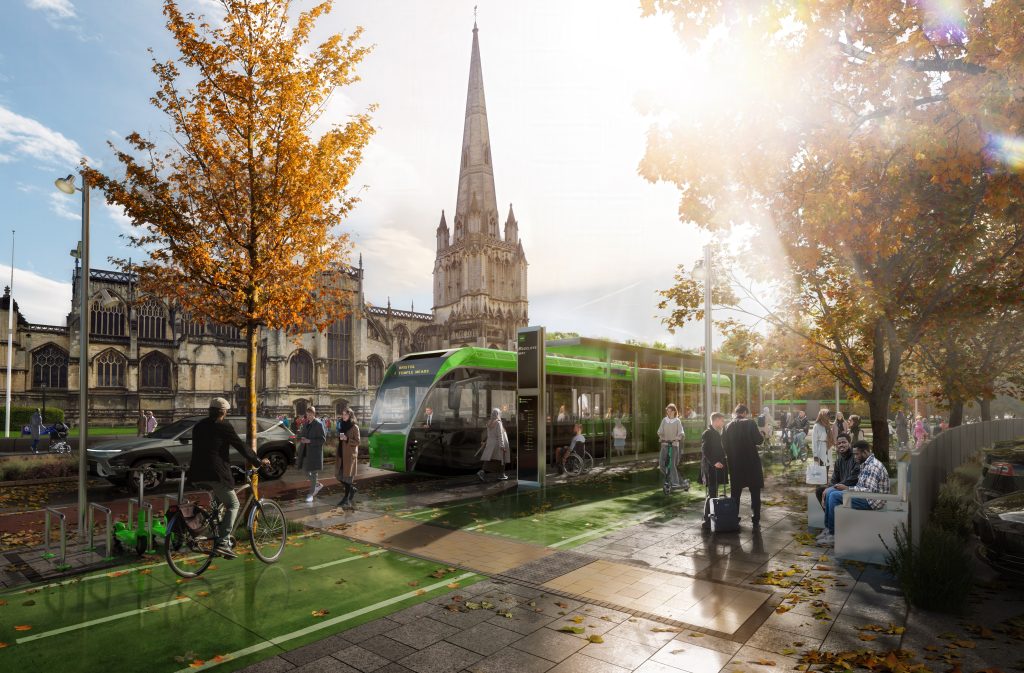
WECA’s artist’s impression of a bendy bus has clearly been influenced by the Belfast Glider (look closely and you can even see the ‘G’ at the front of the vehicle) – image: WECA
WESTACT campaign coordinator, Jo Sergeant, added: “There may be economic benefits of a tram/train to the airport.
“However, I’d argue that the case for mass transit is just as strong for many other workplaces in the West of England.
“We should be seeing routes between residential areas and all the main economic centres across the region.
“Whilst they may not all be achievable in this project timeline, it’s hard to see why a route between Bristol and the airport appears to be the flagship of a mass transit vision.”
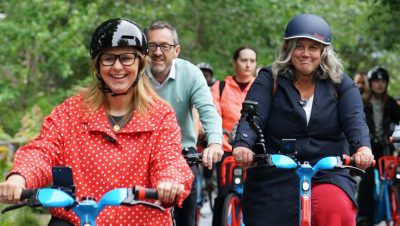
Main photo: Martin Booth
Read next:
 Our newsletters emailed directly to you