News / Transport
How does Bristol’s public transport compare to European cities?
Looking at similar sized cities in Europe reveals how poor quality public transport in Bristol is holding back the region’s economy.
Less than half of Bristolians can get to the city centre in 30 minutes by public transport, compared to almost three quarters in Bristol-sized cities in Europe.
Although 1.2 million people live in Bristol, South Gloucestershire, Bath and North East Somerset, there are no trams and few decent bus services, while the local trains are often either too expensive or infrequent for many potential passengers.
is needed now More than ever
And there are two similar cities with better transport, where the local economy has grown much faster than in the West of England.

WECA’s tram or light rail solution could offer “small, electrically-powered rail vehicles generally running on fixed tracks” – image: WECA
In February the West of England Combined Authority revealed its latest plans for building a mass transit system.
The 48-page transport vision includes a map of potential routes, which could be trams, light rail, guided bus or Metrobus extensions, as well as a computer-generated image of a tram outside Bristol Airport.
Construction of the first projects could begin by 2030.
The transport vision states: “Other global regions have demonstrated that a strong transport vision can drive real transformation. The city-regions of Toulouse, France and Malmö, Sweden are a similar size to the West of England.
“They have both made sustained investment over the past 20-plus years to deliver their transport visions, resulting in much more comprehensive networks than we have today.
“Their economic performance reflects this vision-led investment, with growth rates significantly higher than we have seen in our region.
“Centre for Cities found that less than 50 per cent of Bristol’s population can access the city centre within 30 minutes by public transport – the European average for similar-sized places is more than 70 per cent. This is a historic failing that holds back our region’s global competitiveness.”
The rail network in the wider Toulouse city region is twice as long as the West of England’s, while the wider Malmö area’s network is more than five times as large.
The West of England has 1,000 kilometres of bus routes, while Toulouse has 2,000 and Malmö has 4,000.
Half of journeys in the West of England are by public transport or active travel, while in Toulouse the figure is 60 per cent and in Malmö 69 per cent. From 2002 until 2022, the West of England’s economy grew by 40 per cent, while the economy in Toulouse grew by 55 per cent and Malmö’s by 57 per cent.
Growing economies mean more jobs, higher wages and better public services.
Over three decades Toulouse invested in transport to cut congestion and boost its economy. There are now metro lines, trams, more than 130 bus routes and the longest urban cable car in France.
Around a third of journeys are made on foot. The region is investing €3.1bn on a third metro line, opening in 2028.
And a giant bridge now connects Malmö with Copenhagen, with many people crossing the border for jobs.
The 16-kilometre Øresund Bridge was built between 1995 and 2000 and includes a railway, bridge, tunnel and artificial island, making access from one city to the other convenient on public transport.
This would be like a bridge connecting Clevedon with Newport.
Utrecht in the Netherlands has a similar population to the West of England, as well as three tram lines serving more than 40 stations.
Oslo in Norway has five metro lines and six tram lines.
Bordeaux has installed a four-line tram network using ground-level power and avoiding overheard wires.
Bilbao in Spain has a three-line metro which launched in 1995 with 48 stations.
There are 23 French cities smaller than Bristol which have metro networks, partly because they levy a tax on local businesses.
While this is unpopular among businesses, who say the tax discourages them from creating new jobs, for half a century the Versement Mobilité has provided cities with a stable source of income to pay for upgrading public transport.
Whereas in Britain, cities rely on sporadic pots of cash from the government to invest in upgrades like building a tram network.
This makes having a smooth pipeline of projects harder. And the lack of a similar levy here was the reason that Helen Godwin, the Labour mayor of the West of England Combined Authority, recently gave for taking bus franchising off the table.
Other English cities, like Greater Manchester or London, charge a mayoral precept on people’s council tax bills.
In Manchester this helped pay to franchise the bus network, essentially bringing the buses back under public control of the combined authority, rather than private companies like First. Meanwhile in Dunkirk, the Versement Mobilité even pays for the buses to be completely free.
In an interview in February Godwin said that franchising could be explored in future, but local residents “have not seen enough value for money” from the combined authority yet for them to consider an addition to their council tax bill. “We can’t afford to do it”, she added.
But the transport vision did include lots about building a mass transit network. ‘Mass transit’ means public transport services that run often, with plenty of seats, and are reliable with dedicated operating space.
This could be delivered with a mix of different vehicles, like trams, trains, and express buses like the Metrobus services – depending on road space and costs.
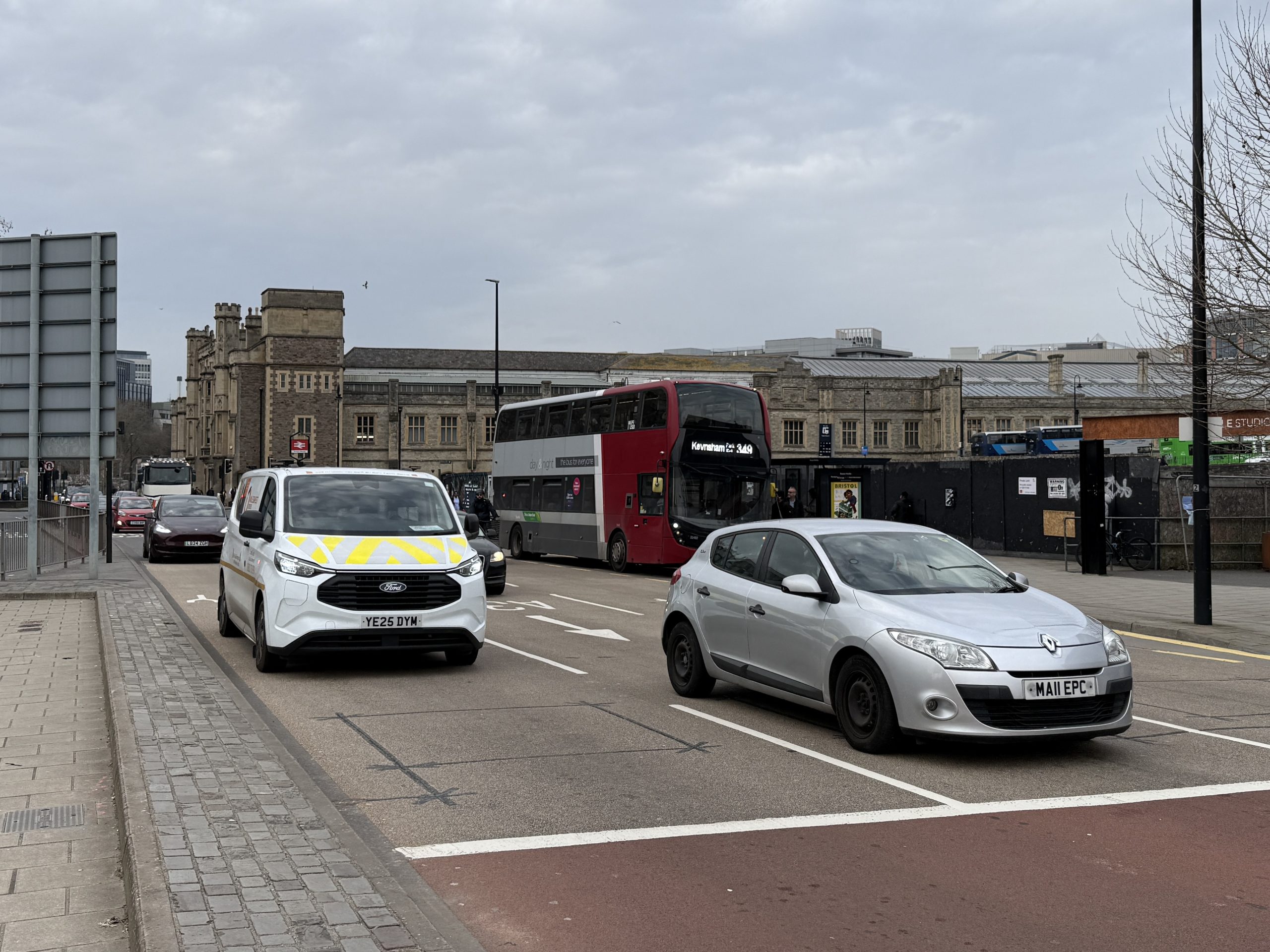
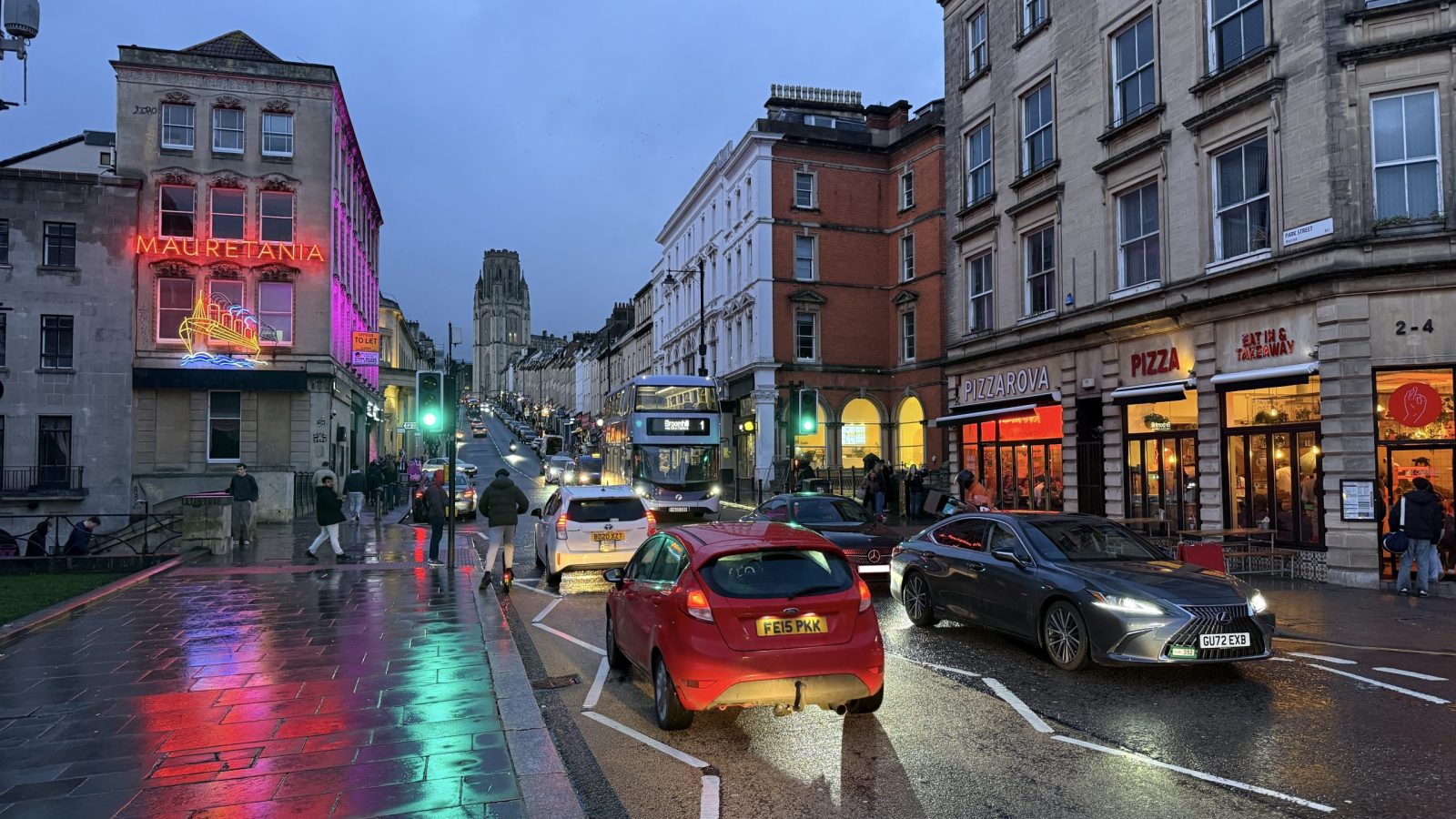
In Bristol, there are no trams and few decent bus services – photo: Betty Woolerton
In 2025, the West of England received £200m from the government to draw up plans for a mass transit network. But this won’t cover the costs of actually building the network, and the combined authority will have to rely on the government for more money at some point in the future.
Previous governments got cold feet on paying for trams, with former plans never built.
The combined authority will also explore “opportunities for innovative funding and delivery mechanisms with the private sector”.
Meanwhile Bristol City Council is exploring plans for a workplace parking levy, charged on businesses to raise money for upgrading public transport.
A similar levy in Nottingham paid for upgrades like an extension to the city’s tram network.
Every year employers in the city centre would pay a charge to the council for each parking space they provide at their place of work.
This could be passed onto their staff. The levy aims to raise money for “realistic alternatives to using private cars” and could be rolled out in 2028.
How much employers would have to pay hasn’t been decided, and the public will be consulted soon.
Alex Seabrook is a local democracy reporter for Bristol
Read next:
 Our newsletters emailed directly to you