Your say / South Bristol Liveable Neighbourhood
‘Dodgy data is forcing through an expensive transport project which will adversely impact thousands of people’
This is an opinion piece about the South Bristol Liveable Neighbourhood scheme. But before I allow my opinions to flood forth, let us first acquaint ourselves with the facts.
Low traffic neighbourhood (LTN) schemes promise lots of lovely shiny things, like “slower traffic”, “less pollution” and “more active travel” – which all sounds wonderful, doesn’t it? But the introduction to the Department for Transport’s Statutory Guidance for Implementing Low Traffic Neighbourhoods sounds a note of caution:
“LTNs can work well where they are well-designed and where there is local support for them… But they can do more harm than good where they are poorly thought-through and introduced with insufficient public engagement and support.”
is needed now More than ever
And that introduction states that an LTN is defined as “an area-wide traffic management scheme aimed at reducing or removing through traffic from residential areas, put in place using traffic signed restrictions or physical measures such as planters or bollards”.
So, to qualify as a “low traffic neighbourhood”, a scheme must contain these measures – known as “modal filters” – with the specific intention being to eliminate “through traffic”.
This is what was done in the East Bristol Liveable Neighbourhood – where it was greeted with enthusiasm by those residents who benefit – but dismay by others, who complain of longer journeys, social isolation, compromised emergency services, and the displacement of congestion and pollution onto neighbouring roads.
Government funding for LTNs in this region is administered by the West of England Mayoral Combined Authority (WECA) whose mayor Helen Godwin will have the final say about whether this project proceeds. And perhaps, after studying this article, some readers may be inclined to contact her.
When outlining its South Bristol Liveable Neighbourhood proposals, Bristol City Council’s website (click ‘Residential streets’) notes:
“Measures to reduce through-traffic and unsafe speeds have most of the health and environmental benefits. To secure UK Government funding for this project from the West of England Mayoral Combined Authority, our designs must include these types of measures.”
So, again – in order to secure Government funding from WECA – the SBLN has to include modal filters. Without them, there is no funding for any of the lovely shiny things.
Sure enough, the council’s SBLN proposals (published in early September 2025) include 12 modal filters within the ‘Southville zone’.
So – in order to eliminate “through traffic” – this area is divided into four separate colour-coded “cells”, between which most vehicles may not pass.
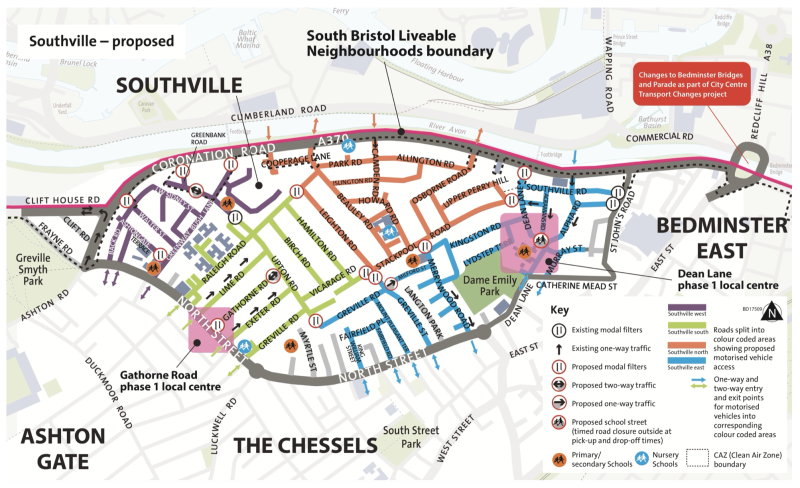
The proposed design for modal filters (planters and bollards) in Southville – image: Bristol City Council
While certainly blocking “through traffic”, the side effect of modal filters is that they make journeys longer for residents – and for visiting relatives, carers, taxis, tradesmen, utility services, delivery drivers, and emergency vehicles – and increase congestion and pollution on the boundary roads to which vehicles are deflected.
In order to justify the disruption caused by these modal filters, and to garner public support for the scheme, since September 2025 Bristol City Council’s website (click ‘Phase 1 neighbourhoods: Southville’) has claimed: “Traffic data show that high numbers of vehicles from outside the area use residential streets in Southville as a cut-through to other destinations.”
But to what “traffic data” are they referring? In June 2024, the council commissioned numerous traffic studies, and the resulting data is published on the council website – where we can download the “Traffic survey results 2024” zip folder, which contains 94 complex spreadsheets.
The only way to establish any quantity of “through traffic”, is to install numerous automatic number plate recognition (ANPR) Cameras throughout the relevant area, to record which vehicles are detected at multiple locations, and therefore deduce their routes.
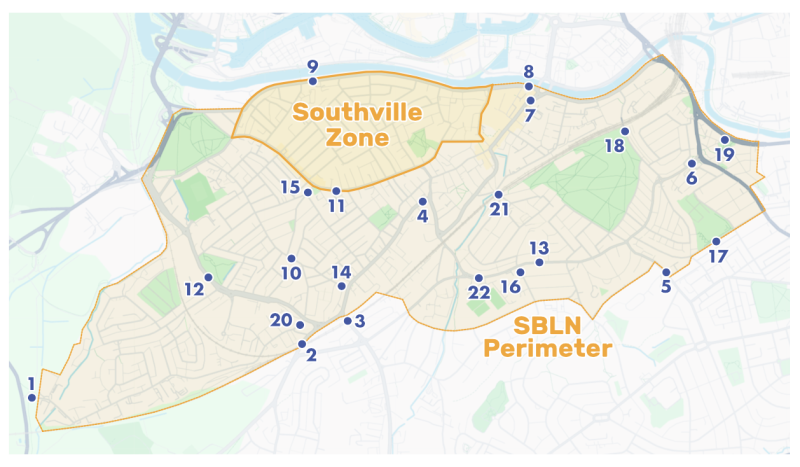
This map of camera locations shows that, in June 2024, the council had 25 ANPR Cameras throughout the SBLN study area. However, crucially, none of those cameras were actually placed within the Southville zone itself:
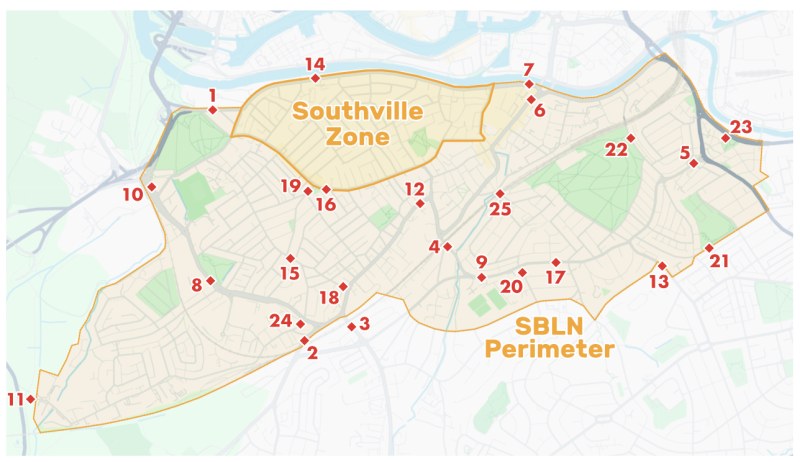
Locations of ANPR Cameras throughout the SBLN study area in June 2024. None of the cameras were within the
‘Southville zone’ – image: Matt Sanders
As there were no cameras in the Southville Zone, there is no data to confirm any quantity of vehicles “cutting through” that area – let alone the “high numbers” claimed on the council’s website.
Two of the 25 cameras were placed on the Southville zone’s perimeter roads: Camera 14 on Coronation Road, and Camera 16 on North Street; as shown on this map:
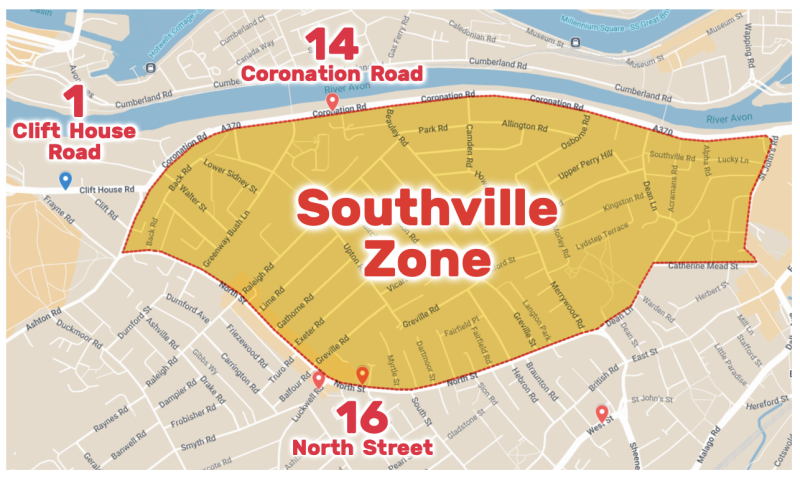
Locations of ANPR Cameras around the “Southville Zone”, in June 2024 – image: Matt Sanders
The ANPR spreadsheets show that on June 11 2024, each of these cameras saw more than 1000 vehicles which were also detected by other cameras within the same 15 minutes.
But only four of those vehicles were detected by both of these cameras. And there is no way of knowing if those four vehicles drove around the zone’s perimeter, or “cut through” the middle – as there were no cameras within the zone, to see them doing it.
The vast majority of matching detections relate to Camera 1 – at Clift House Road – as the vehicles seen by Camera 14 drove along Coronation Road (the zone’s northern perimeter) – while those seen by Camera 16 drove along North Street (the southern perimeter) – all without “cutting through” the Southville zone.
So the only “data” which can be gleaned from these spreadsheets, is that the vast majority of drivers are already using the zone’s perimeter roads — which is what the SBLN is intended to achieve.
The available data does not support the website’s claim: “Traffic data shows that high numbers of vehicles from outside the area use residential streets in Southville as a cut-through to other destinations”.
So that claim – which has been published on the council’s website for the last eight months, and must have been approved for publication by senior transport officers and councillors – is a bare-faced lie!
As there is no “traffic data” to justify the proposed modal filters, it appears that they have only been specified in order to make this project qualify for the government funding – which is only available to an LTN scheme, if it uses modal filters to block through traffic.
Let us pause for a moment, to gather our breath.
Regardless of anybody’s valid opinions about the pros and cons of Low Traffic Neighbourhoods – and there are excellent arguments on both sides – Bristol City Council is basing its entire justification for the South Bristol Liveable Neighbourhood on a single, blatant, fraudulent lie.
And that is a fact!
But it doesn’t end there…
Based on this and other claims, at the February 5 meeting of the council’s transport & connectivity policy Committee, councillors voted by a slim 5:4 majority, to triple the budget for development of the SBLN full business case, to nearly £2m – as can be seen from 1.57 on the meeting’s YouTube video.
On March 27, I presented a statement titled ‘The Fundamental Lie’ to WECA’s Joint Committee meeting. This appears at 50.30 on the meeting’s YouTube video – which shows that, while the WECA mayor and the council leaders from North Somerset, South Gloucestershire and Bath & North-East Somerset, all paid close attention to my presentation. Bristol’s council leader Tony Dyer studiously ignored me throughout.
This is particularly curious, considering that his own constituency is actually the Southville ward.
After my WECA statement, an independent data analyst named Ali Bin Shahid examined all of the 94 published spreadsheets, and wrote a comprehensive report – which supports my conclusion that none of the data available to the council in September 2025 demonstrates any quantity of “through traffic” afflicting the Southville zone, let alone “high numbers”.
His report was published on April 3 by Keep Bristol Moving from where it can be downloaded in full.
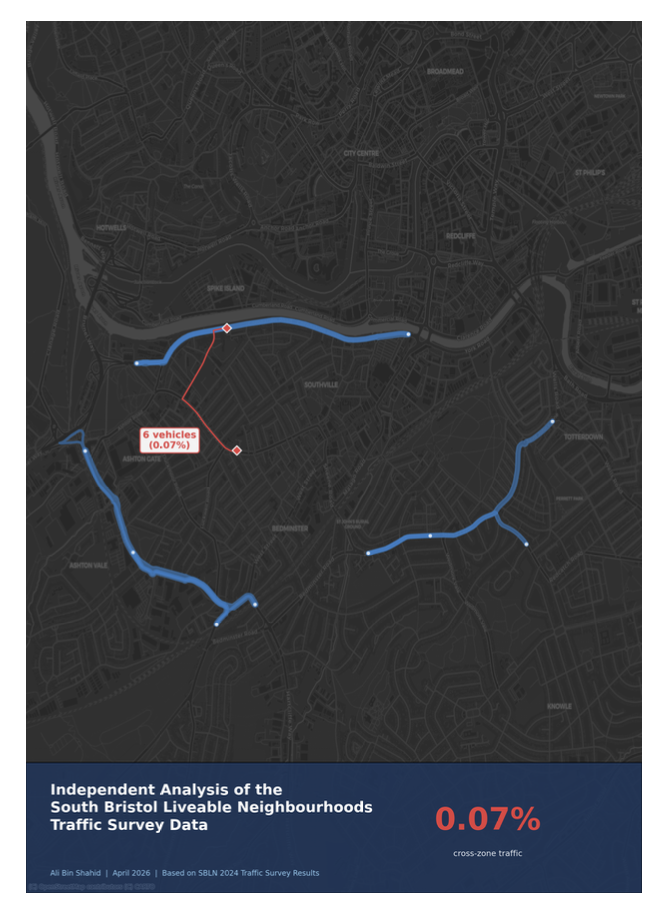
Front page of an independent analysis of the SBLN traffic survey data – image: Ali Bin Shahid
This report also highlights the fact that the 2024 traffic surveys had 22 ATC (Automatic Traffic Count) sensors throughout the SBLN study area, to record the numbers, speeds and directions of passing vehicles – see the map below.
But again, none of those sensors were within the Southville zone.
So, in September 2025, when they published the modal filter proposals, the council had no data relating to the quantity and speed of vehicles in this area.
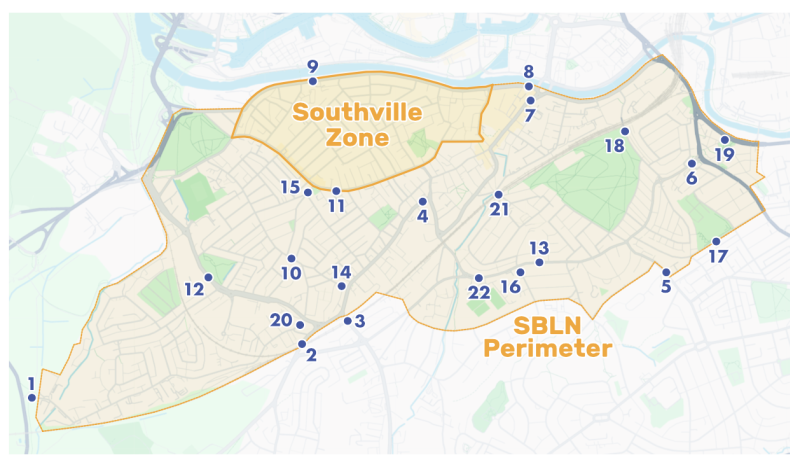
Locations of Automatic Traffic Count sensors throughout the SBLN study area in June 2024. None of them were within the ‘Southville zone’ – image: Matt Sanders
The 2024 traffic surveys also had 11 JTC (Junction Turning Count) surveys, placed at selected junctions throughout the SBLN Study Area. Again, none of these were placed within the Southville Zone.
So in September 2025, the council had no data relating to traffic movements in this area.
In November/December 2025, the council collected ATC and JTC data at several locations inside the Southville zone. But they have not yet published any of the results – which is curious – especially if those results support the council’s claims.
But obviously, that data was not available in September 2025 when the website published those claims of “traffic data” supposedly proving “high numbers” of vehicles “cutting through” Southville.
The 2025 ATC and JTC surveys can only give volumes, speeds and directions of vehicles passing certain locations.
They cannot confirm which routes those drivers took or any ratio between local traffic and those who are “cutting through”.
Only ANPR cameras can confirm “through traffic”. And in these recent 2025 surveys, there were no ANPR Cameras anywhere in the Southville zone, or in any other part of the SBLN Study Area – as shown on the council’s online map of SBLN traffic survey sites 2024 and 2025.
So if the council was keen to gather “traffic data” to support its claims of drivers “cutting through” Southville, it is curious that the ANPR Cameras necessary to do that, were not installed.
And another pause for breath.
I’m not the first person to draw attention to this outrageous scandal.
Since December 2025, Southville resident Bobby Harakis has submitted numerous public forum questions and statements, and a Freedom of Information (FOI) request, to Bristol City Council.
These documents, and the officer responses, have been compiled into a report which was published on April 8 on Keep Bristol Moving and include the following extracts from the council website, which confirm that the scheme’s justification is “to prevent cut-through traffic”:
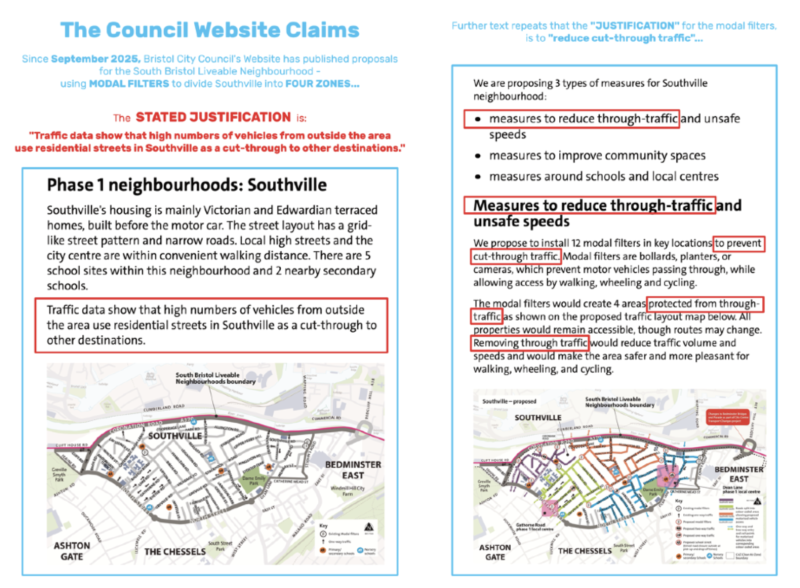
A compilation of claims on Bristol City Council’s website – images: Bristol City Council and Bobby Harakis
In public forum questions to three meetings of the transport & connectivity policy committee, Mr Harakis requested that officers state exactly which “traffic data” proves the website’s claims of “high numbers” of vehicles “cutting through” Southville.
On every occasion, he was fobbed of with generic waffle about traffic surveys, and “resident feedback” – which is absolutely not traffic data. But no specific numbers (let alone “high” ones) were ever forthcoming. This is despite it being in the council’s interest to bring any such statistics to wider public attention!
Similar questions to full council received identical evasive and disingenuous officer responses.
All of these officer responses were approved for publication by Adam Crowther, head of transport, and the transport chair, councillor Ed Plowden. So those senior individuals were clearly well aware of the lack of any supporting traffic data – so must also be well aware that the council’s website is publishing false claims.
When Mr Harakis submitted a public forum statement to the January full council, it was “mysteriously omitted” from the published papers.
When he submitted questions for the February transport committee, his 800-word introduction (condemning the previous meeting’s evasive responses) was also “mysteriously omitted” from the published papers. And when he submitted questions for the March Full Council, they were again “mysteriously omitted” from the published papers.
In December, Mr Harakis submitted an FOI request for the specific traffic data which supports the website’s claim. Again – as well as being a legal obligation to release this information – it was in the council’s interest to provide any such data, as it would support their case for the SBLN modal filters.
The ‘transport engagement team’ missed the statutory FOI deadline by four weeks and then issued a threadbare response which contained no data.
This FOI response stated that “some” of the requested data “is not held” by Bristol City Council; but failed to specify which data was not held. The response directed Mr Harakis to the 94 spreadsheets from the 2024 traffic surveys but failed to specify which of them supposedly contained the requested information.
Like the public forum officer responses, this evasive FOI response will have been approved before release, by senior managers within the transport department – who were therefore complicit in this further attempt to stifle investigations.
Mr Harakis requested an internal review, and eventually a revised FOI response was provided. This included a garbled attempt by officers, to give some specific numbers.
But this laughable “explanation” entirely misrepresents what the spreadsheets have to say. So either the council officers were being deliberately misleading, or they simply do not understand the data that they have gathered. Full details are in Mr Harakis’s report.
As with the original FOI response, this misleading revised response must also have been approved before publication, by senior transport officers.
On April 9, I brought all of these facts to the attention of WECA mayor Helen Godwin – who has asked her colleagues to examine this evidence.
On April 21, I brought all of these facts to the attention of Bristol South MP Karin Smyth – who is also making investigations.
On April 13, I brought all of these facts to the attention of the 69 Bristol councillors of the four main political parties. Only five of them have deigned to reply.
So, what have we learned, from these numerous proven facts?
- Bristol City Council has no “traffic data” to confirm any quantity of vehicles “cutting through” the Southville zone – let alone “high numbers”. So those claims on the council’s website are a bare-faced lie.
- Senior transport officers and the transport chair are well aware of this fact, and have repeatedly approved evasive and disingenuous responses to all enquiries
- Without the claimed “traffic data” there is no justification for modal filters in Southville
- So the modal filters have only been proposed in order to meet specific funding criteria and not because of proven issues within the Southville locale
Unfortunately, I have listed so many facts that there are hardly any words left for my opinions. But here they are:
Opinion 1: Everybody is entitled to their opinion. But nobody is entitled to concoct bare-faced lies in order to force through an expensive transport project which will adversely impact thousands of people.
Opinion 2: All Bristol City Council transport officers who are responsible for these proven lies – and for the various cover-ups to deflect attention away from them – should be very politely asked to walk through the nearest bus gate. And then served with a strictly-enforced penalty charge notice for “being in a bus lane”.
Opinion 3: All elected councillors who are well aware of these proven lies and have chosen to turn a blind eye should be prosecuted for misconduct in public office and voted out at the first opportunity.
And to end with, here’s a prediction:
Bristol City Council will prove to be entirely morally bankrupt by issuing a disingenuous press release which trots out a fatuous stream of self-righteous virtue-signalling nonsense about “rat-running” and “air quality” and “disadvantaged children” – while entirely ducking all of the issues raised in this article.
Because that’s what they always do.
This is an opinion piece by bus gate campaigner Matt Sanders
Main photo: Sam McEvans
Read next:
 Our newsletters emailed directly to you