Your say / walking
‘Fundamental changes in walking from 500 years ago continue to impact us today’
A recent feature in Bristol24/7 on International Women’s Day shone a light on the issue of girls’ and women’s reduced access to public green spaces, showing how Bristol is leading the way in prioritising their voices in conversations around park design to make the city a safer and more inclusive place to be.
Betty Woolerton’s article also briefly referred to how parks developed into public spaces to begin with, though research I have been undertaking at the University of Bristol would place the starting point of that development back by about 200 to 300 years, beginning in the early modern era (about 1500-1800).
As a historian of Renaissance drama, I have spent the last few years looking at how walking, as both a cultural and theatrical performance, underwent fundamental changes during that period – and how these continue to impact us today.
is needed now More than ever
At some point during the 1500s, walking shifted from being a primarily working-class activity – something you did because you couldn’t afford a horse – to one associated with the wealthy elite. As a result, parks and gardens became more important sites of recreation.
The partial opening of former royal hunting grounds to commoners, such as Hyde Park in central London, alongside the development of pleasure gardens, allowed people to walk in new places and in new ways – enabling the development of promenading, for instance.
People would perform such walks in the most unlikely of venues: by the end of the 16th century, it became so popular for groups of men to stroll and chat in St Paul’s Cathedral that they were even known as ‘Paul’s Walkers’.
This redefinition of walking was made possible because the increasing recognition of ‘leisure’ during the early modern era.
As the concept of ‘free’ time became more and more acceptable, a leisured class emerged; initially drawn from the wealthy elite but then gradually spreading to the middle classes.
Special spaces for recreation were built, such as the piazza style concourse of Covent Garden, or the two-tiered walks at Bath.
Tellingly, the lower walk at Bath, aimed at the working class, remained rough and unsurfaced, while the higher walk was gravelled so that the gentility could promenade.
The Bath walks are a classic example of how walking was reclassified during the period but also tell us something about who the ideal walker might be.
According to drama and other early modern texts, this perfect walker was invariably white, affluent, non-disabled, and male.
This history matters because when one walker was elevated over all the others – namely women, the working class and people of colour – the bodies of imperfect walkers were seen as problematic. And the problem of women’s walking was a particular cultural concern during the Renaissance.
Ideally, the early modern woman shouldn’t leave the house at all, but if she did, she should be accompanied by a male chaperone, and stick to ‘safe’ places like gardens.
Woe betide a female pedestrian who strayed from her house on her own, or wandered into remote areas, such as woods. If she were to be attacked as a result, a victim-blaming logic would see that as a natural consequence of her ‘waywardness’.
Sadly, progress in this area has remained slow over the last 500 years.
When media coverage of the tragic murder of Sarah Everard emphasises that she was kidnapped at 9pm, that she wasn’t drunk, that she was wearing trainers, or took a populated route through Clapham Common, it is haunted by the shadow of another woman – one walking at midnight, drunk, in heels and in a secluded area – who deserves to encounter her attacker.
All these centuries later, the onus still falls on women not to be raped, rather than on men not to rape.
Since 2022, a network of researchers at the University of Bristol and UWE as well as public health experts, activists and the theatre company Breathing Fire have been trying to find solutions to this age-old problem.
In the first instance, we ran drama workshops with women’s groups to listen to how they get from from A to B, hearing about the amount of risk they had to assess just to undertake simple everyday journeys, and about their anxieties in public space after nightfall.
We asked them how we could change this situation. “A curfew on men!” some initially joked, before agreeing that education was the best way to move forward with this problem and potentially change it.
We therefore developed a drama workshop to talk to Key Stage 3 children to think about girls’ free movement through the world, using a scene from Romeo and Juliet in which the character of the Nurse is harassed by a group of young men to show the longstanding nature of this issue.
We asked the pupils to change the ending of the scene so that they could imagine a better outcome for the Nurse but also for themselves.
The work continues and the next stage involves developing the KS3 workshop with boys’ sports clubs, seeking the perspectives of disabled movers through the city, tackling VAWG in sport alongside Bristol Girls Can, developing VR programmes to train men in how to become upstanders, all the while continuing to talk to girls and women about their experiences, and connect them to a wider historical picture.
We firmly believe that improving girls’ and women’s access to public space isn’t just about lighting or urban design but involves raising awareness and developing historical understanding about the deeper systems in play.
We believe that if we don’t take the challenge back to its historical roots in the Renaissance, then we are doomed to repeat the mistakes of the past; that if we don’t disrupt those deep-seated, ancient ideas, then we will always be treating the symptoms, rather than the cause, of the disease.
This is an opinion piece by Dr Eleanor Rycroft, associate professor in early modern performance at the University of Bristol’s Department of Theatre
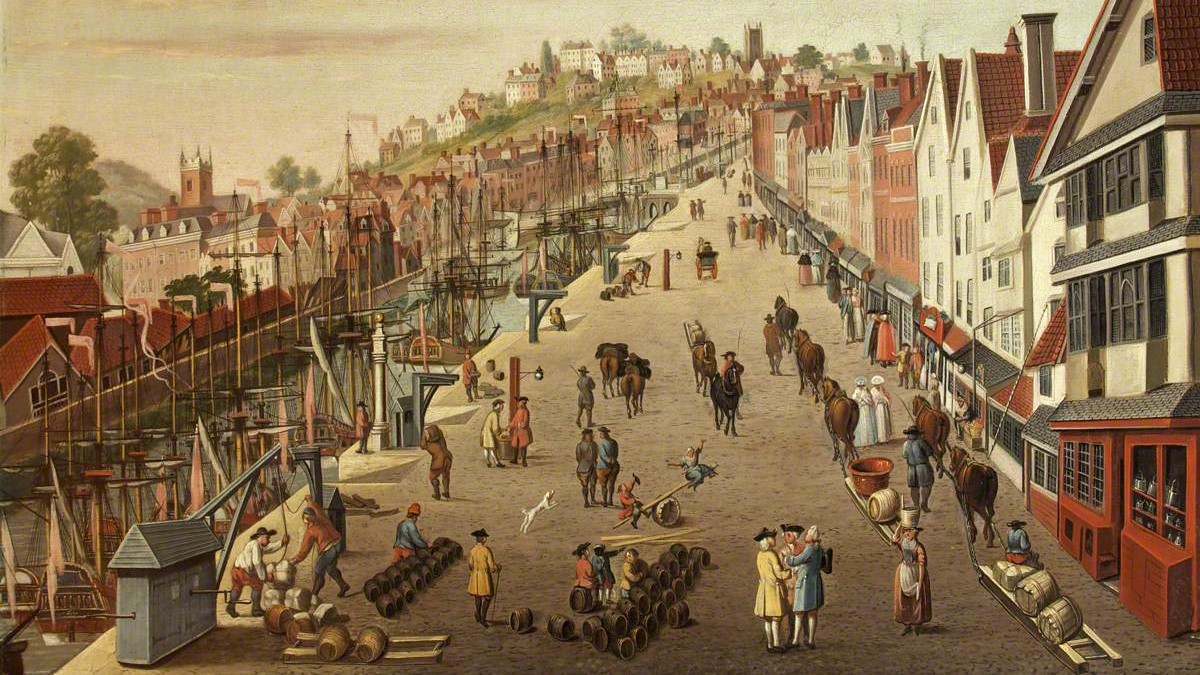
Main image: Broad Quay, Bristol, c. 1760 courtesy of Bristol Museum & Art Gallery
Read next:
 Our newsletters emailed directly to you