Music / contemporary classical
Review: Bristol New Music Festival, various venues: So – what’s new?
So – what’s new? Plenty of people want to know, judging by the impressive numbers of folks crammed into sundry venues for this year’s highly successful Bristol New Music festival. After twenty-three performances across fourteen events the answer may be as elusive as ever but the quest for it certainly proved satisfying. Herewith a few glimpses …
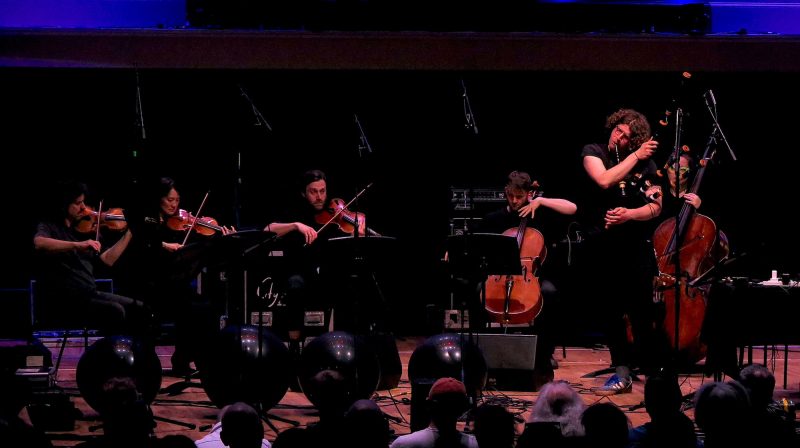
Harry Górsky-Brown & Phaedra Ensemble
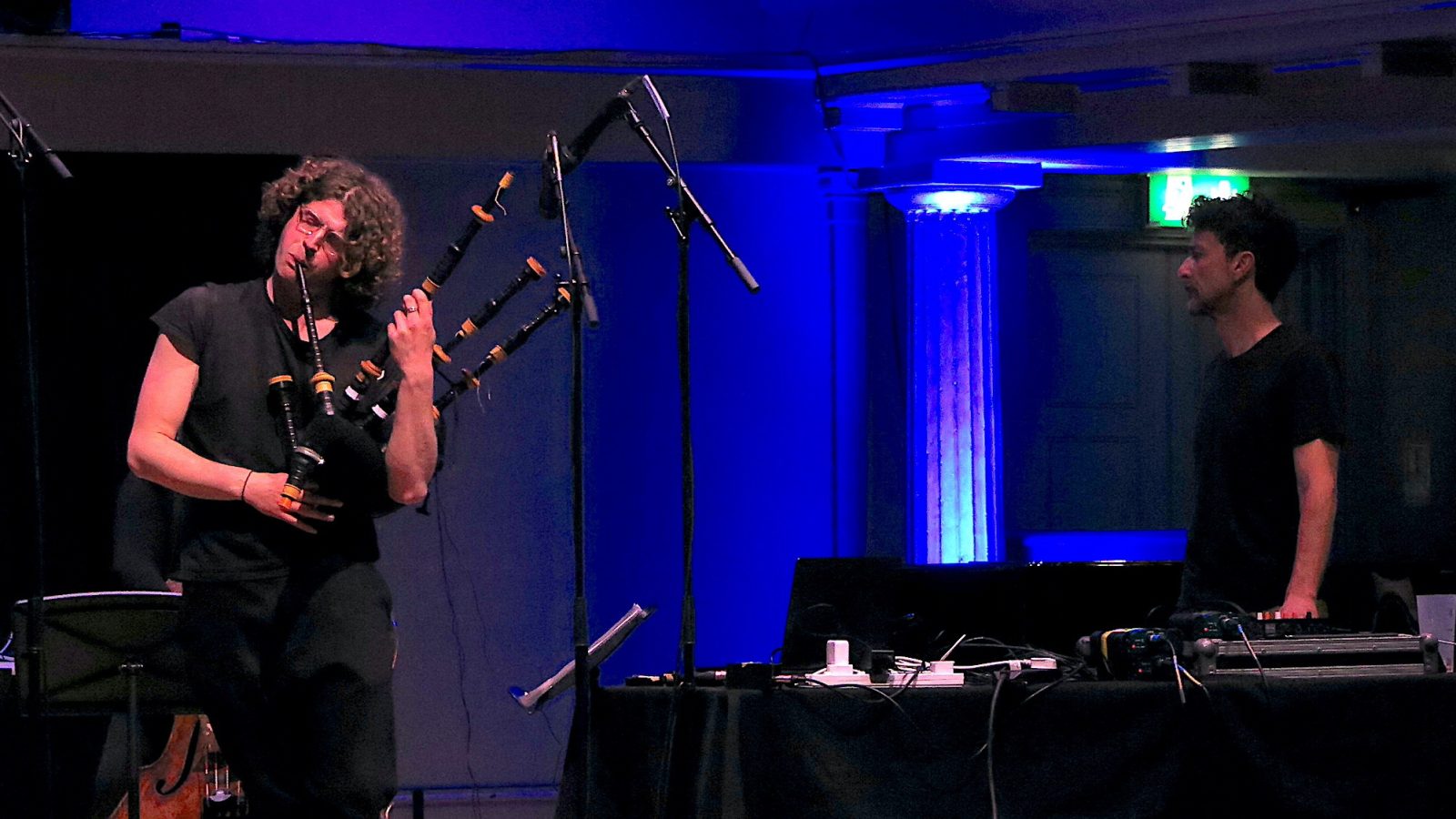
Radical bagpiping, anyone? Yes, the programme featured two exponents, each with their own take on the possibilities of the instrument. Breton piper Erwan Keravec’s percussive rhythms within detuned drones hovered between weird house music and Steve Reich minimalism. Spotlit in the Cube darkness his rigid, clattering fingers were a mesmerising dance in the dark. Scots piper Harry Górski-Brown, supported by the Phaedra Ensemble’s string quintet and electronicist Wojciech Rusin, literally deconstructed his instrument, pulling the drone pipes apart and reassembling them, retuning the harmonies to weave among the quintet’s strings.
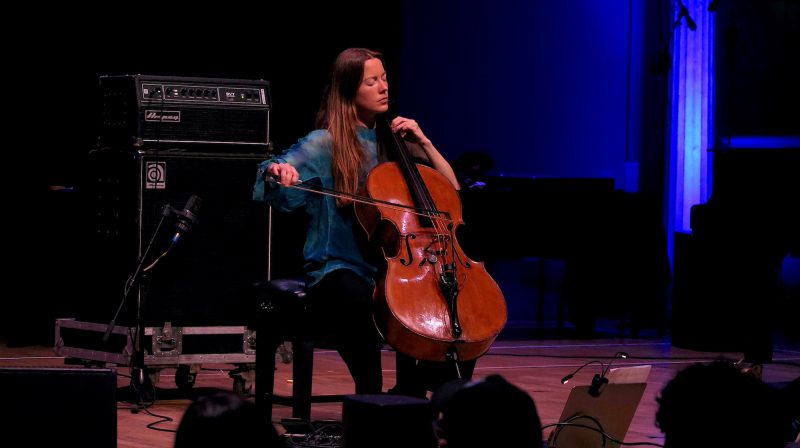
Lucy Railton
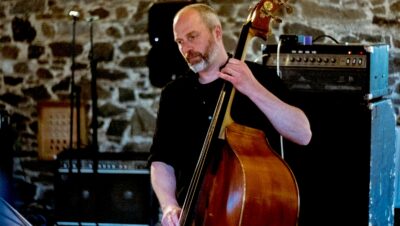
He was followed in St George’s by Lucy Railton’s solo cello explorations of harmonic resonance, long notes slowly changing with rhythmic consistency in a meditative flow of overtones and emergent beats. The Hall’s famous acoustic added a particular clarity to the subtleties unfolding. Later, in the Lantern, emptyset ended their pounding electronic performance with an extended piece of intensely (and intentionally) monotonous techno that was weirdly similar in its subtle modulations, albeit delivered with head-slamming force and floor-shaking beats.
is needed now More than ever
They had followed the vivid collaboration of vocalist Cara Tolmie and producer Ryan Treanor, a collaged sequence of electronic snapshots and shifting beats. Cara’s remarkable vocal dexterity took the sound from electro-noir through industrial muttering and chirpy synth-pop with techniques that included a remarkable whole-body vibrato method.
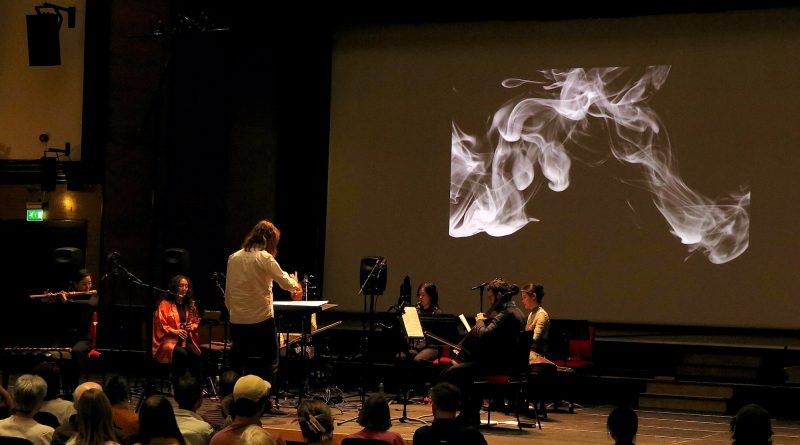
Shui Mo Ensemble
The Victoria Rooms hosted contemporary classical music from East Asian composers, the University’s New Music Ensemble particularly impressive in the atmospheric tensions of May Kay Yao’s Four Nightmares. They topped that with Terry Riley’s In C, over 60 years old but always a new composition thanks to its improvisatory structure. Sunday’s concert from the Shui Mo Ensemble was a spellbinding blend of traditional instrumental textures and formal ideas from China, Japan, Korea and Hong Kong, brought together in specially commissioned compositions. The three premiere pieces had powerful moods and textures economically constructed and explored. Ensemble cellist George Owen’s 6-part suite inspired by Japanese artist Hiroshi Yoshida gave each instrument a turn in the spotlight, with Peng Cheng’s soaring érhú particularly virtuosic. To the untrained ear the music was revelatory, though it would be interesting to know what the respective traditionalists would think.
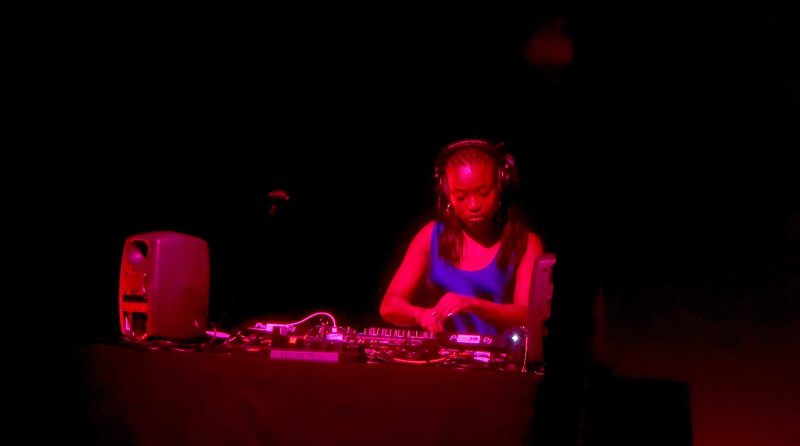
Olukemi Lijadu
Olukemi Lijadu’s beautiful and captivating film installation Feedback is still showing at Spike Island – catch it if you can. Her Festival performance saw her occasionally glimpsed working on electronics and DJing behind a scrim screen with clips from the film projected on it. The musical and visual elements were well chosen and true to the sentiment “Anything can be a drum if it beats, Our hearts …” but the effect didn’t really add to the value of Feedback itself.
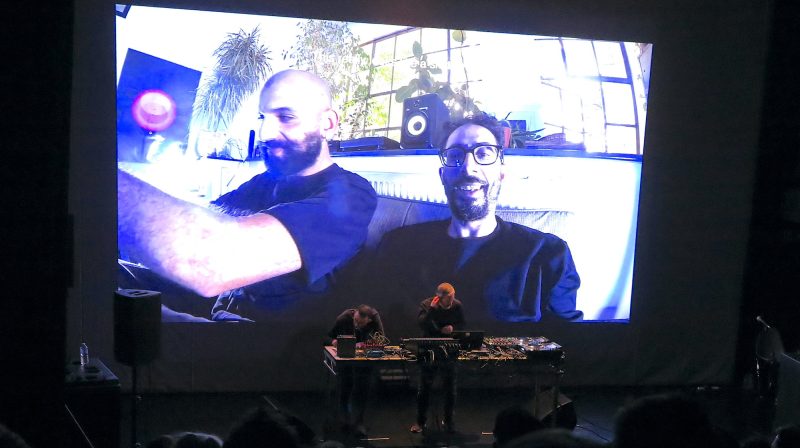
Saint Abdullah, Eomac, Rebecca Salvadori
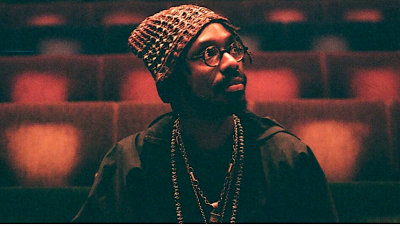
More successful integration of sound and vision came to Arnolfini courtesy of A Forbidden Distance, the collaboration of Saint Abdullah – Iranian-Canadian brothers Mohammad and Mehdi – with filmmaker Rebecca Salvadori to a live soundtrack from Ian McDonnell aka DJ Eomac. Forewarned by an onscreen caption that ‘all you need to know is what you’re told’ the piece tumbled helter-skelter through home movie clips of the brothers’ family story in Canadian exile, largely focussed on their sister as she grew up. The music crashed, roared and soared while Mehdi sat alongside the ever-bustling Eomac seemingly urgently writing something in the dark.
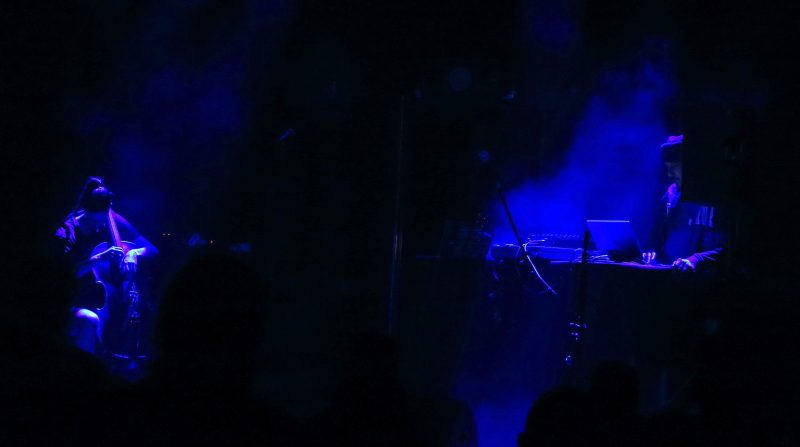
FRANKIE + Kelman Duran
As already mentioned, cellos played a big part across the Festival. When FRANKIE met Kelman Duran in the Lantern her scorching cello wrestled successfully with his complex rhythms, apocalyptic bass and surges of electro wash. It was a sequence of surprises, not least when her vocals joined his piano in a surprisingly straightforward ballad halfway through.
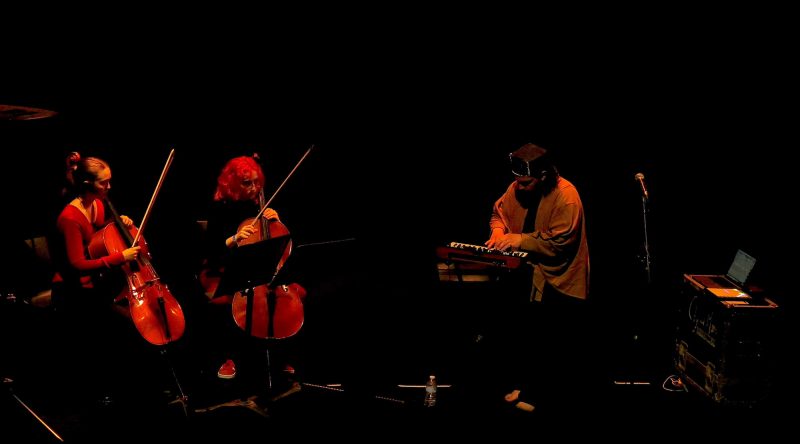
YUNIS
In the Arnolfini Egyptian sound artist YUNIS performed the ritualistic incantations of Opera for 1000 Crows with looping electronics and two cellos, a funereal piece of strange intensity followed by a raga-like cello duo set to a 6-time drum loop.
The set had a feeling of ancient mystery, as did the solo performance of ãssiah ghendir in the same venue. Shrouded in darkness and a shawl they pleaded in repeated vocal phrasing against a rising soundtrack of weather and ambience. A lost muezzin from an unspecified desert, the set climaxed with them smoothing and shifting a small pile of sand before gathering clattering rocks to finish.
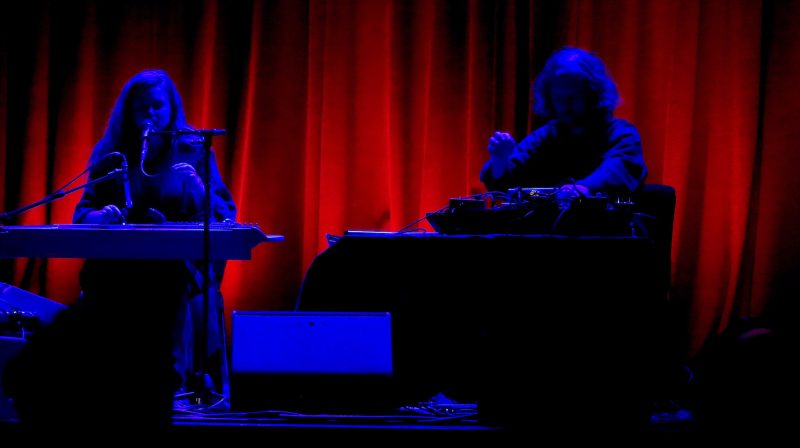
Merope
Techno-vagabonds Merope also played their set in subdued light – quite a theme for the festival. Despite being surrounded by an airplane cockpit of electrickery the core of the sound was the combination of Indrė Jurgelevčiūtė’s beautifully voiced laconic Lithuanian vocals and the harp like tone of the traditional kanklės dulcimer. It made for a spellbinding soundscape, as did what followed: local composer Yas Clarke’s The Playhouse, another festival premiere.
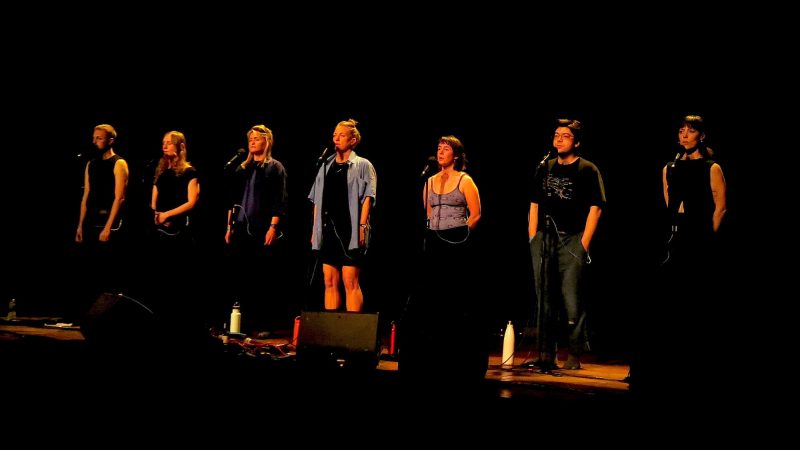
Yas Clarke – The Palmhouse
This was an acappella sound work based on a spoken text for seven speaking ‘singers’ each triggered by separate in-ear promptings. Rhythmically precise, words and phrases passed between the voices to form new patterns and emphases while occasional choreographed body language added a dimension of physical theatre (and humour) like an elaborate game of Simon Says. The piece was compelling, if possibly over-long, and felt fresh in its conception and use of technology. Hopefully it will be performed again – the fate of festival commissions can too often be to remain a one-off memory for the lucky few.
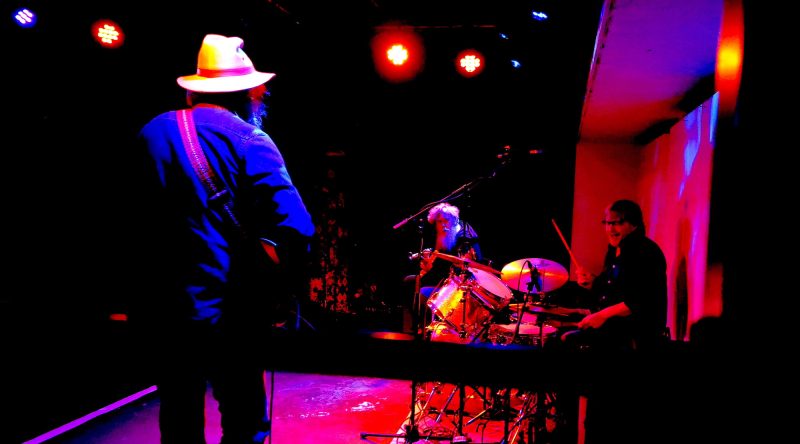
Orcutt, Shelley, Miller
There were many other fine performers, with the festival bookended by two Strange Brew events the first of which saw the trio of guitar behemoth Bill Orcutt with bass player Ethan Miller and former drummer for Sonic Youth Steve Shelley. It was, as was to be expected, a masterclass in the language of instrumental rock: solid, vivifying and impeccably performed. As an opener for a ‘new music’ event it was utterly ‘old school’ but no-one seemed to mind – maybe there’s a Post-New Wave going on?
The closing act of the festival was decidedly new, however. Playing in the round, Ex-Easter Island Head wove an experimental path from multiple redeployed electric guitars, hand bells and a drum kit. The effect of their evolving layered music had the throb of early Kraftwerk but the sound was entirely new, each as yet unrecorded number distinct in its character and ideas. They finished in a crowd-pleasing surge of noise and crashing techno bass drum that was exactly the right way to round off an eclectic and intriguing five days of musical individualism. Were we any nearer to answering that original question? Who knows. Whatevs!
 Our newsletters emailed directly to you