Film / Reviews
Review: The Post
The Post (12A)
USA 2017 116 mins Dir: Steven Spielberg Cast: Tom Hanks, Meryl Streep, Alison Brie, Sarah Paulson, Bruce Greenwood, Carrie Coon, Matthew Rhys, Jesse Plemons, Bob Odenkirk, Bradley Whitford, Michael Stuhlbarg, Tracy Letts
Steven Spielberg dropped everything to bash out The Post in just six months on the grounds that this was a story he “needed to tell today”. On the face of it, that’s an odd claim to make about a Vietnam war-era drama. Except, of course, that this big prestige flick is actually Liberal Hollywood’s most high-powered swipe at Donald Trump, featuring the first screen teaming of Tom Hanks with that notoriously over-rated actress Meryl Streep, who’s been nominated for a derisory 20 Academy Awards. No opportunity is lost to underline the parallels between the events of 1971 and today, with a ranting, foul-mouthed president (wisely shown only in silhouette) surrounded by “real bad people”, who wages war on the press as they set out to reveal how the American public have been deceived. In case anyone still doesn’t geddit, there’s even a big speech about how the President cannot be allowed to “run the country by himself without reference to Congress”. All of which has succeeded in making our unappealing friends on the alt-right even more apoplectic than usual. That, of course, is no bad thing. But is it any good? Well, you’d hardly expect a film of this pedigree to be mediocre. But it’s safe to say that everyone involved has done better work elsewhere and All the President’s Men, to which The Post acts as something of a prequel, remains unchallenged as the greatest heroic investigative journalist flick.
is needed now More than ever
For anyone who lacked the patience to sit through Ken Burns’ exemplary 17-hour TV documentary series The Vietnam War (i.e. most of the American people), Spielberg’s inky tale provides an unequivocal précis of The Pentagon Papers – a secret study commissioned by Secretary of Defense Robert McNamara (Greenwood) to provide an overview of American involvement in Vietnam under successive administrations. Although they knew it was an unwinnable war, each president from Truman to Nixon covered up the truth and continued to send young men to their deaths to avoid the political humiliation of defeat. Disgusted at this duplicity, young Rand Corporation researcher Daniel Ellsberg (Rhys), who has full access to the report, photocopies and leaks it to Neil Sheehan of the New York Times.
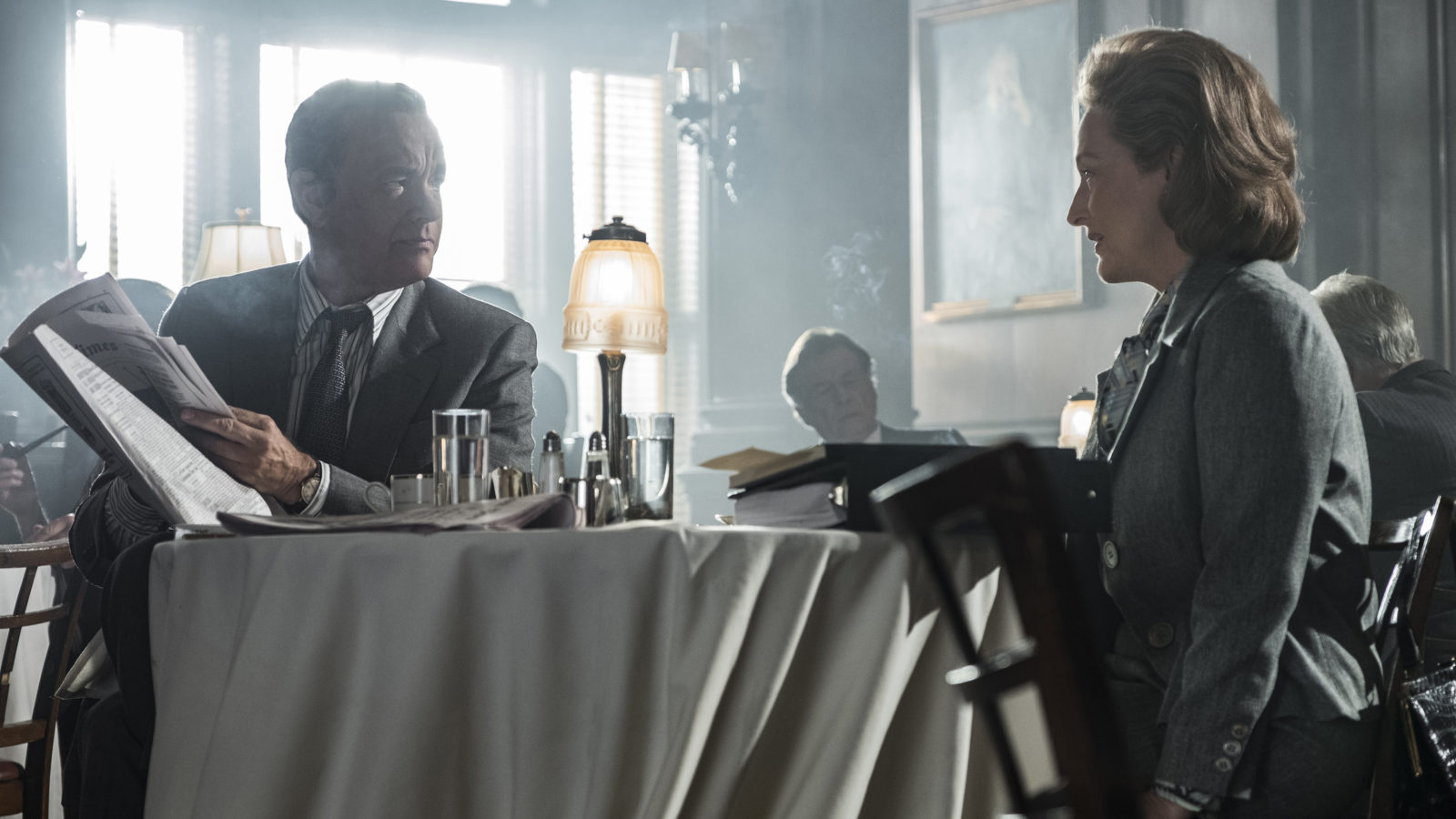
Meanwhile, the Times’s smaller, inferior rival, the Washington Post, is preparing to go public with a share offer. Its nervous, uncomfortable socialite publisher Katharine Graham (Streep), who inherited the paper after her husband’s suicide, is viewed by her pushy, male board members as a lightweight who’s not up to the job and is warned that the whole process could collapse in the event of any major upset. When the Nixon administration blocks further publication after the Times’s initial splash, the Papers fall into the hands of the Post, whose editor Ben Bradlee (Hanks) refuses to compromise on the issue of press freedom.
Having cast Hanks and Streep, Spielberg is obviously keen to make the most of their first screen pairing by centring the drama upon the tension between Graham and Bradlee. Will she rise to the challenge and assert herself in support of her editor’s desire to publish, or capitulate to the suits and lawyers (watch out for Zach Woods from Veep and In the Loop, knowingly cast as one of the latter)? It’s a particularly strong, conflicted role for Streep, underlining the fact that feminism had yet to penetrate the higher echelons of business and society. In one telling dinner party scene, the women, including Graham, all depart to make fluffy small talk about ‘lifestyle’ and celebrities once the men spark up and begin to discuss politics, as though nothing has moved on from the 19th century. Hanks is impressive enough at conveying the steely determination that drives Bradlee, but inevitably labours in the shadow of Jason Robards’ acerbic, Oscar-winning performance as the same character in All the President’s Men.
As newspaper drama, it’s rousing enough, but lacks the emotional power of Spotlight and the tense investigative sleuthing of All the President’s Men (the Pentagon Papers are acquired with relatively little cloak’n’dagger business). There’s also an awful lot of exposition to get through, but Spielberg and writers Liz Hannah and Josh Singer keep it cracking along at a fair old pace as the film reminds of both how little and how much things have changed. In a world of fake news, press freedom remains under attack. But journalists toiling in the ailing fourth estate in the clickbait era may be forgiven a hollow laugh when an argument is made that would never be heard today: “Improving quality will lead to greater profitability”.
 Our newsletters emailed directly to you