Film / Reviews
Review: Lady Macbeth
Lady Macbeth (15)
UK 2016 89 mins Dir: William Oldroyd Cast: Florence Pugh, Christopher Fairbank, Cosmo Jarvis, Paul Hilton, Naomi Ackie
What’s a nubile, sexually frustrated young girl to do when she’s purchased as a bride for a stern, controlling old brute who forces her to strip naked and face the wall while he attempts to beat off? Why, take a strapping, horny-handed labourer as her lover of course, setting the scene for a Shakespearean orgy of murder, duplicity and revenge. Except that this Lady Macbeth is only tangentially related to the Bard, its title being chosen by 19th century Russian writer Nikolai Leskov for his 1865 fin-de-siecle novel Lady Macbeth of the Mtsensk District as a nod to Shakespeare because it’s a tale of murder plotted by a woman. This, in turn, inspired Shostakovich’s opera of the same name, which was denounced by Stalin, and Polish director Andrzej Wajda’s 1962 film Siberian Lady Macbeth.
is needed now More than ever
https://youtu.be/zDhZI4WiQ78
Enter British theatre director William Oldroyd, whose confident feature debut relocates the drama to 19th century Northumberland, tweaks the ending to introduce a satisfying element of ambiguity, toys with issues of race, and achieves visual wonders on a tiddly iFeatures budget. The result invites comparison with Andrea Arnold’s Wuthering Heights by putting a grittier spin on chocolate box costume drama conventions, while carrying thematic echoes of Lady Chatterley, Flaubert’s Madame Bovary, and even a more austere The Duchess, with unbridled sexuality and brutal murder in place of genteel National Trust stately home porn.
Timid teenage Katherine (Pugh) finds herself trapped in a remote farmhouse on the windswept moors (imagine a less gothic Thornfield Hall) having been purchased as a bride for charmless mine owner Alexander (Paul Hilton) as part of a two-for-the-price-of-one deal along with a crappy plot of land. Her role, apparently, is to squeeze out sprogs, but this is hampered somewhat by his impotence. She’s kept in line by her even scarier, gnarly father-in-law, Boris (Fairbank), her only female ally being the maid, Anna (Ackie). When plot contrivance (an “explosion at the colliery” rather than “trouble at t’mill”) takes Alexander away for an extended period, Katherine find herself drawn to macho, surly young groomsman Sebastian (Jarvis) and it’s not long before she’s engaging in vigorous, lusty, bedpost-rattling fornication with this virile bit of rough. But the horny couple make no real attempt to conceal this shameless adultery, setting tongues wagging with their brazen rumpy-pumpy. And rather than submit to the ire of the cuckold and his father, they turn to murder.
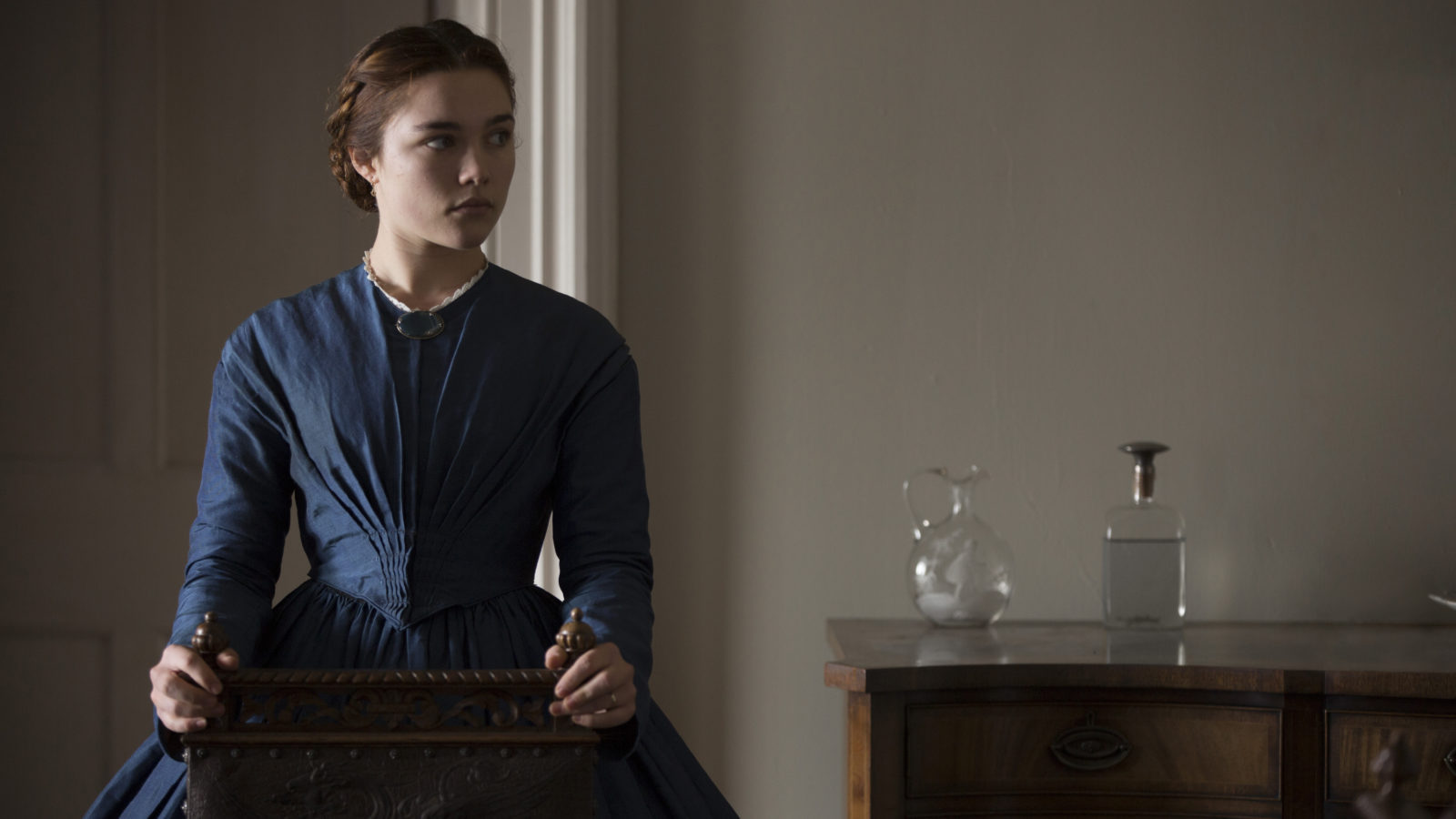
Having trimmed all the fat to deliver a brisk, intense 89 minute drama, Oldroyd presents quite a challenge to his talented, then 19-year-old lead Florence Pugh, who played rebellious minx Abbie in Carol Morley’s The Falling. She has little room to manoeuvre in order to pull off a convincing character transition and negotiate a couple of plot twists that threaten a jarring detour into black comedy as the demure, cowed bride becomes a boozy, concupiscent, patriarchy-trouncing serial killer. Fortunately, Pugh proves more than equal to the task, while any fears that Oldroyd’s background might lead to a stagy and theatrical approach are soon allayed as he skilfully blends urgent, hand-held camerawork with more static, formal, symmetrical, Peter Greenaway-esque compositions that make much of the symbolic value of Katherine’s striking blue dress while allowing a scene-stealing cat to wander freely through the frame. Unmentioned by any of the characters but clearly central to Oldroyd’s re-interpretation is the issue of race, underlining that of class: Anna is black and, as played by singer/songwriter Cosmo Jarvis, who’s of part-Armenian ancestry, Sebastian appears to be of mixed race. Most refreshing, however, is the refusal to punish Katherine in traditional moralising Thérèse Raquin style, permitting her to emerge as a powerful yet intriguingly ambivalent figure.
 Our newsletters emailed directly to you