News / Development
Golf club expansion opposed due to ‘serious risk’ to wildlife
An application by Bristol & Clifton Golf Club to expand their course has been strongly criticised by local environmentalists.
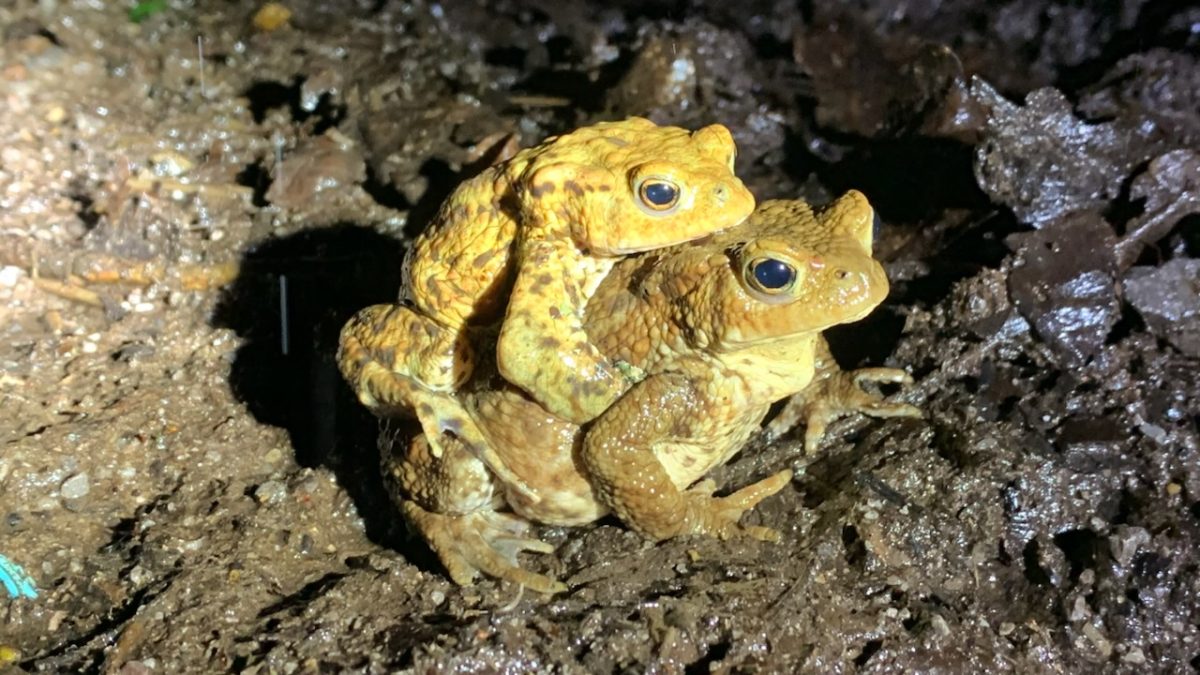
Friends of Abbots Pool, a medieval pond located in woodland near the expansion site, say the club’s plans to truck in over 300,000 tonnes of soil will be detrimental to local wildlife including a large population of toads, an at-risk species in the UK.
They say the soil dumping will kill toads in their burrows, while the pool is at serious risk of sediment and chemical pollution.
is needed now More than ever
Objections to the club’s application to North Somerset Council also focus on the damaging environmental impacts of transporting the soil which will amount to one HGV travelling along Weir Lane every seven minutes for the next two years.
The single-track road is overhung with vegetation which will require cutting back and passing ways will need widening to allow the trucks access.
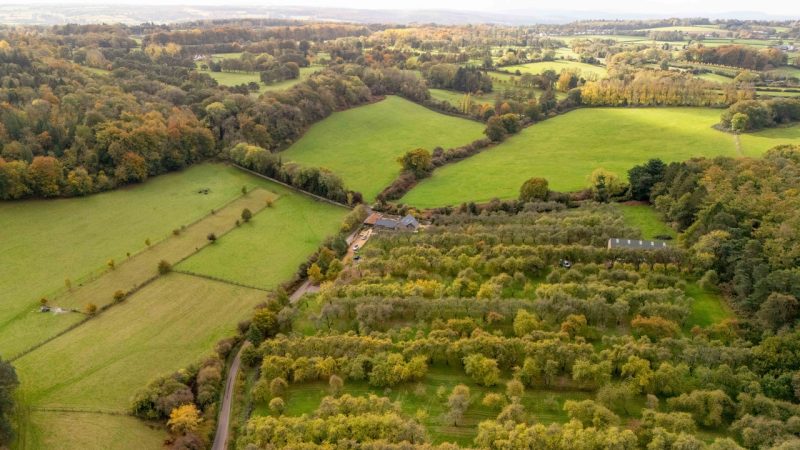
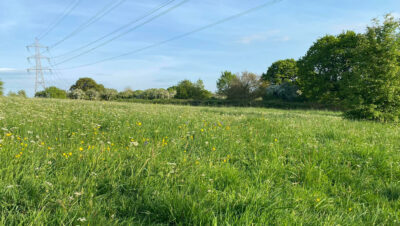
Bristol & Clifton Golf Club is one of several golf courses in the area including at Long Ashton and Ashton Court – photo: Tim Martin
The club says the new nine-hole ‘academy’ course is designed to encourage more young players and to cater for their ageing membership.
But its necessity has been contested on the grounds there are many other courses in the vicinity and some suggest the plan is predominantly a fundraising exercise, with the club standing to gain an estimated £1m for receiving the waste soil onto its land.
Tim Martin, who has helped to run the Abbots Pool wildlife group for more than 15 years, says the pool and surrounding woodland is “a really beautiful, wildlife rich site”.
“The club seems to have completely overlooked the impact on Abbots Pool,” he told Bristol24/7. “In heavy rain Manor Lane and Weirr Lane become rivers and the road runs straight down to Abbots Pool.
“Spreading bare soil, compacted by heavy machinery, with the steeper slopes of new features (means) there’s probably going to be at least ten times as much water running off those fields, and with that will come a lot of soil.”
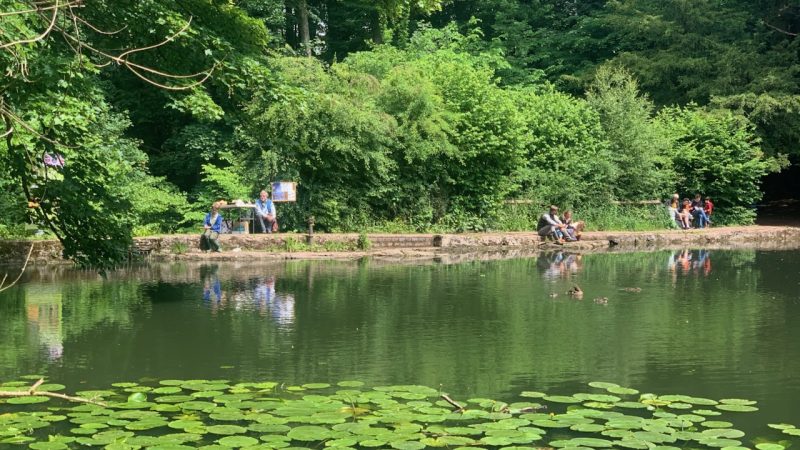
Abbots Leigh resident Tim Martin says Abbots Pool is a “beautiful, wildlife rich site” that is of great importance to the local community as well as the many that visit from central Bristol – photo: Tim Martin
Martin added: “Silt itself is a major pollutant. It chokes animals, blocks gills, smothers habitats…
“We don’t know where the soil that’s being trucked in has come from. It could be intensive farmland, former industry or urban development sites, who knows.
“And for a perfect putting green and playable fairways you need to implement a lot of herbicides, fungicides and pesticides. These will be constantly washing off the site for years to come. There’s a serious risk this is massively increasing the amount of chemical pollution in the valley.”
In response, Bristol & Clifton Golf Club general manager, Ian Veale, said: “Abbots Pool is 600 metres from the site and is not hydrologically connected.
“The works will be strictly controlled via permit, which ensures that all spoils used in the creation of the new academy course are clean.
“The allegations that contaminants will be delivered to the site is completely incorrect in that context.
“Furthermore, the development will reduce water runoff from the site through the implementation of a new drainage system.
“Currently no such system exists and that is why water leaves the site onto the road in times of heavy rainfall.
“Should any concerns be raised by the council’s ecologist looking at this, we will propose measures to mitigate.”
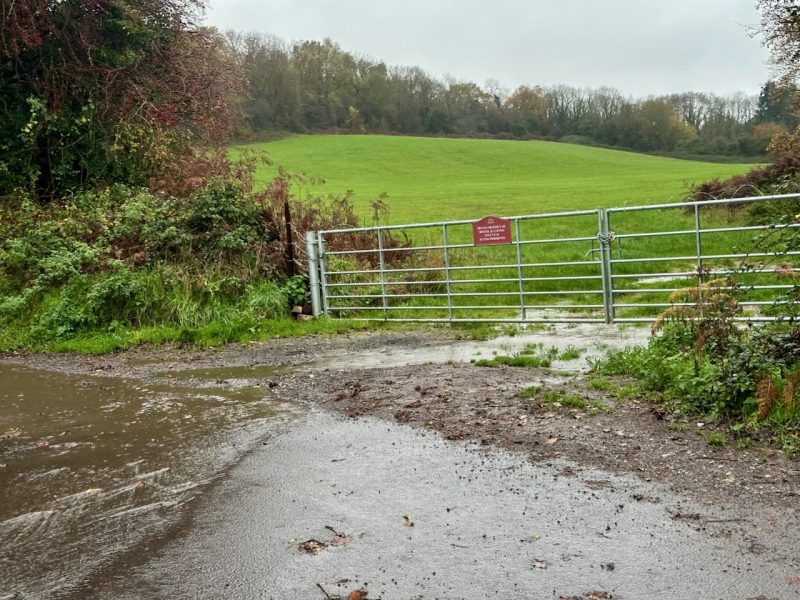
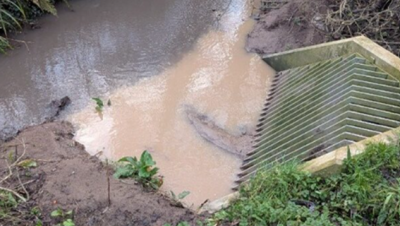
The Abbots Pool wildlife group are consulting independent professionals about the risk of soil run-off from the fields onto roads which already flood in heavy rains – photo: Tim Martin
Veale said the application lays out biodiversity improvements for the site. But independent analysis by environment consultants Abicron shows the plans will result in a 74 per cent decrease in the relevant habitat.
Their report states: “To achieve the mandatory requirement for at least a 10 per cent Biodiversity Net Gain it is recommended that design changes to reduce the proposed habitat loss of higher distinctiveness habitats and further habitat enhancement or creation is considered.”
Veale referred to the club’s intention to retain existing trees and hedgerows across the whole course, adding: “We have instructed our technical team to ensure that trees and hedgerows are protected during the works.
“After the earthworks are completed, if approved, significant new planting will…provide additional tree and hedgerow cover across the site to enhance its biodiversity value. This will ensure connectivity for wildlife remains, and the golfing operation here remains subservient to its ecological interest.”
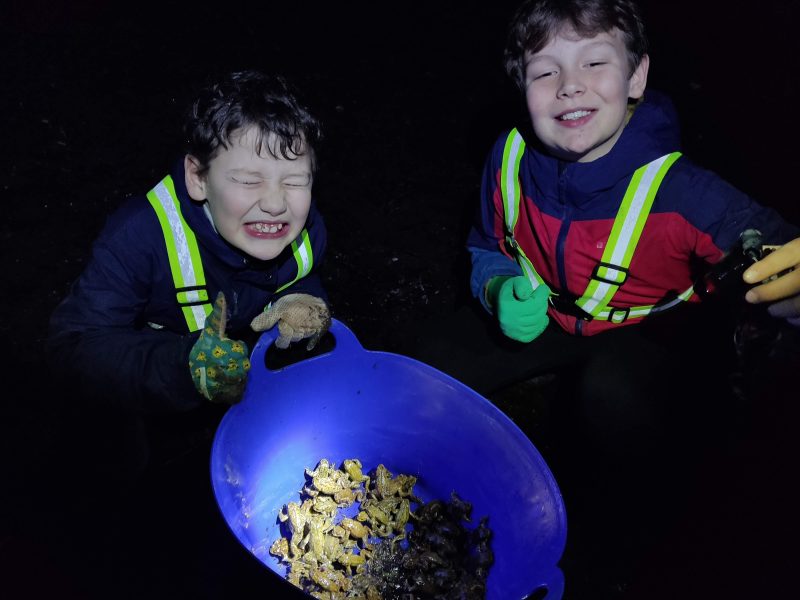
The wildlife group organise an annual Toad Patrol to assist toads from their homes in the fields to the pool to breed. The local toad population, numbering “well over 1000”, has thrived due to a lack of development in the area to date says Martin; damage caused by this new course will be “galling” for those that have volunteered to save them over the last 15 years – photo: Rachel Jefferson
Veale said development of three irrigation ponds “will attract insects, birds, and mammals… The ponds will reduce our reliance on abstracted water to irrigate the course which will be a more sustainable use of natural resources.”
Martin, who founded sustainable agriculture consultancy Farm Wilder and is also a wildlife filmmaker, questions the value of the ponds given their potential chemical contamination and fluctuating water levels as they are used to irrigate the site.
The wildlife group is calling for a sediment collecting basin with a reed bed filter to be a condition of the development. The basin would catch soil run-off, filter out chemicals and create a natural wetland habitat.
“Golf courses can be wildlife friendly,” said Martin, suggesting the site would be improved with more wildflower and orchid meadows. “I’d love to see Bristol and Clifton Golf Club say, how can we extend our course into this sensitive environmental area in a way that minimises negative impact and boosts biodiversity. But I’m just not seeing that in their plans.
“We’ve tried to speak with golf club representatives but they wouldn’t engage with us directly. The local wildlife group would love to work with them to make the course as wildlife-friendly as possible.”
The planning application is open for comments at planning.n-somerset.gov.uk/online-applications under ref 25/p/2595/ until January 29
Main photo: Tim Martin
Read next:
 Our newsletters emailed directly to you