News / East Bristol Liveable Neighbourhood
Priest claims church has lost 100 worshippers due to liveable neighbourhood
A church has lost 100 members of its congregation in one year – which its priest blames on the East Bristol Liveable Neighbourhood.
St Patrick’s Church in Redfield is one of the victims of the controversial traffic scheme with fewer worshippers now attending Sunday mass, “decimating community life”.
Supporters of the liveable neighbourhood say quieter streets are now much safer for children and people cycling, with speeding cars outside their homes now a thing of the past.
is needed now More than ever
Bristol City Council could soon face a legal challenge if the East Bristol Liveable Neighbourhood Trial is made permanent this summer after going live just under a year ago.
Bollards, planters and bus gates block drivers from driving through several roads in Barton Hill, Redfield and St George.
In January 2025, the church’s Sunday services were attended by 575 worshippers. In January 2026, there were 475.
The church on Dillon Court off Netham Road has lost a fifth of its income and 30 per cent fewer people are participating in community events.
Nearby St Patrick’s Catholic Primary School has also been oversubscribed every year since opening in 1933 – until now when almost every year group now has vacancies.
The reverend canon Gregory Grant said the wider church site used to have four entrances and exits but now has only one.
“They’ve created a Catholic ghetto here,” he said. “You cannot get out of it with any ease whatsoever. It has decimated our community life.
“They don’t want to spend more time in the car going to church than the services. We do feel second-class citizens.”
The broad parish reaches to Kingsway, Barton Hill and Brislington. Many parishioners have not stopped going to church but now go elsewhere instead including in Fishponds or Kingswood, as they say these places are easier to drive to.
Grant said removing the bus gate at the Avonvale Road end of Pile Marsh would improve access to the church, particularly from Church Road and further afield.
The parish priest added that Bristol City Council have “nailed their colours to the mast”.
“We all know how hard it is in our personal lives and professional lives to admit we were wrong.
“We just started a season of Lent, and one of the principal purposes is to reflect on what we do wrong and how we have to change.
“It’s not easy. It’s certainly not easy for the council to say ‘we made a big mistake here’.”
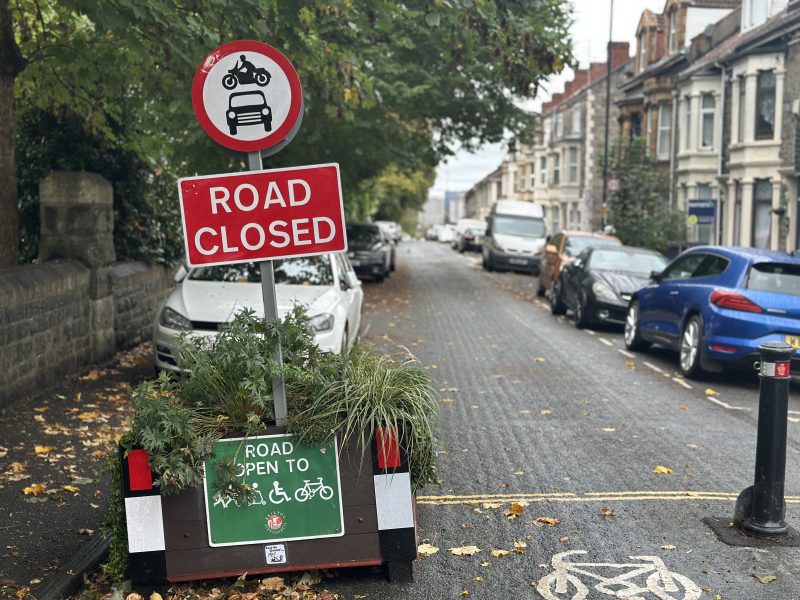
Councillors are due to decide whether to make the East Bristol Liveable Neighbourhood trial permanent in July – photo: Carla Wakfer
A funeral was held at the church on Wednesday and many mourners following the hearse got tickets after driving through a bus gate.
Denise Gaiger, the priest’s sister and self-described “general busybody”, said nuns living at adjacent retirement flats now have to drive a long circuitous route to get to Hamblins, a popular fish and chip shop on Avonvale Road in Barton Hill.
Asked why they don’t walk to the chippy, Gaiger said: “If you didn’t have polio as a child and were bedbound, you could walk it easily in ten minutes.
“Any of the nuns who are aged in their 70s, 80s or 90s, they can’t walk it.”
She added: “There’s always standing traffic right outside the school. Outside the four-year-olds’ classrooms is the worst traffic.
“We would like the same courtesy extended to this church as was extended to the mosque down the road.
“When they complained about a (modal filter), it was taken away immediately. It was stopping worshippers going, so they took it away.”
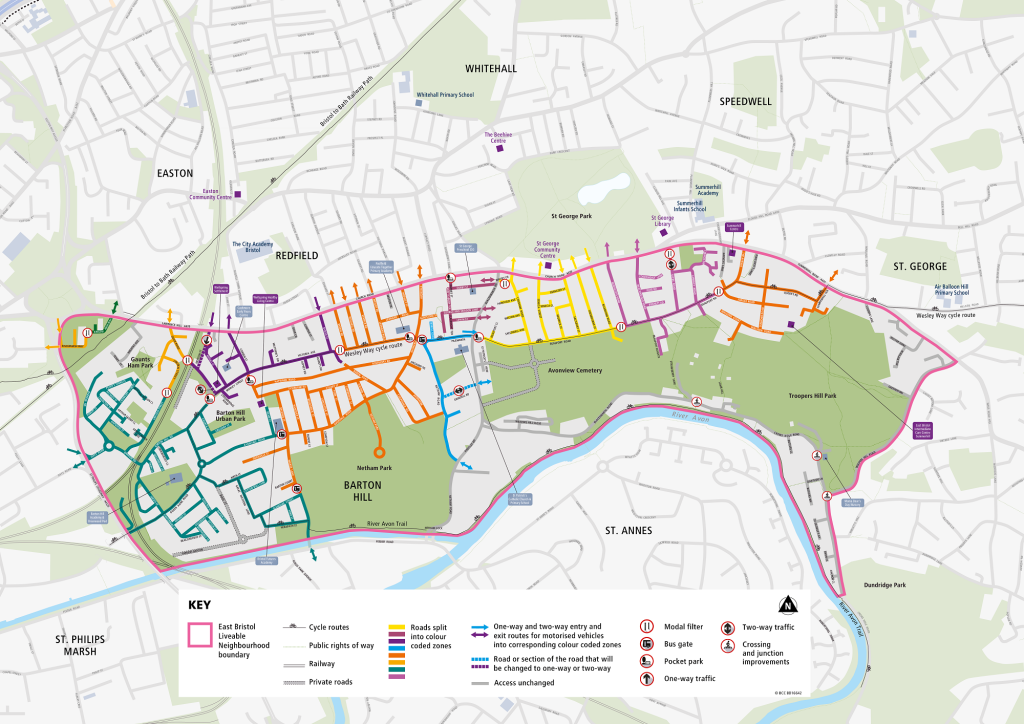
The East Bristol Liveable Neighbourhood encompasses areas of Barton Hill, Redfield and St George – image: Bristol City Council
For many, however, the East Bristol Liveable Neighbourhood scheme has had a positive impact.
Angharad Hughes lives on Beaconsfield Road in St George, has a disability and “loves” her car. She is too afraid to ride a bicycle and relies on her car to drive “quite a bit”.
However, since the liveable neighbourhood was rolled out, she has been walking more, including down to the shops on Church Road in Redfield.
Hughes has also welcomed the drop in traffic on her residential road.
“We used to experience people trying to cut the corner, racing up Beaconsfield (Road) and racing down Beaufort (Road). There was two-way traffic at high speed.
“It used to be a bit hairy with people mounting the pavement. It’s so much more peaceful, it feels much safer.”
Luke Hall who lives off Chalk Road is another supporter of the EBLN. Since the scheme was rolled out, he said cycling feels much safer, although recognises that some people have been impacted by the scheme and that should be considered.
“It’s much more pleasant, it’s much safer,” he said. “The anti sentiment is always quite loud but it doesn’t represent everyone.”
Councillors on the transport policy committee are due to decide whether to make the trial permanent in July.
If they do, opponents of the scheme are planning to legally challenge that decision on the grounds that the initial process was not followed in regards to disability law.
Main photo: Alex Seabrook
Read next:
 Our newsletters emailed directly to you