News / Transport
Motorway viaduct repairs to last six years and cost up to £450m
Major repairs to a motorway viaduct running through the middle of Bristol will last six years and cost up to £450m.
Drivers will face several years of disruption but National Highways is planning to keep two lanes of traffic open on the M32 in both directions while the Eastville viaduct is fixed.
Engineers will lift the entire bridge up to replace the bearings at the top of 130 concrete pillars, as well as install new noise barriers to protect residents living in nearby houses from the sound of traffic.
is needed now More than ever
However, during the work those residents will endure an “absolute racket” as contractors use hydrodemolition lances to blast off concrete off the bridge.
The nearest houses are about ten metres away from the side of the bridge which carries around 85,000 vehicles a day.
Construction work is now due to begin in 2029 and includes extensive repairs to concrete. The speed limit will be reduced to 30mph while the works take place.
Project manager, Will Miller, in charge of what will be biggest ever repair project carried out by National Highways in the South West, said the bridge “is in need of some TLC”.
Miller said: “The main skeleton of the structure is in pretty good condition still. But most visual aspects need to be repaired or replaced in some way.”
The team is working on a detailed design of the repairs, a phase which will run until the middle of 2027, and then National Highways will appoint a contractor in 2028.
Preparations are already taking place, with chalk marks visible underneath the bridge showing where engineers have used ultrasound to inspect some of the 3,500 steel cables criss-crossing inside the concrete.
Estimates for the cost of the project range between £300m and £450m. This has risen substantially since the last figure of £200m in 2023.
………………………………………..
This article is published as part of the BBC-funded Local Democracy Reporting Service. Another website in Bristol is making its readers pay for LDRS stories but at Bristol24/7 we will never have a paywall. If you want to support our independent journalism, please consider becoming a member from just £3 per month.
………………………………………..
If the motorway was completely closed, the repairs could be carried out in half the time and for less money too. But the impact on Bristol’s road network and wider economy would be devastating.
Miller added: “We want to keep the M32 open in both directions. It’s essential to us to keep Bristol city centre open for business.
“There’s traffic modelling being done at the moment, and that will identify any congestion hotspots and we’ll work with Bristol City Council to alleviate those as best we can.”
The four slip roads joining and coming off the M32 will close for some months, one at a time.
National Highways are discussing with Bristol City Council how best to manage the traffic impact of these closures but the main motorway will remain open because the central reservation will be removed, creating more space on the top deck.
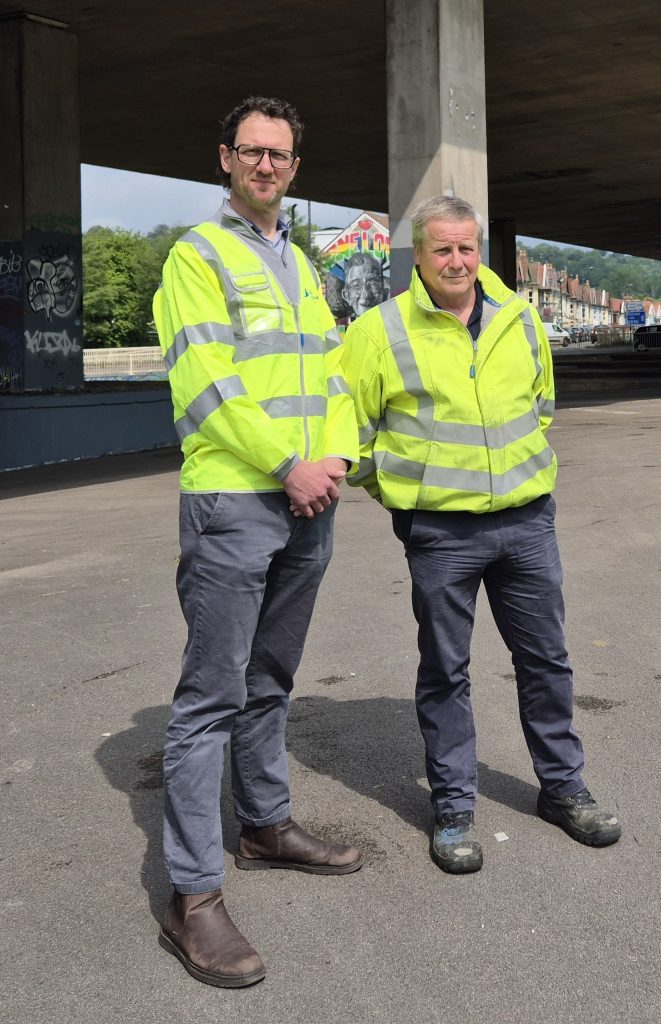
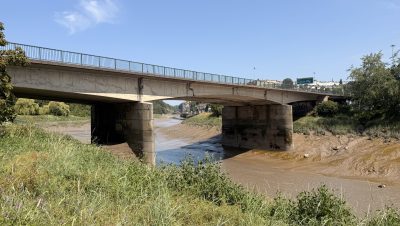
National Highways project manager Will Miller and engineering team manager Terry Robinson at the Eastville viaduct – photo: Alex Seabrook
Part of the reason the work is needed is because the engineers who designed the bridge in the 1970s did not have long-term maintenance in mind.
This means the drainage system which runs through underneath the road cannot be maintained and the concrete has been damp for many years.
Effects of this can be seen underneath the bridge, with exposed sections of steel cables.
Terry Robinson, engineering team manager, said: “We’re not dealing with just one structure here. It may look like one structure, but there’s actually six structures.
“There’s four retaining walls and five gantries that are all included in the package of work. A lot of the structure is hidden to us, and until we start stripping it back, we can’t see it.”
In April, there were a series of overnight closures on the M32, while a team from Switzerland used cutting-edge technology with ground-penetrating radar to inspect the condition of the bridge.
This should provide more information about the depth of cover to the reinforcement of the top of the viaduct, as well as how much salt has contaminated the deck.
Robinson warned that if the repairs do not take place, then the structure would continue to deteriorate.
This could leave the bridge getting weight restrictions or even being closed to traffic completely within the next ten to 20 years.
But with this huge investment, the bridge should last at least another half a century with funding that was only recently approved by the Department for Transport.
Demolishing the viaduct would unfortunately be out of the question.
Even disregarding the impact on Bristol’s traffic of severing the main artery by road into the city centre, the steel cables inside the concrete are under hundreds of tons of pressure, and houses are so close that demolition would be extremely dangerous.
In the longer term, the M32 could be reclassified as an A road.
A website about the project will launch in the next couple of weeks, with details of the upcoming works.
And an engagement van will communicate with local residents in the autumn, to give more information about what the plans are and how people in the area will be affected.
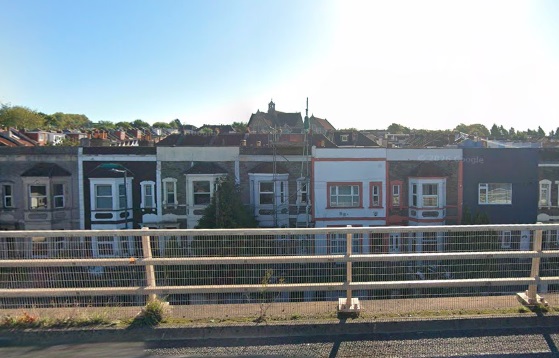
Some houses are only metres away from the motorway – photo: Google Street View
Main photo: Martin Booth
Read next:
 Our newsletters emailed directly to you