Theatre / preview
Ramesh Meyyappan and George Mann on making their boundary-breaking non-verbal show for Ad Infinitum
From Bristol’s multi-award-winning Ad Infinitum, Last Rites is a boundary-breaking non-verbal theatre show that tells the story of one man’s journey to honour his late father, and to bridge the communication divide that separated them in life.
Co-created by Ramesh Meyyappan, who also performs, and George Mann, who also directs the show, it’s designed to be accessible to d/Deaf and hearing audiences alike.
A blend of storytelling, movement and a heavy bass-led soundtrack that can be felt or heard, Last Rites also features creative captioning – an innovative mode of storytelling that also featured in Bristol Old Vic’s smash-hit production, Wonder Boy (2022 and 2024).
is needed now More than ever
Meyyappan and Mann explained to Bristol24/7 what drew them together creatively, and how working on the show has opened up new levels of understanding both for themselves and audiences:
Can you share some insights into your background as theatremakers and artists, and how your collaboration for this show originated?
RM: “I’m Ramesh. I’m a Singaporean Glasgow-based creative who has worked on physical and visual theatre for over 25 years. This is the first time I’ve worked with Ad Infinitum and the first time I’ve collaborated with the wonderful George Mann. This is an original idea – we started from scratch to create Last Rites, and it’s wonderful to be able to make something completely new. We’re both physical theatre performers and makers so that informed the style of the show, but it’s also informed by our own experiences, and we brought all of that together to make it.”
GM: “I’m George. I’m a theatre director, actor and deviser. I’ve run Ad Infinitum as co-artistic director for 18 years, and I’m also a freelance director on the side. Physically, my background is rooted in my Lecoq training and putting the body first; movement is a big part of what I do. It was amazing to finally collaborate with the incredible Ramesh and make a really physical, visual piece.
“The piece is based on some of our own experiences but it’s also a new piece of fiction. We largely connected on this concept of what it means to lose your parent, and then become one, because it’s something that’s happened quite recently in both our lives. Originally, the plan was to create a two-person show – but when I became a father, this wasn’t possible, so we switched to a director-performer format and created this one-man show that Ramesh performs.”
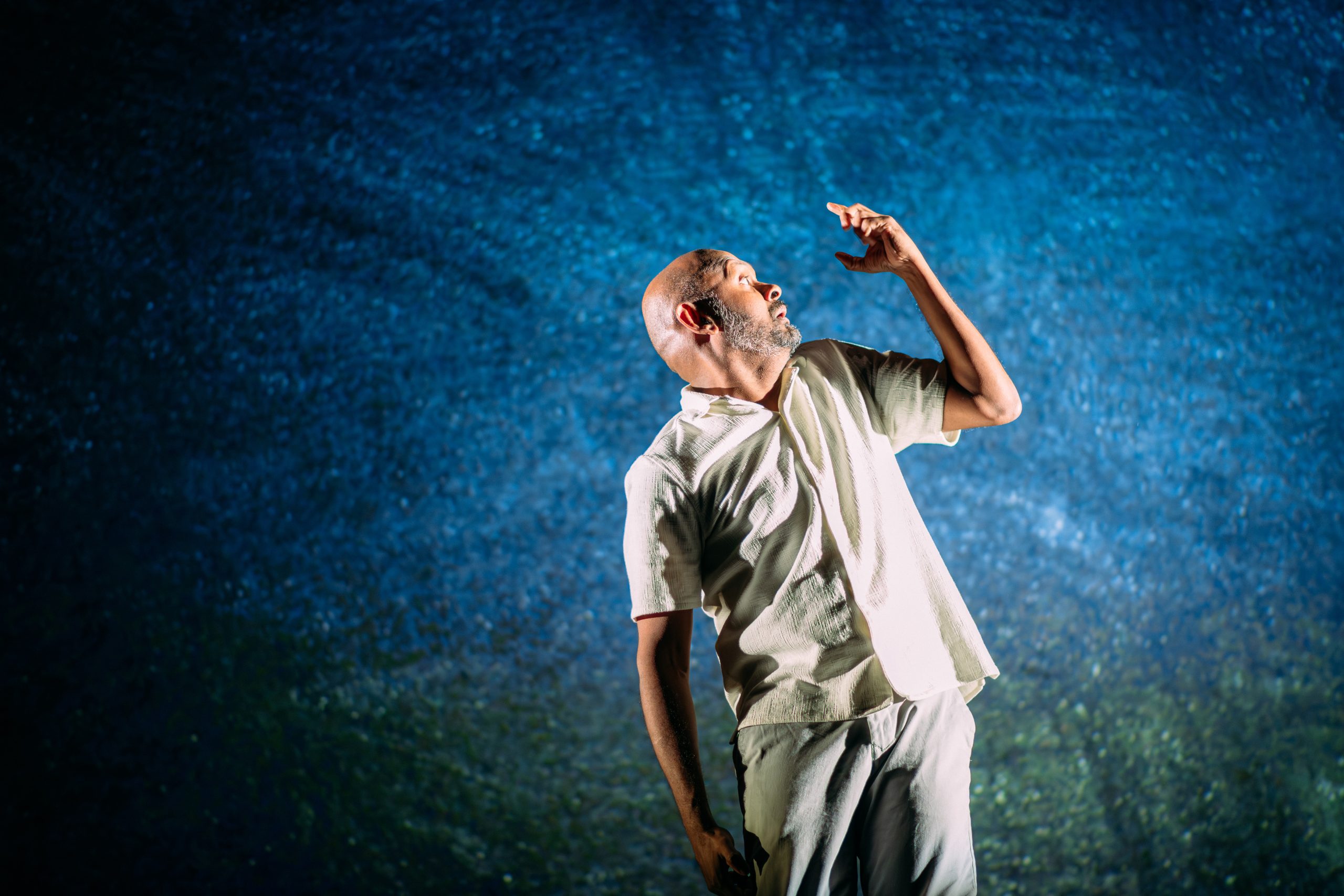
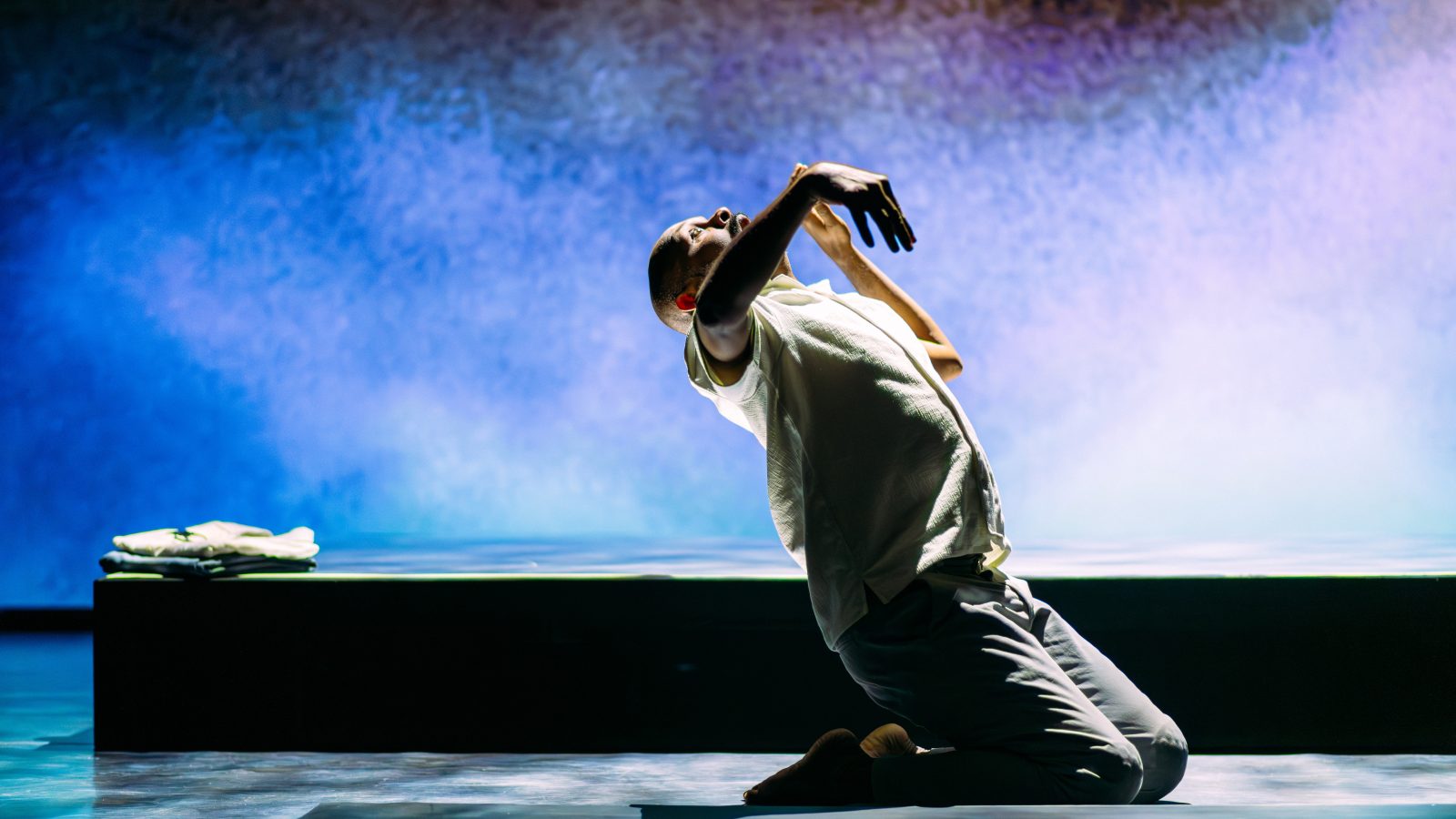
Performer Ramesh Meyyappan in a white shirt and grey trousers. Ramesh is stood up facing the left towards his left hand which is held in front of his face with curved fingers. The back wall is full of galaxy-like projections.
What excites you both most in creating a non-verbal solo production of this kind – particularly in terms of opening up audiences to a new understanding of the d/Deaf experience?
GM: “This is a universal story – most people will have or will at some point lose a parent, and many people will have a child (or children!). But you don’t often see this story through the eyes of a Deaf Asian man. So, it’s this new perspective on a universal theme.”
RM: “Initially, it was exciting to make a more Indian story and to think about what that should look like and how it should be – I have some Indian heritage, and some of the show is based on my family’s culture and beliefs. And then bringing the Deaf perspective into it is a whole new layer! There are so many elements in the show – we talk about the Hindu religion, we talk about sign language – and about what it means to have these different elements of your being. So I hope it opens the audiences up not just to the Deaf experience, but to loads of different elements.”
GM: “Collaborating with Rams was an amazing way to create a physical word that I wouldn’t have done by myself. We both make really physical work, but by merging our two approaches to physical storytelling, we found something new. In particular, I’ve never worked with video and projection before because I always felt that it made you feel like you were watching TV and lost some of the imagination that’s at the heart of what theatre is. So my challenge was, how do you incorporate that into the show without taking the imagination out? I’m confident that we managed to do that by creating projection that feels like another character onstage, and pushes everything further rather than losing anything. It was really challenging to make, and pushed us out of our comfort zone, but was so exciting as a result.”
While the main thrust of the narrative tells Arjun’s story, how important was it to you that the show also be seen through a more universal lens of family, mortality and grief?
GM: “Strictly speaking, I wasn’t going through the rehearsal process thinking about universal themes, but as a theatremaker you are always thinking about how you’re relating and connecting to your audience; how you reach out and touch them. Universal themes are how we relate to one another through those shared experiences, and most importantly, it’s where the humanity of the show is. It’s what makes it relatable and it makes a shared experience where you come into a space and you live it together.
“Especially when you’re looking at underrepresented characters and artists – showing that humanity is really important because there hasn’t been lots of that historically. I think the universality is really important to both of us, and it’s doubly important – to bring people together in one space where they can connect – in a time with so much conflict and separation.”
RM: “For me, another universal theme within the show is communication and communication breakdowns – across different cultures but also within families. It’s not unique to hearing parents and Deaf children – hearing fathers and hearing children still have communication breakdowns! For this story it’s doubly hard for our character Arjun because he and his father don’t have a shared common language, but it’s also about each of them trying to communicate what’s important to them – Arjun is trying to accept that his father is trying to communicate his religious beliefs, for example. The universal themes connect with the audience as they watch Arjun’s story.”
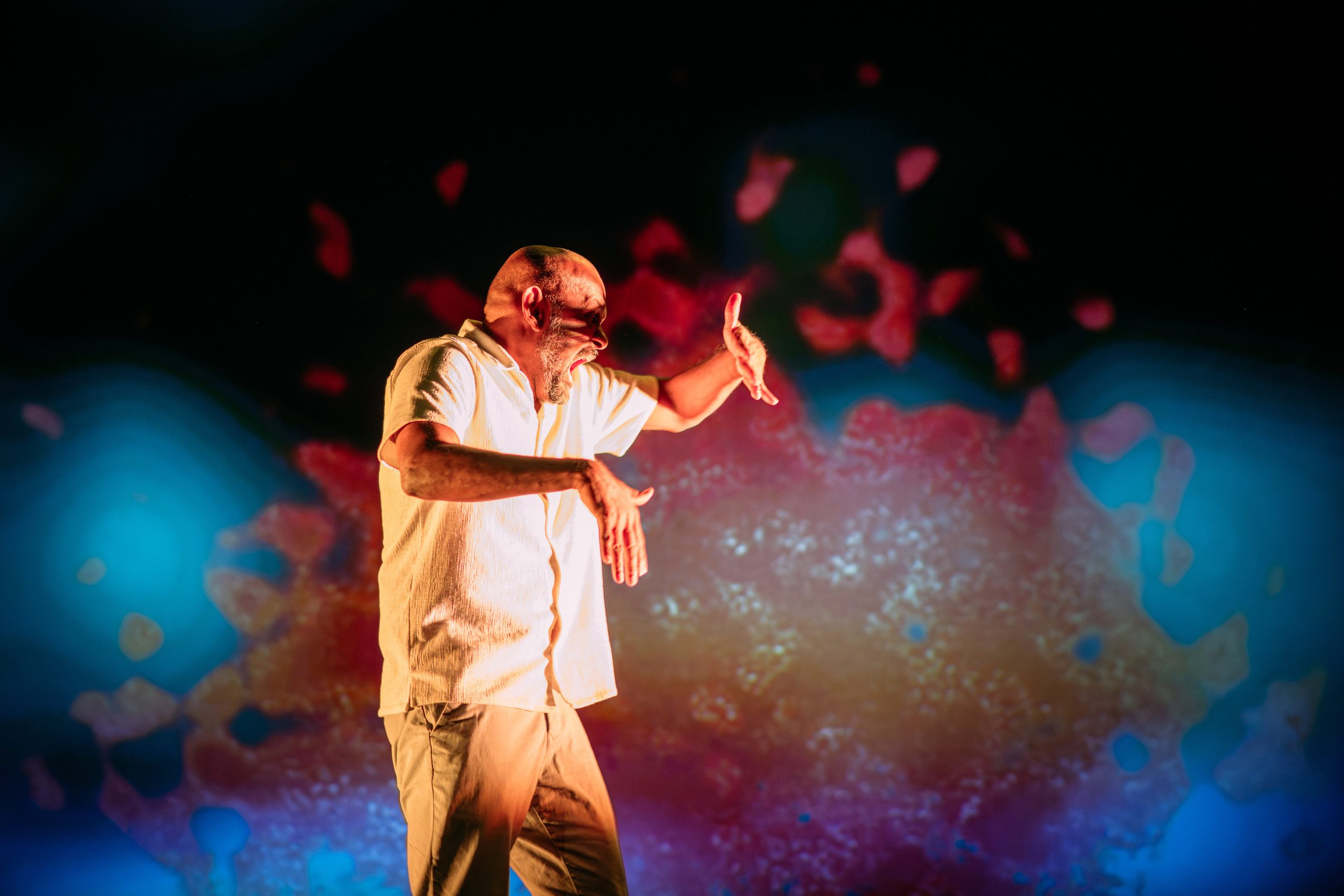
Performer Ramesh Meyyappan in a white shirt and grey trousers. Ramesh is stood up sideways with his left arm out blocking his eyes and his right arm out to the side with fingers pointing down. His mouth is wide open. The background is projected with a red and orange explosion.
How did you bring your own experiences of being, and losing, a father to the story?
GM: “In rehearsals, we ended up sharing quite a lot of our lives and realised that we had some similar experiences, for example when our fathers passed away. We were able to feed this into Arjun’s narrative, as well as his emotional journey.
“For me, I was in Canada on tour when I had a phone call to say my dad was in the last stages of his illness and that I needed to get home. I had a 30-hour journey from hell to get back to Lincolnshire as fast as I could, and arrived about eight hours before he died. My family was there, but we had some moments alone together. He was in and out of consciousness with some lucid moments, some dreaming moments, and it was a strangely beautiful experience.”
RM: “I was studying in Liverpool, and I was hoping my father might attend my graduation, but I got a message from my sister to say that my father was in a coma in hospital. So I chose to fly home to Singapore to see him. So many relatives were there, and I was pretty overwhelmed because I didn’t fully understand what was going on – most of my family don’t sign, so I didn’t really even understand his illness or why he was in a coma.
“My father and I were close; we had our clashes, but I also have some really lovely memories with him. And it was very hard to say goodbye because he wasn’t responsive. I just kept signing the word ‘father’ to him. After about a week, he opened his eyes and said ‘enough’, and soon after that he died. I would have loved more time with him but I was so relieved that he saw me, that we made eye contact and he knew I was there.”
GM: “I remember Ramesh and me sharing these memories in the rehearsal room and realising how many similarities there were – it was quite uncanny, and felt serendipitous. It formed a backbone for this fictional story that we wanted to create, but it also meant that we were really connecting and we had a shared understanding of how to approach the themes with sensitivity. It made the process – not easier exactly, but it gave a fluidity to the process that might not have otherwise been there.”
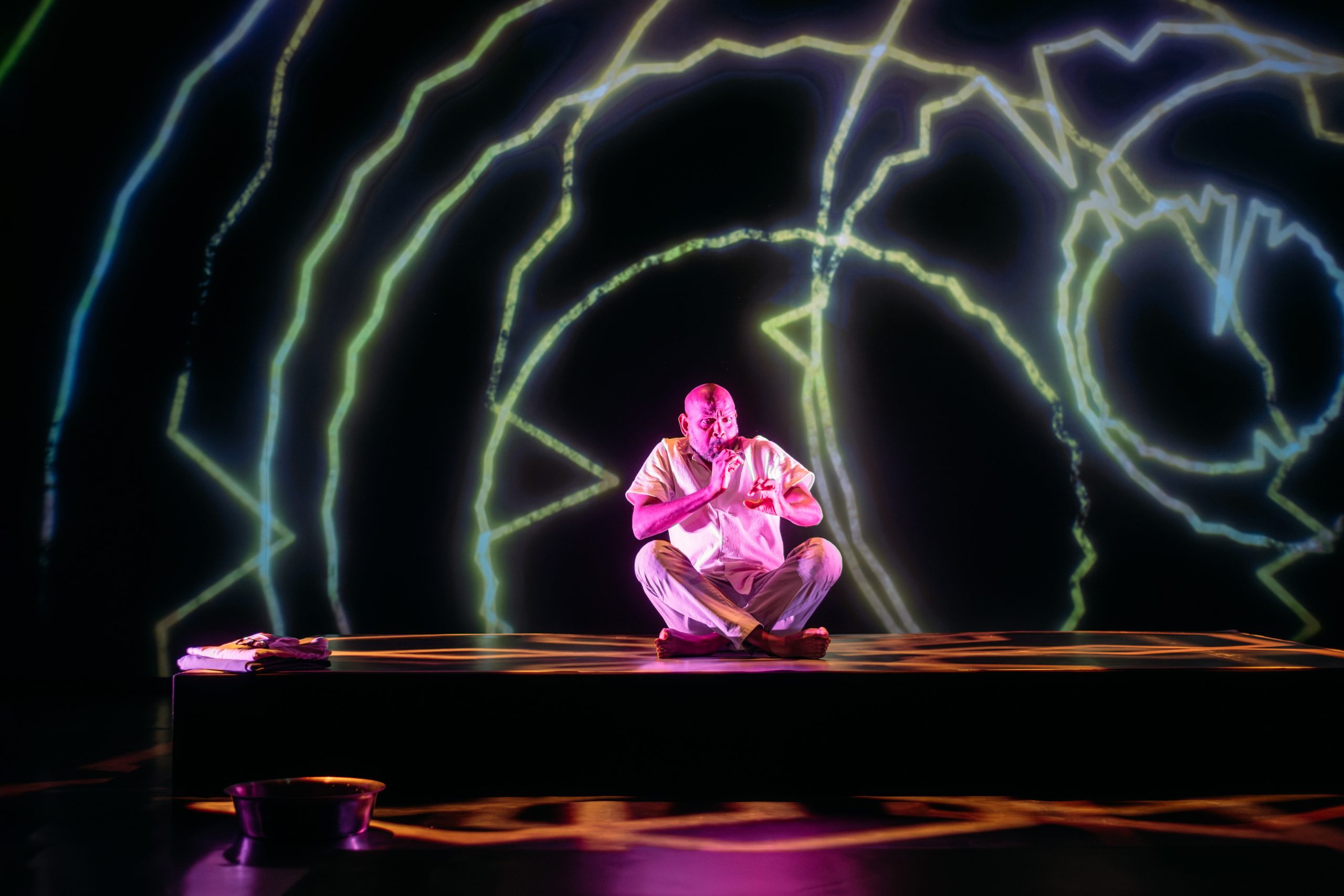
Performer Ramesh Meyyappan in a white shirt and grey trousers. Ramesh is sitting facing forward, crossed leg on platform with his hands creating two circles in front of his mouth and his lips are pursed. On the right edge of the platform are folded clothes and on the floor in front is a silver bowl. The back wall and floor has projections of various yellow and white circle outlines with jagged, wavy lines.
To what extent have you been surprised by people’s responses to Last Rites?
RM: “When we premiered the show at MimeLondon in 2024, a lot of audiences were surprised by the projection and the use of creative captions. They just hadn’t thought about how the sign language would be translated into written English, and they didn’t think it would be so imaginative and be part of the show. They were blown away. So that was great to see!”
GM: “Yes – in general, audiences have been surprised by how much they enjoyed it, particularly hearing audiences. I think it shows the power of creating new, original work. There’s an aversion to risk in theatre at the moment – venues program the same shows, plays that we’ve seen a million times, rehashed over and over again, and I’m personally very sick of it! What you don’t see a lot is celebrated brand new work. So what’s lovely is to see the audience react so positively to the show – we’ve been really struck by the reaction, and I’m hopeful that venues will see this, and be brave enough to program more new work. You get a lot of out seeing something brand new!”
RM: “Yes, audiences don’t want to see the same stuff, the familiar stuff. Brave and bold programming and creating is so important. Also, the fact that we’ve chosen the theme of death, with a marginalised character, and a corpse onstage for a lot of the show (!) – all done as a one-man show with physical theatre – to get such a positive reaction from venues and audiences is amazing.!
GM: “It is so wonderful that we’ve been able to take this show to so many main house theatres, in really prestigious venues, across the country. We’re bringing it to Bristol Old Vic’s main stage which is a huge deal! It’s a real endorsement.”
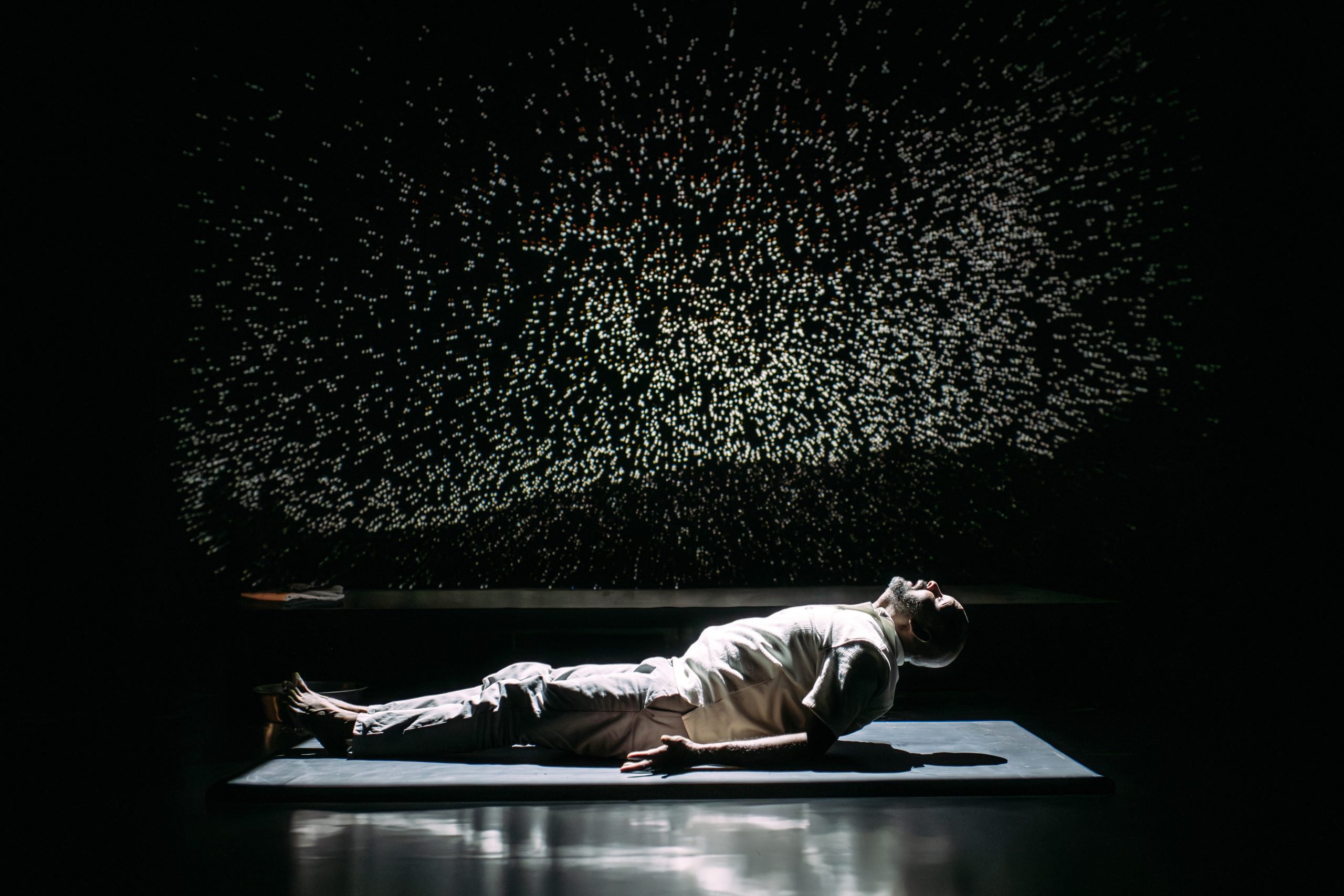
Performer Ramesh Meyyappan in a white shirt and grey trousers. Ramesh is lying on a black mat, with his head and torso lifted forwards and his legs on the floor. His left arm is beside him on the floor with fingers stretched out. The back wall is dark with thousands of tiny white lights projected.
Finally, if this show was a call to action, what would you want that call to be?
GM: “For hearing audiences I’d say: to think about allyship. Bring yourself closer to Deaf culture and sign language. In the show, you see the damage that a breakdown in communication does – if we think about that, and the privilege we have as a hearing hegemony on a societal level, it can help us to consider the steps we need to take to address this. It doesn’t have to be huge, but I believe we need to challenge ourselves to do something to change this historical inequity.”
RM: “On tour, we had audience members come up to us after the show and say that they wished they’d learnt sign language to communicate with a Deaf family member.”
GM: “Yes – the reality of the show, and what it’s saying, can hit people in very personal ways, and really make them think about their own choices. It’s amazing to see the impact it can have, and that message – to think about your own choices – is a powerful one.”
RM: “Also, I think we want audiences to appreciate the people in their life. You don’t know how long you have with the people around you – so you must value those you love. It doesn’t matter if you’ve had conflict; it doesn’t matter what your relationship is like or who you are. Reach out and connect.”
View this post on Instagram
Last Rites is at Bristol Old Vic on July 15-19 at 7.30pm. Tickets are available at www.bristololdvic.org.uk. Follow @theatreadinfinitum for updates and future shows from the company.
All photos: Mihaela Bodlovic
Read next:
 Our newsletters emailed directly to you