Film / Reviews
Selma
Selma (12A)
USA 2014 128 mins Dir: Ava DuVernay Starring: David Oyelowo, Carmen Ejogo, Tom Wilkinson, Alessandro Nivola, Giovanni Ribisi, Tim Roth, Dylan Baker
Much has been written about Ava DuVernay and David Oyelowo being snubbed by Oscar voters, so it’s interesting to compare and contrast awards frontrunner The Theory of Everything with Selma. Superficially, both seem like archetypal awards bait. But while Theory adopts the safe, conventional meat’n’potatoes ‘inspirational disability biopic’ approach, Selma takes more risks. It would be easy to churn out a Dr. Martin Luther King Jr film that works its way through all the historical bullet points, tugging at the heartstrings and presenting its subject as an unimpeachably noble, two-dimensional martyr. In her assured first big-budget movie, publicist-turned-director DuVernay takes the bold decision to ignore the “I have a dream” speech and her subject’s dramatic assassination to focus on a narrow period in the mid-sixties. King’s gift for oratory and leadership qualities are superbly embodied by David Oyelowo, but DuVernay is as much interested in backroom political chicanery and dissent within the civil rights movement as she is in those big set-pieces. Fans of House of Cards should feel right at home here.
It’s 1965 and black Americans have won the right to vote. Actually exercising that right is another matter entirely down in Alabama, where a campaign of intimidation keeps them off the electoral roll. With his Nobel Peace Prize in his back pocket, King decides to make this his next great campaign, recognising as he does that it’s about a great deal more than voting. Anyone who isn’t registered to vote cannot serve on a jury, which means that black folks continue to be judged exclusively by whites. In Washington, President Lyndon B. Johnson (Wilkinson) lends a sympathetic ear but tells King that he has other fish to fry and “the voting thing will have to wait”. That’s not good enough for this tactically astute, media savvy operator, who selects the city of Selma as the battleground – not least because the racist, hot-headed local sheriff and segregationist Governor George Wallace (Roth) are certain to be provoked by non-violent protest.
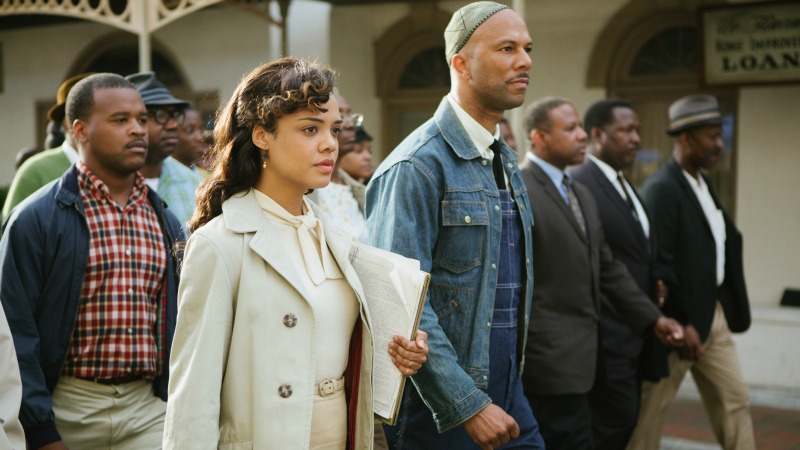
What emerges is a riveting game of brinksmanship between two shrewd political operators, as images are beamed around the world of brutal assaults on peaceful protestors marching from Selma to Montgomery across the Edmund Pettus Bridge. The complexity of the situation is reflected in King butting heads with local black activists who consider him to be a self-serving outsider and being criticised by his own supporters for pulling back from a final confrontation. Even the militant Malcolm X pitches up to stick his oar in. Additionally, King’s shaky marriage to Coretta (Carmen Ejogo) is exploited by a ruthless J. Edgar Hoover (Baker), who throws evidence of infidelities into the combustible mix.
Producer Oprah Winfrey gets a mercifully small and non-showy role as activist Annie Lee Cooper, but oddly enough, as in 12 Years a Slave, all the key parts in this quintessentially American drama are taken by Brits. Oyelowo is outstanding as the flawed King, perfectly capturing his distinctive preacher’s cadences; Wilkinson matches him as an embattled, outmanoeuvred Johnson; Roth makes a fabulously villainous Wallace (the governor referred to in Lynyrd Skynyrd’s Sweet Home Alabama, fact fans); and Carmen Ejogo does her best in one of those thankless ‘living in the shadow of an icon’ roles. DuVernay balances intimate moments with stirring firecracker scenes in a way that never feels manipulative, as these important ishoo films so often do, ending with a speech by King whose modern-day resonance requires no belabouring.
 Our newsletters emailed directly to you