Film / Reviews
Review: Embrace of the Serpent
Embrace of the Serpent (12A)
Colombia/Venezuela/Argentina 2015 122 mins Subtitles Dir: Ciro Guerra Cast: Nilbio Torres, Jan Bijvoet, Antonio Bolivar, Brionne Davis
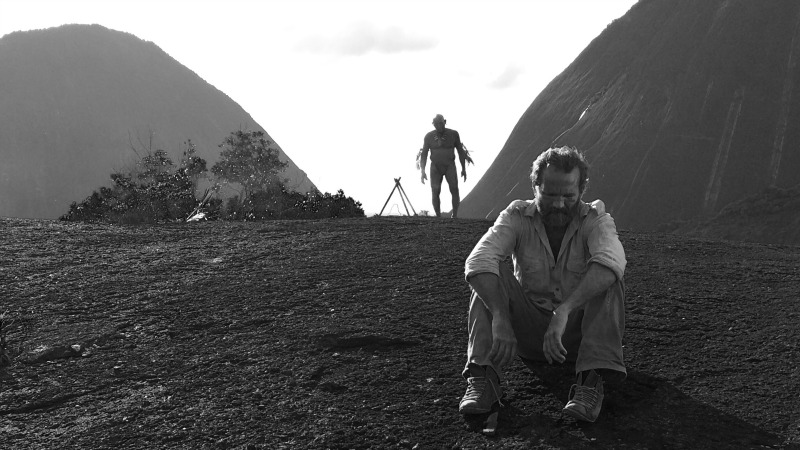
Oh great. Another ‘noble savage’ flick aimed at New Agey types with a yen for self-flagellating native people worship. Actually, while it would be remiss of me not to acknowledge that Embrace of the Serpent does contain elements of this ghastly cinematic tradition, with some particularly clunky last reel ‘scientific rationalism vs spiritual mumbo-jumbo’ exchanges, Colombian writer director Ciro Guerra’s gripping, handsomely photographed, Oscar-nominated monochrome period heart of darkness drama is, for the most part, more subtle and provocative than that, expertly meshing parallel storylines as it earns its place alongside Apocalypse Now, Herzog’s Aguirre, Wrath of God and, er, 2001: A Space Odyssey.
Based loosely on the journals of real-life early 20th century explorers Theodor Koch-Grunberg and Richard Evans Schultes, the big-value narrative offers two arrogant beardy white outsiders for the price of one. In 1909, or thereabouts, Theodor (Bijvoet) pitches up with his westernised native guide in the Colombian Amazon looking somewhat the worse for wear. He’s on the hunt for the sacred psychoactive yakruna plant, which has alleged miraculous healing properties, and seeks the help of local shaman Karamakate (Torres) in tracking it down. Despite possessing an impressively taut pair of buttocks – connoisseurs of the shapely male bottom will have a field day here – Karamakate seems rather glum, and it’s not hard to figure out why. Evidence of the human and environmental devastation wrought by colonialism is all around. Rapacious rubber barons disrespect the fragile jungle, while tribes have been enslaved and pushed to the margins by the forces of ‘civilisation’.
Nonetheless, Karamakate reluctantly agrees to assist Theodor on his quest. Obligingly blowing a huge cloud of marching powder up his snout to get him on his feet, the shaman insists on certain basic ground rules, such as ‘no meat or fish until the rains begin’ and ‘if a woman is found, no intercourse until the change of the moon’. Always a handy tip for any adventure, that one. Laden down with Theodor’s baggage of books, specimen boxes and a bloody great plate camera, the threesome sail off down the Amazon.
Some 30 years later, beardy number two, botanist Evan (Davis), comes paddling down river. The older Karamakate (Bolivar) is now bald-headed and pot-bellied with somewhat flabbier buttocks, but his grumpiness remains undiminished. This time he thaws a little more quickly: “You devote your life to plants? That’s the most reasonable thing I’ve heard a white man say.” It turns out that – ulp! – Theodor never returned, but Evan is clutching a copy of his book, which was published posthumously from a manuscript sent back to Europe by his aide. He too is on the trail of the mystical yakruna plant.
As the two journeys intertwine, Guerra makes much of the contrast between mystical tribal folks’ dream-guided animism and materialistic whitey’s determination to catalogue and explain. There’s no meeting of minds when it comes to religious worship, either. Karamakate enjoys chinwags with plants and rivers while he marvels at creation. Evan prefers to listen to Haydn’s The Creation – his Jungle Island Disc, if you will – on his handy portable phonograph (an obvious nod to Fitzcarraldo here). The clear implication is that the native fella in the loincloth is somehow more wise and in tune with the deeper truths of the universe than his supposedly advanced travelling companion, which will no doubt delight those who buy such guff. But the film also admits more complex ideas. When Theodor’s compass is stolen by a bunch of wily tribal nippers, he angrily demands it back on the grounds that knowledge of its workings would corrupt people who navigate by the stars. Karamakate interjects to observe tartly that he cannot forbid them to learn.
The film’s best sequences take place in a remote riverside Spanish mission. When Theodor’s party show up, they find it run by a deranged priest and populated with tribal boys who’ve been orphaned during the rubber wars. They’re all dressed in identical little white smocks, forbidden to speak their ‘pagan’ language, forced to sing hymns and subjected to regular holy beatings in familiar Catholic style. Karamakate cannot suppress his disgust. And who can blame him? If you must subscribe to supernatural fantasies, that nonsense about loaves and fishes can’t hold a candle to colourful, imaginative folklore in which plants arise from a shower of celestial semen. Anyhow, their visit ends rather badly. When Evan arrives with the older Karamakate many years later, the mission has degenerated to such an extent that it makes Colonel Kurtz’s compound look like a Butlins holiday camp
David Gallego’s lustrous monochrome widescreen cinematography is a wonder to behold on the big screen, and there’s plenty here for ethnologists and psychonauts as well as arthouse audiences – although one can’t help feeling that the distributors may have missed a trick by not inserting a William Castle-style ‘Drop your acid now!’ caption card 20 minutes before the big, bombastic mind-fuck climax. A word of warning to the backpacking trustafarian brigade: don’t bother going in search of the yakruna plant. It doesn’t exist.
 Our newsletters emailed directly to you