News / Advertising Feature
Tired of empty green promises? Try one you can plant
Almost every organisation says it cares about the environment now. Customers, employees and event-goers have heard the pledges so often that the language has started to lose its grip, and the regulators have noticed. The Green Claims Code, overseen by the Competition and Markets Authority, now expects businesses to back up the environmental claims they make rather than simply asserting them. The useful question, then, is no longer whether to be sustainable. It is how to show it in something people can see, touch and remember.
Grand net-zero strategies matter, but they are abstract. What tends to land with an audience is the small, concrete choice: the thing in someone’s hand that quietly proves the point. Stationery is an unglamorous but surprisingly powerful example. Print runs through almost every business and every celebration, from invitations and order forms to compliment slips, business cards and event badges, and most of it is designed to be thrown away within hours.
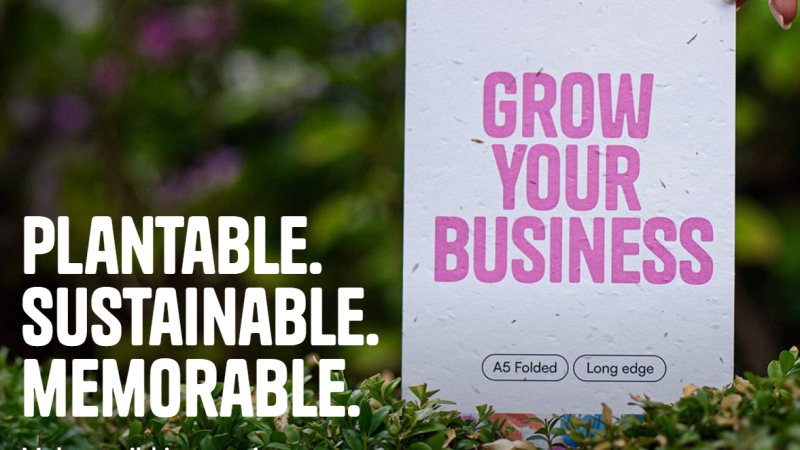
That is where plantable paper has carved out a niche. SeedPrint, a UK maker of plantable, fully recycled seed paper, presses native wildflower seeds into handmade recycled sheets so a printed item can be planted once it has done its job, biodegrading in the soil and growing into flowers. “Our aim is to show that being sustainable isn’t just about talking, it’s about doing,” says founder Tom Willday, a fourth-generation printer. “People are tired of empty promises about being green; this is the chance to actually do something.”
The mechanics are simple enough. Recycled paper is pulped, seeds are mixed in, and the result is formed into thick, tactile sheets that print like ordinary card but end their life as a meadow rather than landfill. Done well, it keeps materials in circulation, which is exactly the loop that resource bodies such as WRAP argue businesses should be designing for, and it gives a little back to the bees and other pollinators that wildflowers support.
There is a behavioural logic to this. People discount promises they cannot verify, but they trust things they can experience directly. A sheet of paper that visibly grows turns an abstract value into a small, memorable event, and that is far more persuasive than another line about commitment in a website footer. For a city well used to weighing up green claims, the difference between saying and doing is often just whether there is something real to point to.
For events and weddings the appeal is obvious: a save-the-date or favour that a guest plants is a keepsake, not a chore to recycle. For businesses, plantable cards, leaflets and packaging turn a routine marketing spend into a talking point that demonstrates values instead of declaring them. The trick is to treat it as part of a genuine approach rather than a token flourish. Seed paper sitting alongside single-use plastic everywhere else fools no one, and it is exactly the sort of inconsistency the Green Claims Code is designed to catch.
It pays to check the substance behind any “eco” product, too. Responsibly sourced, FSC-certified paper, low-impact inks, UK manufacturing to cut shipping miles and a supplier who can explain their process are the markers of something real. A tactile, well-made sheet that actually germinates is worth more than a glossy claim printed on stock that quietly is not recycled at all.
None of this replaces the bigger work of cutting energy use, waste and emissions. But sustainability fails when it stays abstract, and it sticks when people can hold it. A printed invitation that becomes a patch of wildflowers will not save the planet on its own. It will, though, do something most green messaging never manages: leave the person on the receiving end with proof, growing on a windowsill, that the intention was real.
Main image Seedprint.co.uk
 Our newsletters emailed directly to you