Your say / Nature
‘It’s vital the environment and culture sectors meaningfully include young people’
Young artists are using their creativity to open up conversations about climate justice, belonging and who our natural spaces are really for. Their work highlights how deep these issues run.
Rising Arts‘ community of young creatives are intersectional and multi-disciplinary. Yet one thing that has a massive impact on their personal wellbeing, as well as their ability to create, is having access to nature.
Supporting organisations like the National Trust, one recent example is an exploration by Rising artist Lindsay Allen of how accessible pathways in natural spaces limit access for wheelchair users in the wilder parts, and therefore their ability to immerse themselves in nature in the same way walking visitors can.
is needed now More than ever
Another collaborative project, by Ella Trudgeon and Sumaya Hassan-Murphy, examined how alienating the inherited language of past wealth-holders can be on global majority visitors today, and how the formal aspects of managed gardens can make newcomers feel as though there are unknown rules to follow.
As the Government announces new National Forests, it’s vital that the environmental and cultural sectors consider how young people can be meaningfully included in shaping these landscapes.
Our work proves that artists are uniquely placed to reimagine these regenerative futures and many young creatives in our community are already leading the way.
Feelings of belonging and safety came up again in our recent work developing a Climate Justice Action Plan with support from the Bristol Climate and Nature Partnership: not just the how of getting to nature spaces, but what it feels like when you’re there.
If you have not grown up with abundant access to nature or feel permission to climb trees, touch grass or just be in these spaces, it can be harder to navigate.
In our work with the Eden Project in 2022, we commissioned Rising artists to interpret the themes of Alexandra Daisy Ginsberg’s Pollinator Pathmaker and invite people into city farm spaces through creative interventions, a clay-making workshop and an interactive dance.
Building community through creativity and play in natural spaces enables people who may never visit the Eden Project to engage with its conservation work in new ways.
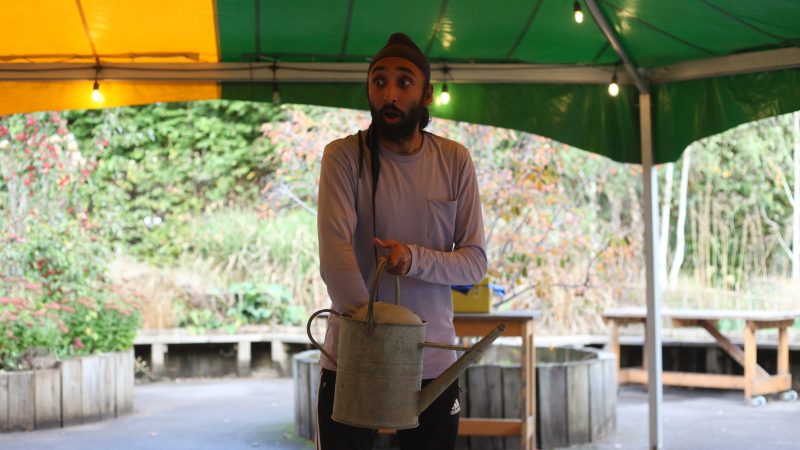
As part of Pollinator Pathmaker, Deepraj Singh invited the audience at Windmill Hill City Farm to help him build a garden using movement alone. Creativity can help people engage with the natural world in a different way says Jess Bunyan – photo: Mercedes Polo Portillo
Creativity has a unique ability to create equity for people in these natural spaces and give them mechanisms to engage differently. Through our work on the Harbour Placeshaping strategy in 2024 a cohort of storytellers engaged their own communities with the future of the harbour and what it meant and could mean for them.
This included guided photography walks with those of South and South East Asian descent who highlighted the importance of connection to water in their culture.
It also included trans people who are pioneering rewilding work around our city and a creative interpretation in flags that could be on display around the harbour to highlight spaces of safety and acknowledgement of this community’s work.
Bristol is known for its creativity and being a progressive climate advocate: it makes sense that those two things would work in harmony.
Interpreting some of the hard data around the climate crisis is also a space where artists can have a massive impact.
As COP30 comes to a close in Brazil, we can look back at a project from COP26 where we commissioned Emmanuella Blake Morsi to create posters responding to research by the Cabot Institute for the Environment, representing this data in beautiful and emotive ways on the streets of Bristol while the scientists presented their findings in Glasgow.
As we start to think of new ways to support our community’s access to nature, we are looking to our practices of reflection and care.
Nature retreats have long been a resource of great healing for many people, but prices can often be inaccessible for the people we work with. With support from the former mental health festival Freedom of Mind, Rising is designing its own nature retreats specifically by and for young creatives to connect with nature more deeply and reinterpret their work in and with connection to natural spaces.
We are lucky to live in a city that celebrates nature and it’s vital that young people and creativity are at the forefront of how those natural spaces are used, accessed and cared for today and tomorrow.
Jess Bunyan is the co-director of Rising Arts, an agency led by underrepresented young people that works to confront and find solutions to existing inequality within the creative industries.
Main image: Olumedia
Read next:
 Our newsletters emailed directly to you