News / community spaces
‘There are so many spaces over time that have been lost – it’s a crisis’
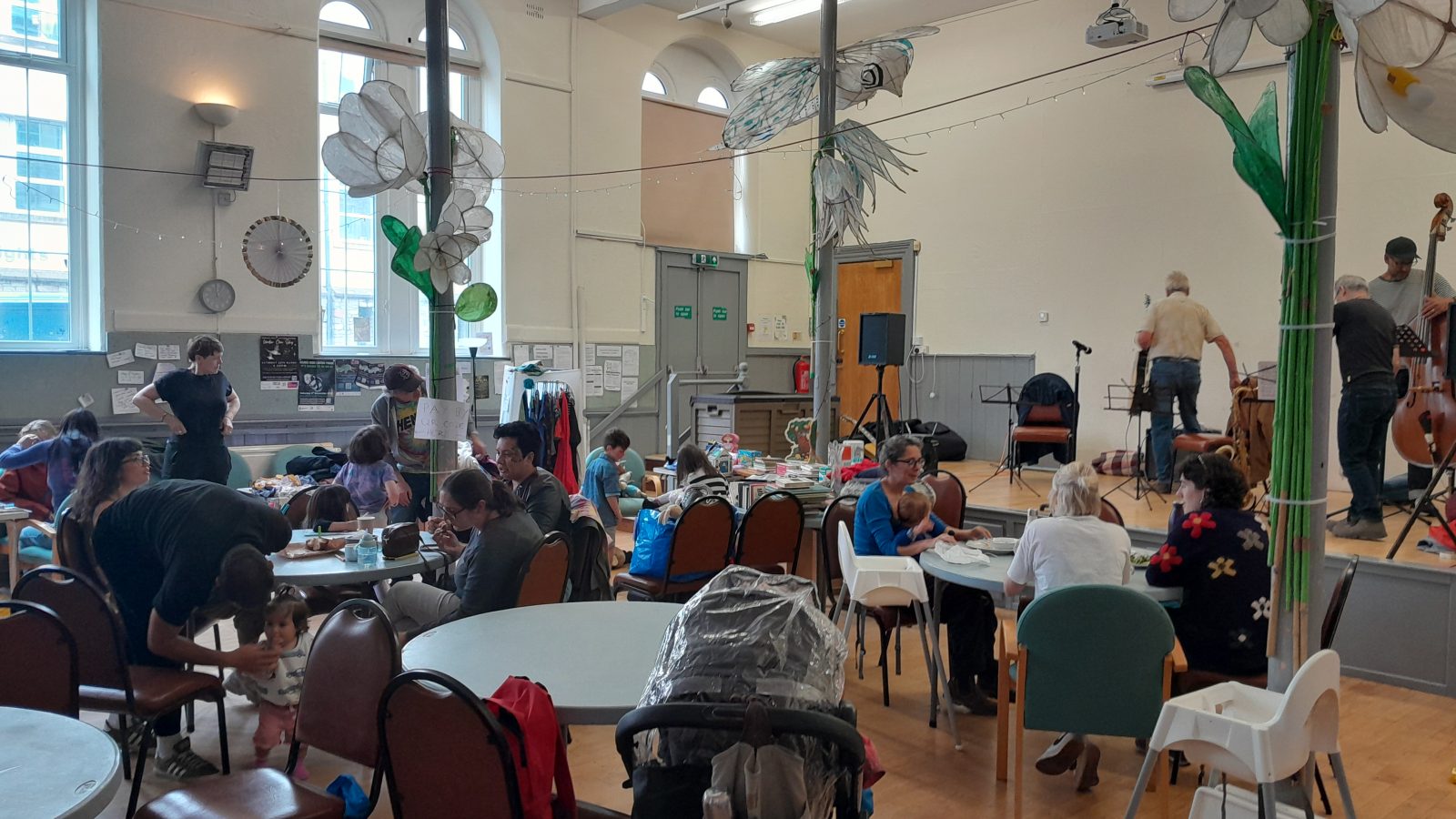
On a wet and windy Saturday in St George, the former Bethesda Methodist Church-owned Old Sunday School building on Church Road (also known as The Spark Space) was a hive of activity.
There were cakes, tea and hot food on sale, children having their faces painted, Lego strewn around, and a steady stream of people popping in, picking up leaflets to find out what’s going on and having a chat.
For the people behind the Bristol Commons project, these moments of community-building are at the heart of what they do.
is needed now More than ever
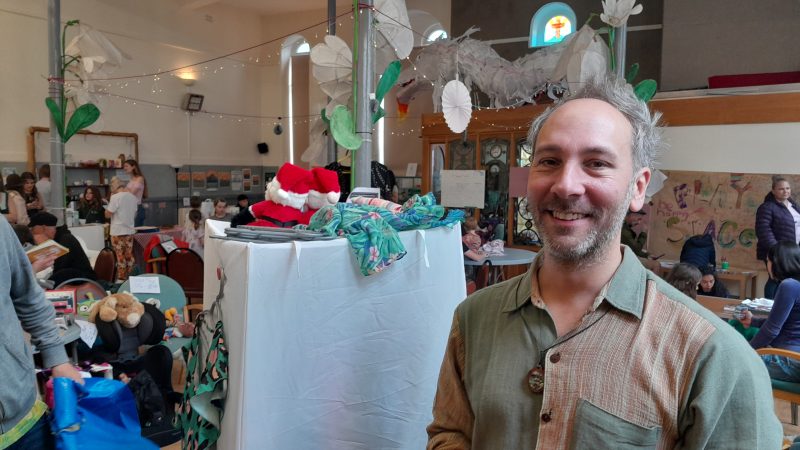
Danny Balla from Coexist said councillors had been supportive of the community ownership idea – photo: Kiran Dhami
The church site was reopened as a community space in March 2024 after its congregation dwindled. But when the Bristol and South Gloucestershire Methodist Circuit, who own the building, decided the time had come to sell, alarm bells rang. Another community asset that campaigners feared could be at risk of falling into the hands of developers.
That’s when Coexist stepped in.
Coexist is a Charitable Community Benefit Society that launched the Bristol Commons in March 2023. The project is built around the idea of nurturing relationships, networks and systems of governance that prioritise community and quality of life over short-term, individual gain.
Bringing assets into shared community ownership is part of that. The concept draws on a long history, where ‘the commons’ were once spaces where communities managed land and resources collectively, making decisions together for the benefit of everyone.
For Coexist, the challenge is to revive that culture in a modern city where privatisation has steadily eroded the spaces that people once shared.
Coexist had already been using the building on Church Road for Bristol Commons’ meetings and are part of the community that has grown around it. When it became clear the building was going to be sold, the church invited them into the early conversations.
“Everybody who didn’t know about the commons suddenly got to learn about it and became passionate about the idea – wanting this to be the first asset we bring into the commons,” said Danny Balla, who is at the forefront of the campaign to bring the building into community ownership.
“We were invited to work with the existing group of studio holders, space users and residents, and we collectively pitched our proposal to the church. They liked it, and that’s why we’re in the situation we’re in now.”
Coexist has experience in this area. They ran Hamilton House, the beloved Stokes Croft community hub, for a decade before they were evicted in 2018. The experience left its mark.
Balla continued: “Hamilton House is now five, six times as expensive as it was when we ran it. Half the building is dead and empty, and they’re still trying to turn part of it into flats
“We’ve lost All Hallows Hall in Eastton. Fantastic that it went to the Kurdish community, but it’s still a community space that was lost. Brunswick Club in St Jude’s. The motorcycle showrooms. So many spaces over the years, more and more being privatised. We’re in a crisis.”
This is not the first time that residents in St. George have fought to hold onto a community space. The campaign to save the Redfield Cinema, on the same road, galvanised the neighbourhood, but ultimately failed. For many involved in this campaign, the memory is fresh. This time, they want a different outcome.
For Balla, the stakes are straightforward.
“We need places to be together – for kids to run around, to listen to people in the community play music, to put on shows, to watch films, to just have a good quality of life.
“It doesn’t cost a fortune. And it doesn’t have to mean the money going to a corporate entity, a landlord or up to shareholders.”
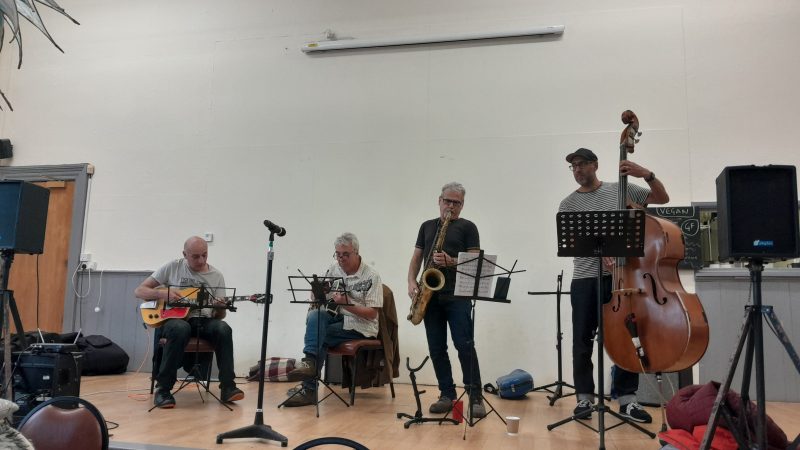
The Brillos Quartet provided some musical entertainment at the Open Day community event in St George in June – photo: Kiran Dhami
The plan is to buy the building outright through a community share offer, bringing it permanently into common ownership. From late July to the end of October, the target is to raise £250,000 through offering people in the community shares.
Contributing financially opens the door to what Coexist calls ‘community stewardship’, meaning that, if they want, shareholders then have the opportunity to get involved in how the space is run and how any surplus is reinvested.
Shares are £1 each, with a minimum investment of £50 for those living within half a mile of the building, and £100 for those further afield. Crucially, no matter how many shares you buy, it’s one person, one vote.
There will also be pay-it-forward shares, allowing people to fund a share for someone who couldn’t afford one otherwise. It follows a model that has worked elsewhere in Bristol, such as the Exchange on Old Market, Jamaica Street Studios overlooking Turbo Island and the People’s Republic of Stokes Croft.
“Based on other share offers we’ve studied,” said Balla, “Three months is a really good amount of time for this amount of money. And all the projects I’ve looked at – not just in the UK but across Europe – that have succeeded, have had the attitude of when – not if – we’re successful, when – not if – we buy the building. It’s that mindset that does it.”
But if the target isn’t met?
“We go back to the church and renegotiate,” said Balla.
The campaign has also applied for Community Infrastructure Levy (CIL) funding from Bristol City Council, a decision they’re still waiting on.
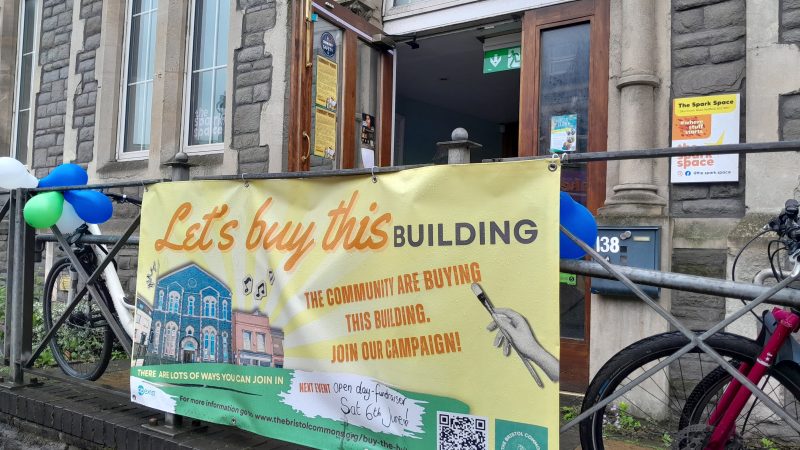
Despite the heavy rain, the event at The Spark Space attracted a steady stream of local residents – photo: Kiran Dhami
The church, for its part, has been supportive, giving the campaign until November to complete the purchase.
The fundraising open day on June 6 was part of the groundwork. It was an opportunity for the community to get together and find out more about the community ownership plan.
And the community, it seems, is ready – some, perhaps, more intentionally than others. St George resident Steph Rivers, was passing the space with her child when something caught her eye.
“I was just walking past and saw they had cake, so that’s why I’m here!” she laughed.
Residents of the area, Dan and Alice Bone, were enjoying the event with their two young children.
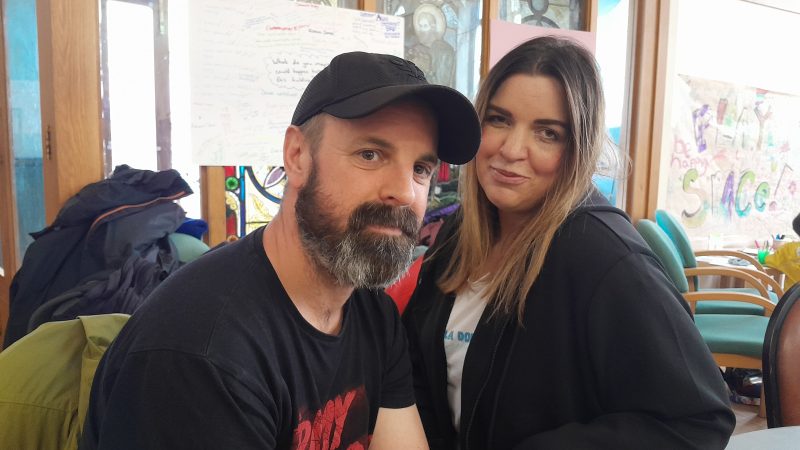
Dan and Alice Bone, who have two young children, have lived in St George for twelve years, up near Air Balloon School – photo: Kiran Dhami
“Up there, there isn’t much going on. And now, with The Orchard recently announcing its closure, there’ll be even less family-friendly places to congregate,” said Alice. “Now we know about this space, we’ll definitely come back.”
“It feels very wholesome, doesn’t it?” added Dan. “I can grab a coffee and chill out while the kids run around and play.”
Christos Paschalidis is moving to St George from St Paul’s in a month. He has already been once before, with his partner and children.
“I like the idea behind the space, that they want it to be owned collectively,” he said. “I want to support that.”
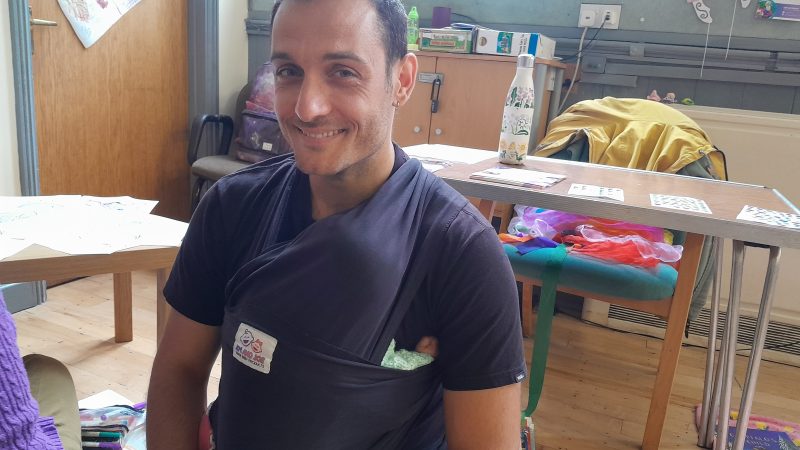
Christos Paschalidis was happy to support the event and the idea of community ownership – photo: Kiran Dhami
When asked about how the space differs from more commercial enterprises, he said: “I feel more amongst people here – how can I say? Amongst the community.”
Izzi Coleman has been coming for a while: to a women’s circle, Friday pilates and a Palestine fundraiser. Her child Elliot, 14, has done drama clubs here.
“We hate the thought of it being taken over and developed,” said Izzi. “It’s such an important part of the community. We want it to be a real hub.”
Elliot said: “It’s really nice to be able to meet other kids here, play, do different activities. It’s just nice to see the people in the community where you live.”
Lara Luna Bartlett shared another perspective. As a parent living in a shared rental, she is clear-eyed about the pressures that define life in the south west of England right now.
“There’s this pressure to stake a claim, get on the property ladder, make your space,” she said. “And when it does happen for someone you know, going to their fancy houses just makes you feel inadequate. Why would I want to be part of that?”
She continued: “But a space like this – a shared space, a community-owned space – you come here and you feel good. I don’t think there’s enough of that.”
The Bristol Commons is built on that feeling. Its governance model, based on sociocracy, uses a system of shared decision-making based on consent rather than consensus. It is designed to keep the process collective, participatory, and vigilant against the professionalisation that can hollow out community projects over time.
When members meet, they share food and find ways to support each other, practicing, as Balla puts it, “a culture of reciprocity.”
“If we can meet more of our needs collectively and through commoning “there’s less need for professionalisation,” added Balla.
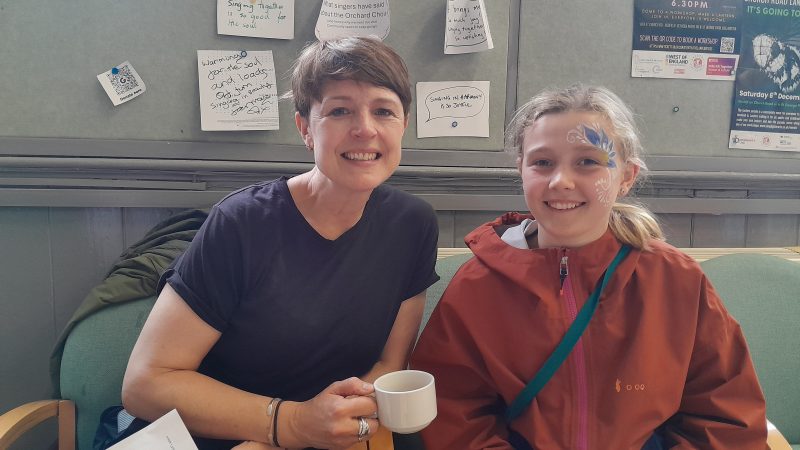
Izzi and Elliot Coleman were enthusiastic about the space and had been to events in the past – photo: Kiran Dhami
But Balla is candid about one of the project’s ongoing challenges.
“A lot of these forward-thinking movements can be characterised by predominantly white, middle-class people with spare time or capital, and that’s also true here,” he said. “But we’ve done a lot to cultivate relationships with diverse groups of people.”
Where funding has allowed, Coexist has paid stipends and prioritised those payments towards people who needed them most.
For Balla, bringing assets like The Spark Space into the commons is itself part of the answer, generating the surplus that makes broader, more inclusive participation financially sustainable.
He said: “We need the experience of working together collectively and to remember what that feels like and to get the benefits from that. We need community wins rather than community losses, so we can build up that sense of identity again. This is our community, we actually have control over our future here.
“If anybody is interested in getting involved, I just say: let’s be part of a success story.”
More information on the share offer launch starting at the end of July is available at: www.thebristolcommons.org/community-share-offer/
Kiran Dhami is reporting on St George as part of Bristol24/7’s Community Reporters programme, aiming to amplify marginalised voices and communities often overlooked by mainstream media. This initiative is funded by our public, Better Business members and a grant from the Nisbets Trust.
Main photo: Kiran Dhami
Read next:
 Our newsletters emailed directly to you