Features / protest
‘I don’t want to be famous’
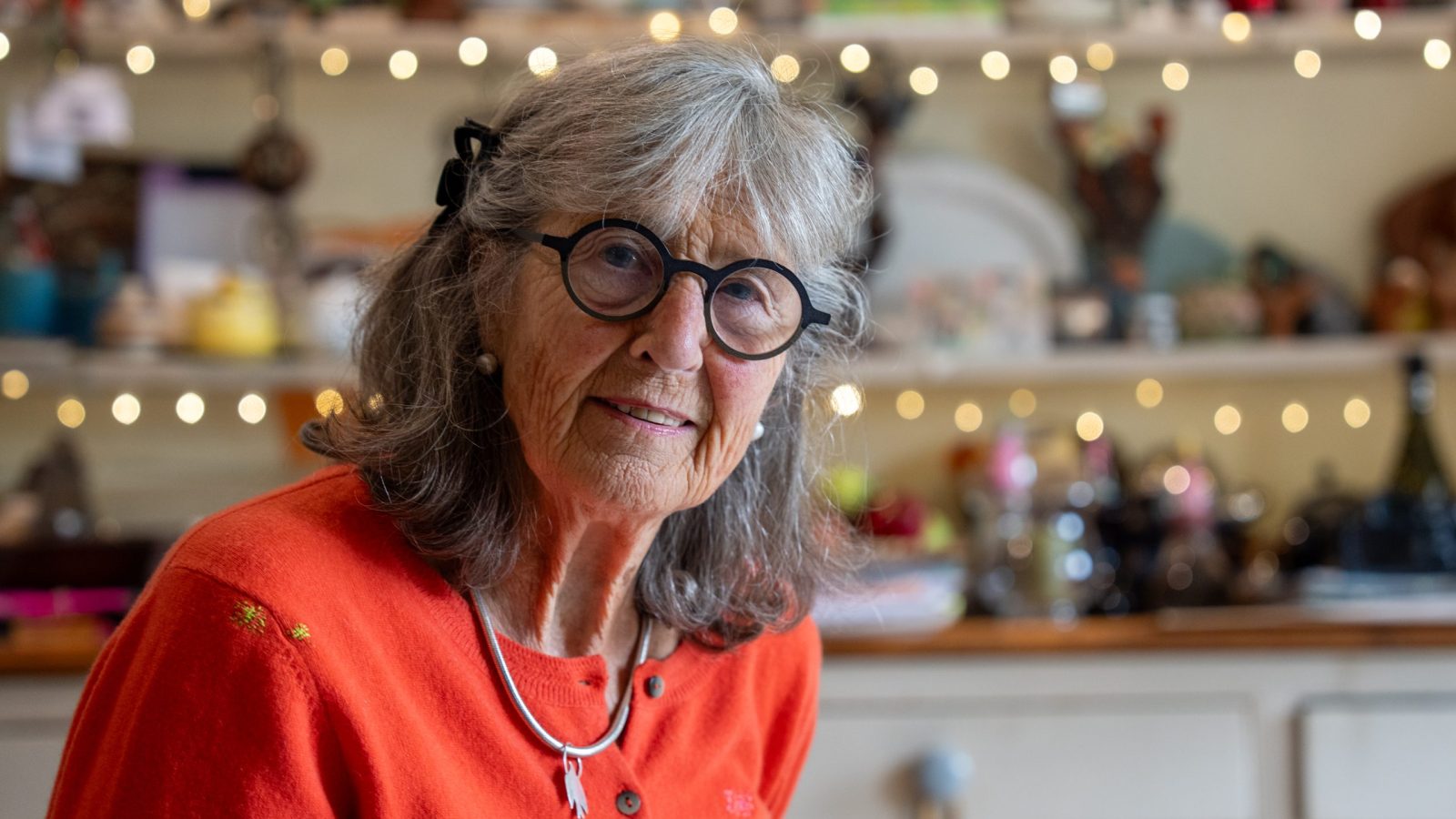
The early autumn air is crisp, but a warm sun shines brightly as I walk along a road in Montpelier.
A large poster in a front window commands my attention: ‘Hate Never Made Any Nation Great.’ I ring the doorbell, and Gaie Delap lets me in.
Gaie, a 78-year-old artist, mother of two and grandmother of six, first made headlines after climbing an M25 Gantry in 2022 with other activists from environmental group Just Stop Oil (JSO).
is needed now More than ever
Listening to Gaie describe it, the protest sounds like a low-budget Bond movie.
“The gantry was very close to a footpath where dog walkers were in the morning…We arrived and parked, and I hid behind a bush. One of the others had a key to unlock the padlock at the bottom of the steps leading up to the gantry.
“But they couldn’t make the key turn, so they came running back to me and asked if I had a hammer.
“And I said, ‘I haven’t got a hammer, but I have got a hefty carabiner’.
“So, I got my hefty carabiner and they whacked the key, undid the padlock and beckoned to me and I came scampering out of the bush and went up that ladder like a rabbit…I mean, it’s not difficult,” she shrugs.
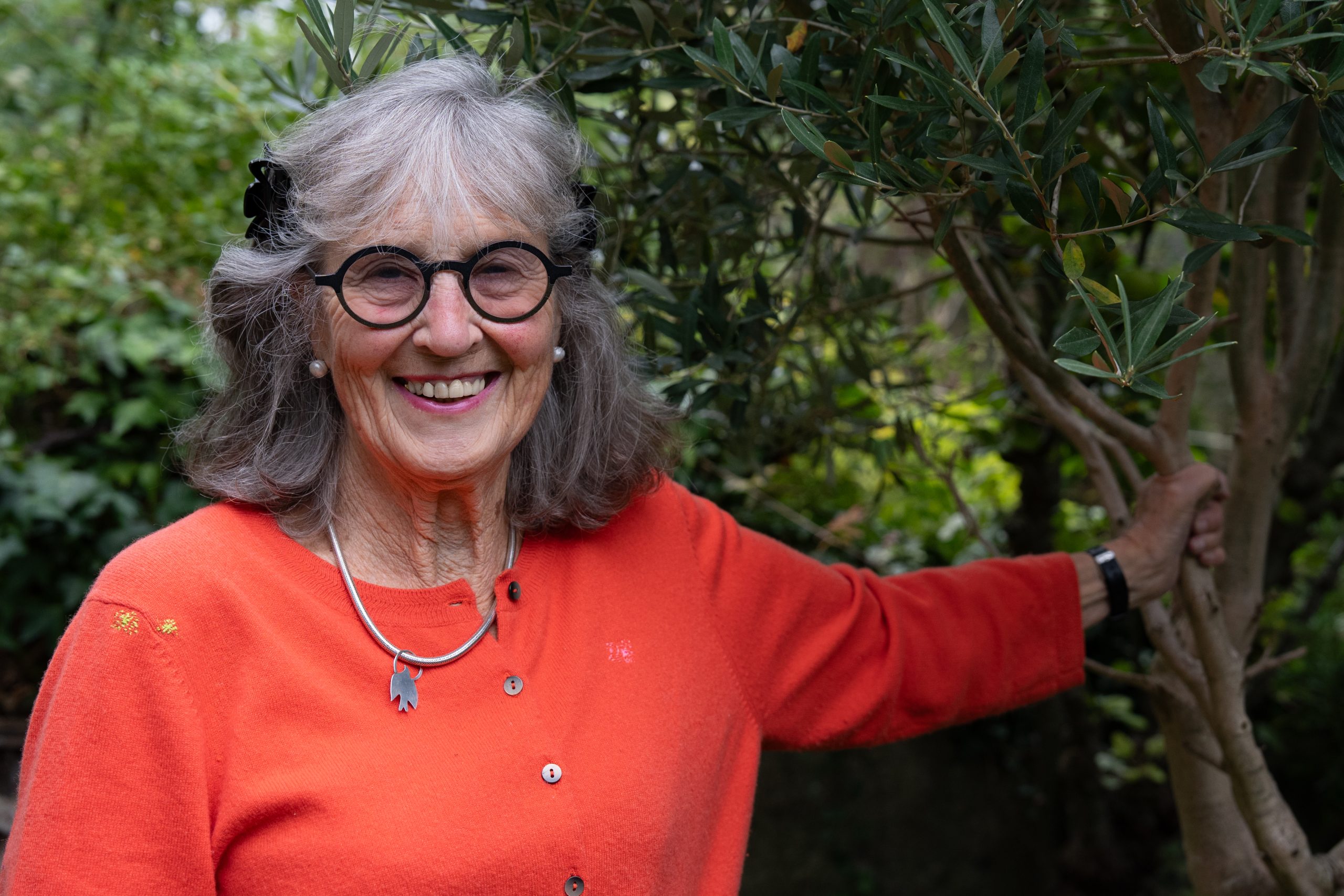
Gaie has an olive tree in her garden, commemorating her time in Palestine
Gaie took part in one of several JSO protests on the M25 in early November 2022. Over four days, around 45 protesters climbed gantries across almost all junctions on the orbital motorway.
They are thought to have caused almost 51,000 hours of traffic congestion, impacted more than 708,000 vehicles and cost London’s Metropolitan Police Service over £1m.
“I caused grief and that’s the point of a protest,” Gaie concedes.
“But the grief, if we don’t do something to change the way we’re going (the government appearing to back the development of a new oilfield in the North Sea, rolling back on net zero commitments and approving plans for a second runway at Gatwick Airport), they haven’t seen anything yet.”
All the ‘M25 Gantry Climbers’ (as the courts later called them) were arrested. Some, including Gaie, were convicted of causing a public nuisance under the Police, Crime, Sentencing and Courts Act 2022.
For her crime, Gaie was sentenced to 20 months in prison. At sentencing, the judge remarked that even though Gaie was one of the oldest defendants, “age has not brought wisdom”.
But, sitting with her in her kitchen, where the wall above the hob is decorated with her grandchildren’s painted handprints, and listening to her speak passionately about everything from gender equality to criminal justice reform, it is hard to think of her as foolish.
“When I was a kid,” Gaie recalls, “my dad used to say: ‘Sometimes it’s a crime not to be in prison’.”
Gaie grew up along the south coast, the youngest child and only daughter of an Irish father, who was a WWII bomber pilot, and a speech therapist mother.
As a child, she watched her mother work to get as many speech therapists as possible to join a union and fight for better pay (the vast majority of speech therapists were, and still are, women).
That’s when Gaie first began to realise the importance of people power.
Gaie moved up to Bristol in the 1960s to study architecture. Although she didn’t complete the degree, she did end up becoming “Bristolised”.
She retrained as a teacher and soon became heavily involved with several activist movements, including the Campaign for Nuclear Disarmament and groups focused on gay rights, second-wave feminism and the fight against apartheid.
Around 40 years later, she became a non-religious Quaker, resonating strongly with Quakerism’s four key values: simplicity, truth, equality and peace.
Becoming a Quaker made her activism truly international. She signed up for a Quaker-managed Ecumenical Accompaniment Programme in Palestine and, a few years ago, travelled with some other Brits to live among a Palestinian community in the West Bank, acting as a witness to “life under occupation”.
Gaie fiddles with the green, red and white bracelet on her right wrist as she remembers. “I went to a tiny, tiny village which I think is now no more because the settlers…attacked them regularly.”
She was in Yanun, an area renowned for its olive trees. She has an olive tree in her garden, planted as a way to remember the three months she spent living there. “I knew the village very well…I rejoiced that I was there all that time. It was very special.”
Gaie starts to cry.
After a moment that feels like an hour, she breaks the silence: “They’re very unvengeful. You would expect them, with what they had to put up with, to be full of wrath. But, what they say is, they want to live side by side…in peace.”
As well as advocating for peace, Quakers have long fought for climate justice. It was inevitable then that, after becoming a Quaker, Gaie would soon become involved in climate activism. “It’s incontrovertible that climate change is happening,” she says.
“The climate crisis is here, now, happening, and has been for quite a while.”
Gaie, who only travels by public transport and has recently resolved to never travel by plane, was an early supporter of Extinction Rebellion, Insulate Britain and JSO.
And when she joined a JSO Zoom call in 2022, and heard organisers talking about a protest that would involve shutting down the M25, she knew she had to be a part of it.
But, although prison was discussed as a possibility, she never thought she would actually end up inside.
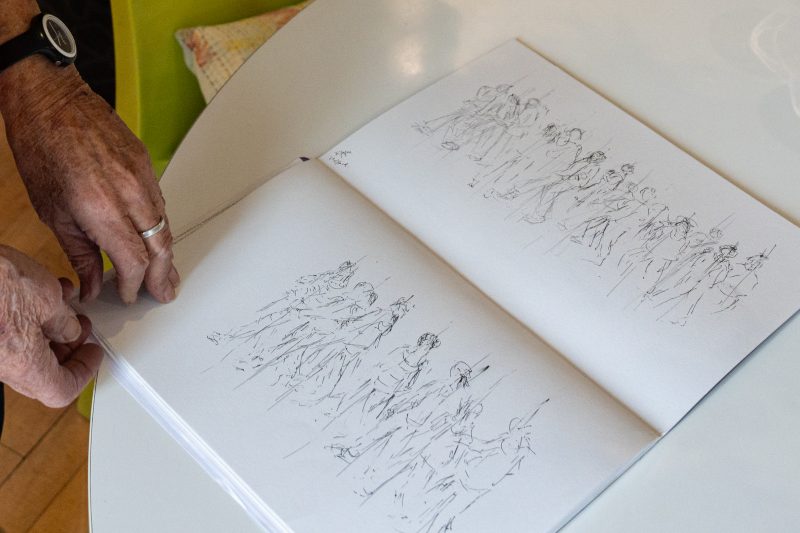
Gaie Delap spent a lot of time in prison drawing
Prison was “a wakeup call”.
After two years on bail, Gaie was sent to HMP Peterborough in August 2024. She was imprisoned among people who had experienced homelessness, severe mental health difficulties and years of coercive control and abuse from male partners.
“I complained about the food,” Gaie recalls. “And then this friend of mine said, ‘I lived out of food from bins for three years’. I didn’t ever complain about the food again.”
To pass the time, Gaie got a cleaning job (earning 50p/hour), “wrote lots of bad poetry,” and helped her cellmate from West Africa learn how to read and write in English. But, of all the things she did in Peterborough, drawing brought her the most peace.
She grabs two A4 workbooks from a shelf and flicks through, pausing on each page to tell me the stories behind dozens of drawings of fruit, plants and birds.
The birds are black and always sit in pairs on a roof. In Norse mythology, Odin sends two ravens – Huginn and Munnin – to fly around the world and update him on what they have seen. From her cell, Gaie often saw two birds appear on the roof of the building opposite: “In my mind, they were reporting back on what was going on in the outside world.”
After a few months in Peterborough, Gaie got a taste of the outside when she was released from prison on a home detention curfew. She was required to stay at her house in Montpelier from 7am to 7pm each day, wearing an electronic monitoring tag to ensure a parole officer could track her movements.
Typically, a tag is placed on an offender’s ankle, but, due to a health condition, Gaie’s tag needed to be placed on her wrist. Ministry of Justice contractors said they couldn’t find a tag small enough to fit. A warrant was put out for her arrest.
Word spread, and Gaie started making headlines again, but there was nothing anyone could do. On December 19, days before a planned family Christmas get-together at her house, “three big chaps” came to her door. “We’ll give you ten minutes,” they said.
Gaie was taken to HMP Eastwood Park, a state-run women’s prison in South Gloucestershire, which was once labelled, by the chief inspector of prisons, as one of the “worst” prisons he had ever seen.
Gaie celebrated her 78th birthday, on January 10, at the prison while hundreds of supporters gathered outside in a show of solidarity. They sang Happy Birthday to her.
“I didn’t hear it,” Gaie recalls, “but somebody said ‘Gaie, Gaie, quick you’re on telly. Put the telly on’…I couldn’t believe it.”
Gaie was released from prison on January 31 to serve the remainder of her sentence from home. But she hasn’t come home to rest.
Since leaving prison, she has joined wildlife conservationist Chris Packham in a legal challenge against the law under which she was convicted and is also exploring legal action against Serco, the company behind the Ministry of Justice’s electronic tag service.
In March, she won an appeal to have her sentence reduced to 18 months.
But, although she is still using her voice, and many people now know who she is (“sometimes people say, ‘Can I have a selfie with you?’”), she has no desire to capitalise on her newfound notoriety.
“I don’t want to be notorious or famous or any of these stupid words. I want people to think about why I put myself on the line for the cause. We are on a ‘highway to hell’, as the UN secretary-general said, if we don’t end our addiction to fossil fuels.
“That’s the focus I want people to take from this.”
This article originally appeared in Bristol24/7’s November/December 2025 magazine
All photos: Rob Browne
Read next:
 Our newsletters emailed directly to you