Music / world music
Review: Beat Frequencies, St George’s – an atmosphere of meditative tranquility was instantly established.
In the immortal words of Private Eye’s resident poet E.J.Thribb: “So farewell, then, Harriet Riley.” Happily Harriet has not passed away, of course, and her planned departure from the Bristol music scene is only for one year. But she will be missed, and tonight’s audience was peppered with members of Toddler, Will Gregory’s Moog Orchestra, Daniel Inzani and others of the many musical acts that have benefitted from her unique talents as percussionist. The occasion was far from sombre, however, as she and her partner Christopher Hull steered us through a programme rooted in the Balinese gamelan tradition that they will be immersed in for the next twelve months.
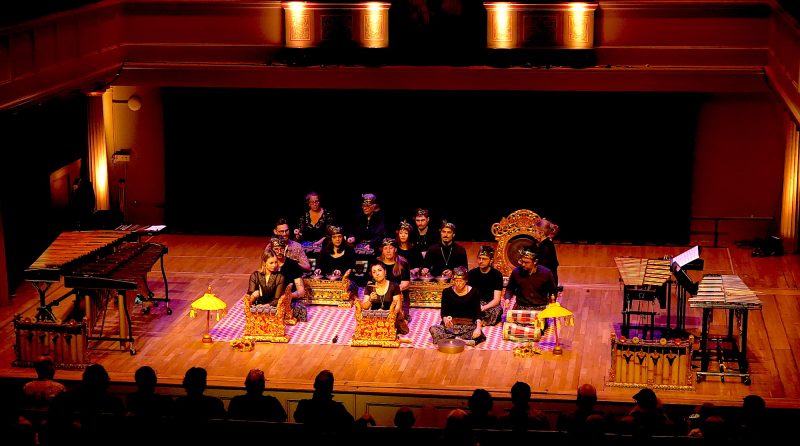
Beat Frequencies: The Adnaya Suara angklung Ensemble (pic: Tony Benjamin)
Flanked by pairs of marimbas and vibraphones the stage was dominated by the highly ornate and colourful instruments that comprise a gamelan orchestra. A waft of incense spread through the hall as the members of the Adnaya Suara angklung ensemble, appropriately clad in Indonesian headgear and sarongs, took up their positions and observed a quiet moment of ceremonial preparation. Then the first gamelan music of the evening began, a hypnotic pulsing gong underpinning the chiming counterpoint of cyclical phrases, and an atmosphere of meditative tranquility was instantly established.
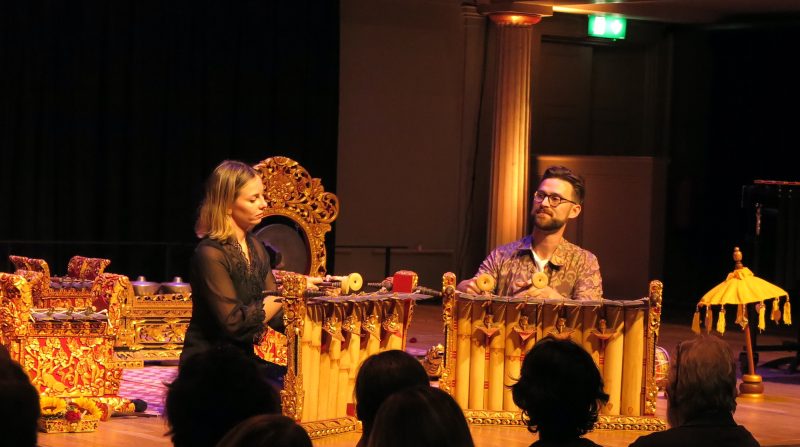
Beat Frequencies: Harriet Riley and Christopher Hull (pic: Tony Benjamin)
After that opening Christopher gave a short but useful explanation of the musical structures within Balinese gamelan, using the ensemble to build up the music’s interconnected layers before he and Harriet performed an intricate chamber gamelan piece as a duo. The music had an evolving structure, the two parts interweaving in a balanced narrative no doubt related to the shadow puppetry that it might have accompanied. That was followed by another duet as Christopher and Tom Nolan performed the ceremonial music for a teeth-filing ritual – apparently a rite of passage for young Balinese men.
is needed now More than ever
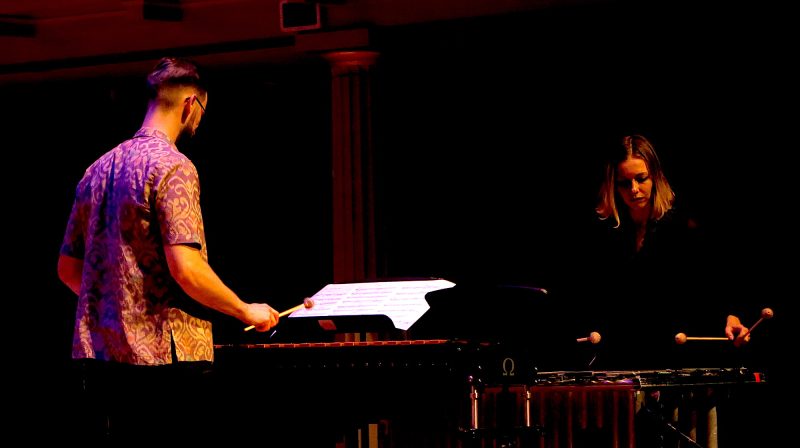
Beat Frequencies: Christopher Hull and Harriet Riley
(pic: Tony Benjamin)
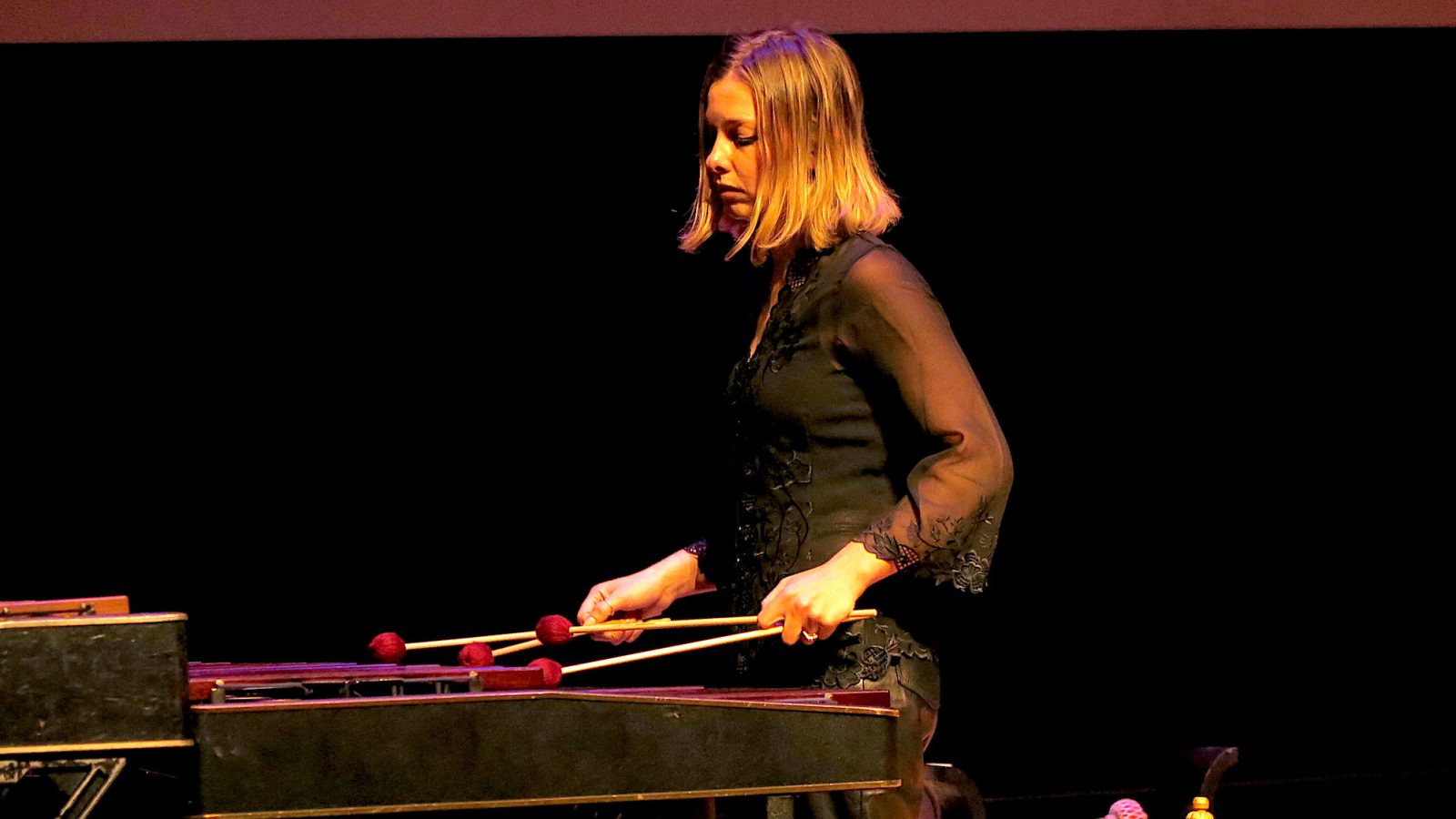
Things shifted in tone, interestingly, as Harriet and Chris moved to the two vibraphones and Harriet explained how the two instruments were slightly out of tune in a way that mirrored the pairs of gamelan metallophones. This dissonance is the key to the shimmering quality of gamelan music, referred to as the beat frequency (hence the evening’s title) and the traditional piece they played – the title translated as ‘frog climbing a banana tree’ – was followed by Harriet’s composition Beat Frequency no 2. The latter’s more Western modes and bluesy notes gave the music a spectral, cinematic Hitchcockian feel.
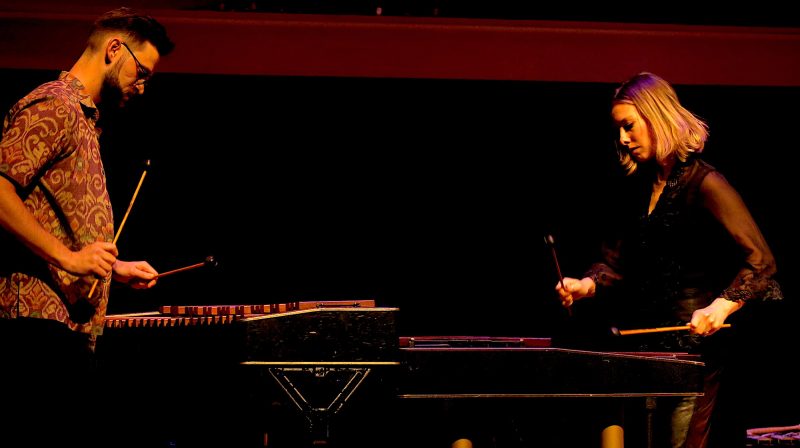
Beat Frequencies: Christopher Hull and Harriet Riley (pic: Tony Benjamin)
Things got even more Westernised as the pair moved to marimbas and performed two contemporary classical pieces: Steve Reich’s Nagoya Marimbas and Ann Southam’s Glass Houses. While the more caressing softness of the wooden tones was a contrast with the previous metallic music, thanks to our earlier tutorial the ways in which the two composers had incorporated the structural principles of the gamelan tradition were immediately evident.
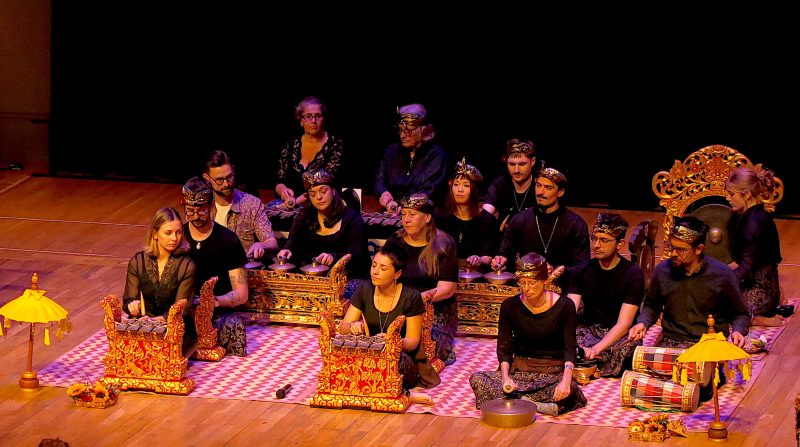
Beat Frequencies: The Adnaya Suara angklung Ensemble (pic: Tony Benjamin)
After the interval the ensemble returned to the stage for a sequence of traditional pieces, led by director Isis Wolflight who, like Harriet, had first learned to play the music as a primary schoolgirl in Totnes. There was a discernible range of atmosphere between the numbers – one about a fisherman had a chirpy melody with a two-step groove, while The Smile That Welcomes Your Presence had an appropriately relaxed glow.
They ended with an upbeat Isis composition dedicated to her favourite Indonesian dish of steamed spicy chicken, no doubt something that Harriet and Christopher will be enjoying once they arrive for their sabbatical year. After such a well-designed and perfectly executed evening I think we could all understand why the traditional music of Bali has such a pull on these players.
 Our newsletters emailed directly to you