Music / Reviews
Review: Shivani Sen, the Arc – ‘Free your mind – shut up and listen’
I was happy: I like a venue that serves expensive rooibos for cheap, where they don’t mind if you insist on asking for ‘redbush’.
And although I don’t want a massage while I’m at a gig, I know thousands of Bristolians who would. I couldn’t help overhearing someone say ‘Shambala’.
Whatever you like, I recommend a Haze session one Sunday afternoon at the Arc on Broad Street. Sit on a rug or a bench. Or in an armchair. Or on some café chairs round a table. Or on some bar stools round a bar table.
is needed now More than ever
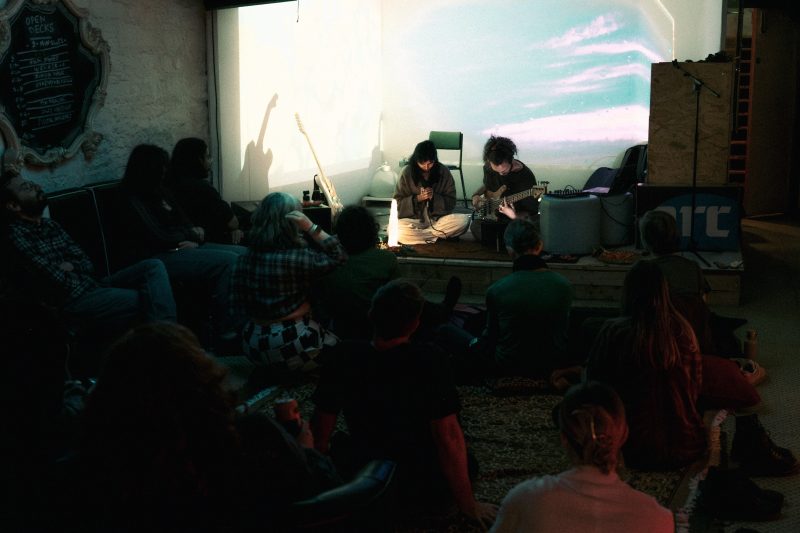
Arc is Bristol’s sober bar in the centre, while the Haze series takes inspiration from the chill out rooms of 90s raves, offering food, trippy visuals and ambient music to relax to – photo: Oz Davy @oz.shoots.your.band
Slow moving visuals loom though the dim light, projected onto the walls behind the corner stage, the vibrant hues of organic-looking patterns. If you are hungover, here at this no-drink-no-drugs-bar you can recover.
But be careful – you might like sobriety more than you realised.
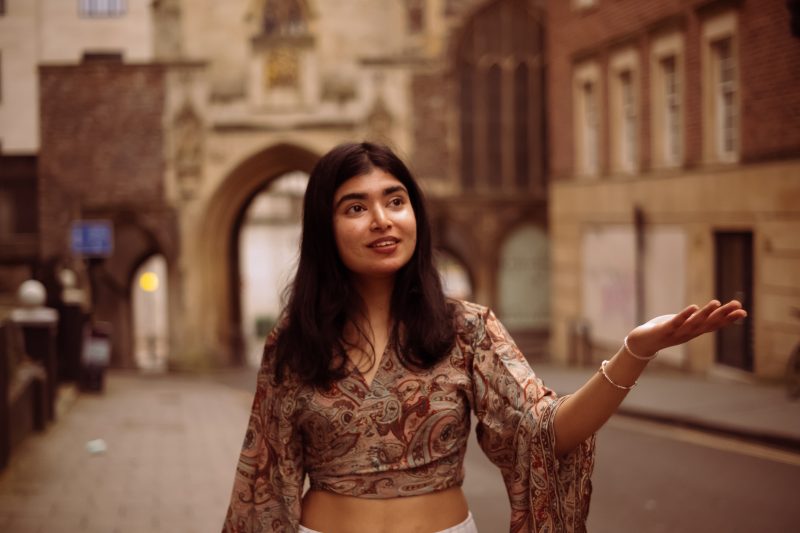
This edition of Haze was hosted by Indian classical vocalist Shivani Sen – photo: Cait Wright @shotbycait_
Shivani Sen sat cross-legged on the low stage, next to collaborator Theo Archer, introducing herself as an “Indian classical vocalist”. She explained that her tradition uses various “ragas” (akin to “modes” in western music) which are understood to have different emotional moods with different meanings for different people.
The raga she chose is characterised as “meditative”, “deep” and “serious”. There are no set words and no set tune. And so she began to sing, accompanied by Theo Archer, and didn’t stop for forty minutes.
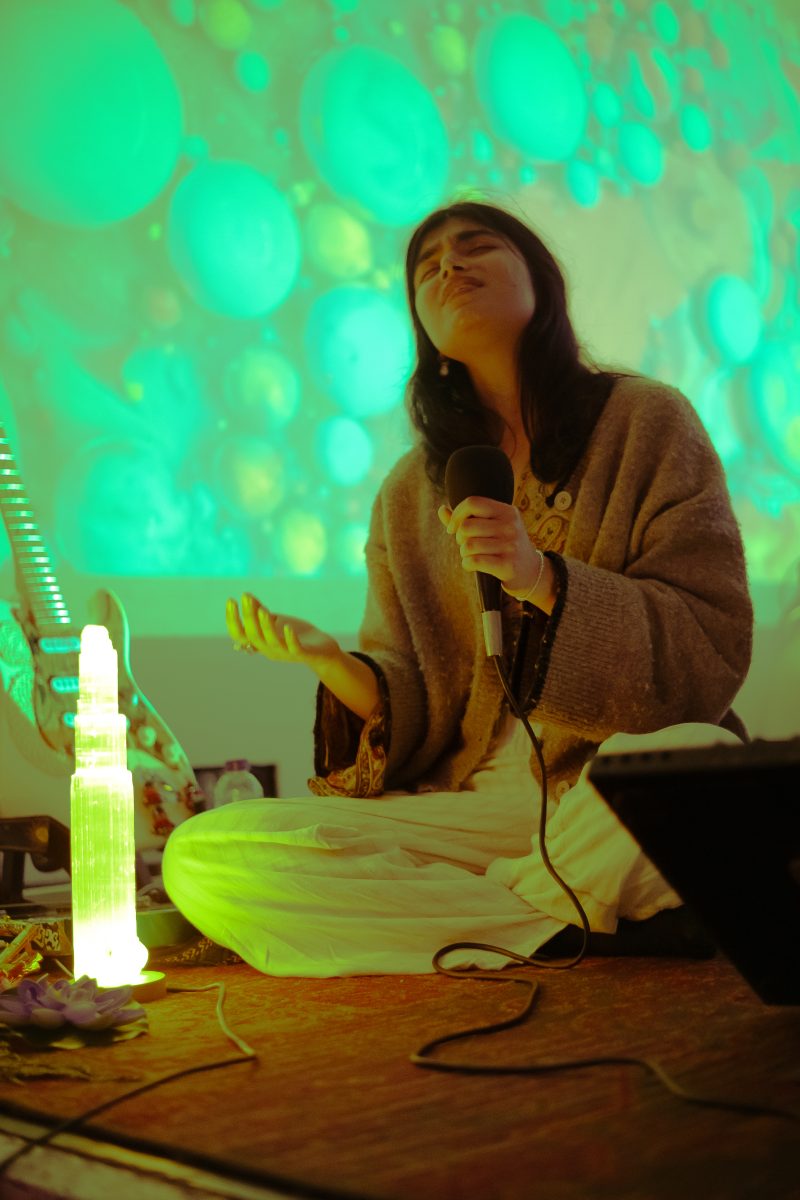
Shivani invited the audience to listen receptively – photo: Cait Wright @shotbycait_
Without an education in the music, it was hard at times to know what she was doing or what we were hearing.
That was (but only in part) beside the point. The music seemed to be a gradual and tentative exploration of notes and timbres and sequences. How a single note sits in tension with the drone and the contexts of its predecessors.
Archer offered electronics from his laptop, mainly two notes in a drone, and a sound you might associate with a sitar.
At the same time, listening closely, he sensitively drew out harmonies from various resonant frequencies. And, when fitting, added some notes from his bass guitar with sensitivity and restraint.
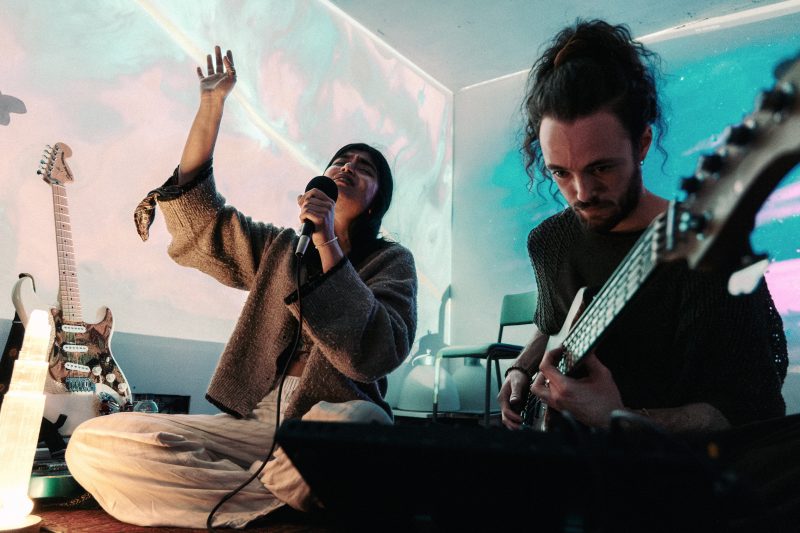
Shivani’s first meditative raga was 40 minutes long – photo: Oz Davy @oz.shoots.your.band
Shivani’s hand gestures signal movement through the scale, seeming to accompany a dialogue she conducts with herself, eyes closed, and at the same time with those listening.
Usually she probes a long note, confident but gentle, expanding into slow phrases, ornamented or punctuated by deft and rapid flurries.
Her open face mirrors the dynamics emerging from deep within as her improvisations take shape as imperatives and implorings.
As the exploration unfolds through her delivery, she remains graceful, natural, sincere. You even imagine that if she’d been singing about her feelings (slice of Western individualism, anyone?) it would still have been superlatively dignified.
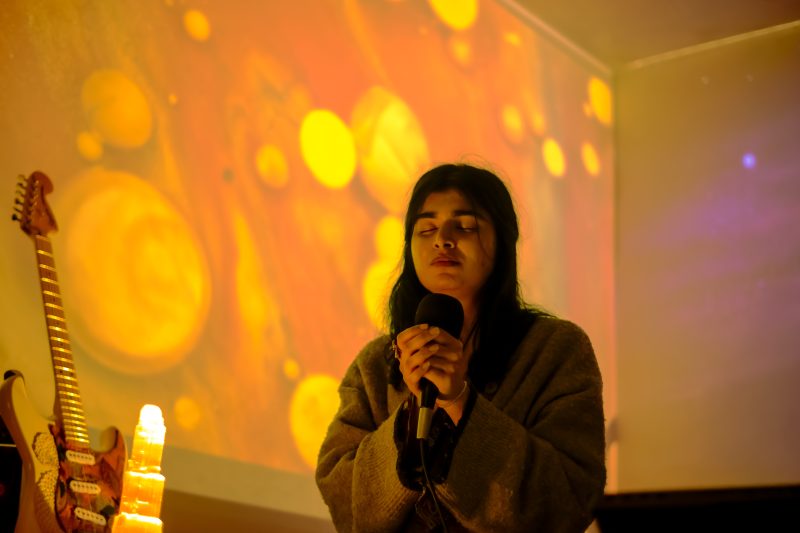
‘Complete poise’: Shivani’s unaffected delivery signified depth and truth, says our reviewer – photo: Cait Wright @shotbycait_
This wordless, literally aimless music—not an exercise or composition but, she insists, simply something to be “received” —was itself the main character. Something, perhaps like a venue without booze, that offers the space to choose not to hide from oneself.
Even better for us, the absence of personal performance resisted any desire to romantically exoticise the music.
Some sat munching dahl and some bizarrely felt inclined to chat. But most paid attention in order to receive what was offered. This was how Shivani invited us to listen: receptively.
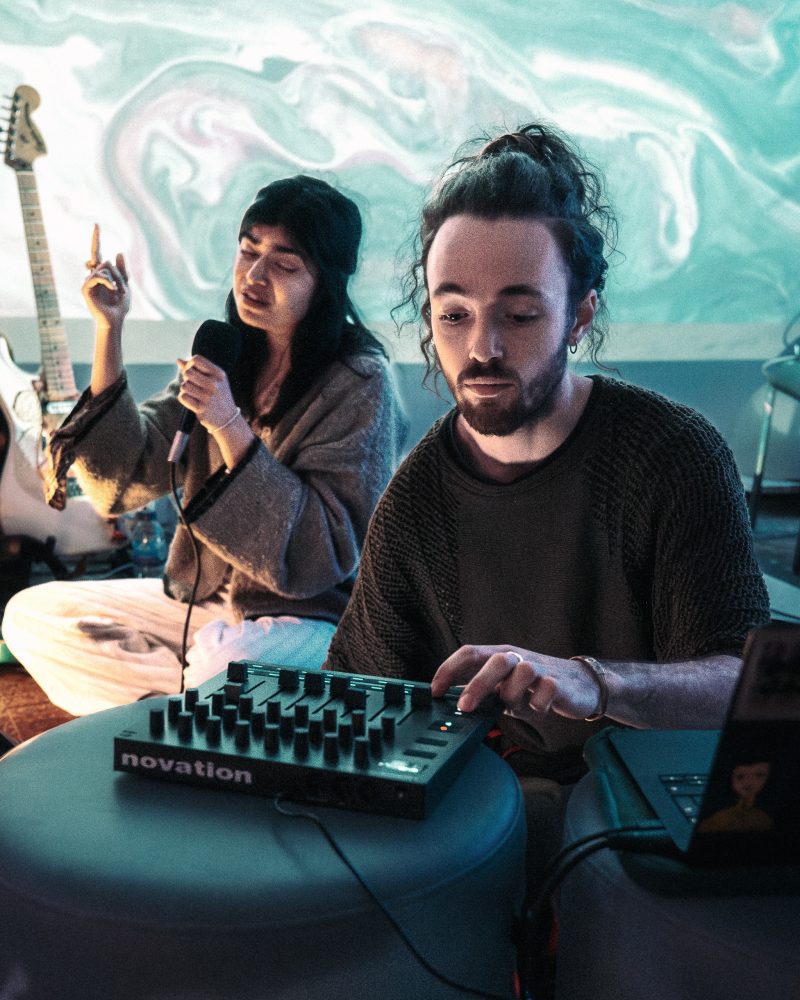
A second session from Shivani explored a different raga, ranging around “nostalgia”, “melancholy” and “healing” – photo: Oz Davy @oz.shoots.your.band
Like all meditation humble before the truth, Shivani’s music had as much the character of a question as a lesson.
I think many “performers” would struggle to attain her complete poise, relying instead on emotion and freedom instead of discipline and tradition. But the latter makes for much truer expression: deeper and less predictable.
This was the fourth in a series of Haze sessions at the Arc where, as well as a lovely vibe and lovely music, you could get a head massage and draw on a wall. Entry fee varies but is aimed at being affordable. And I saw bulging bowls of very fine-looking vegan curry going for a tidy eight quid.
Being in the Arc these sessions, perhaps like all its events, help free “sobriety” from its associations with dour Calvinism. Instead, there’s a freedom as well as a not-self-righteous intention underlying the events.
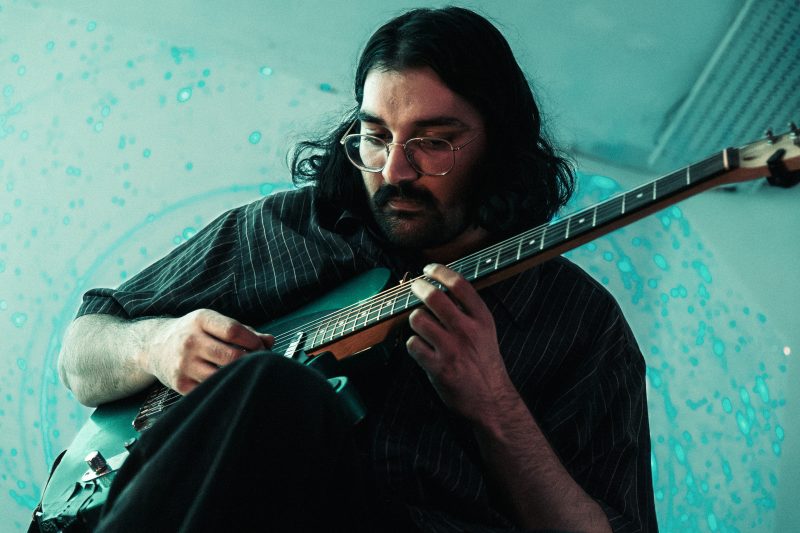
Glassfactory was also on the bill at this event which had an art wall for people to draw on as inspired – photo: Oz Davy @oz.shoots.your.band
I’d rarely expect to find myself in a teetotal venue but found it fitting this Lententide, and especially with Shivani’s music’s purpose of refining spiritual clarity. And I’ve a God-given love of drones, possibly from being left alone as a boy with a broken concertina, far too young and for far too long.
Even so, under a certain analysis, I’d sat still listening to a single note for forty minutes, which I count as virtuous, if not quite heroic.
So while I’m not a believer in the karmic wheel, if my grounded attention to Shivani will accrue to me as a meritorious deed, perhaps I may yet achieve my personal dream and be reincarnated as bagpipes.
Main image: Oz Davy @oz.shoots.your.band
Read next:
 Our newsletters emailed directly to you