Film / Reviews
The Salt of the Earth
The Salt of the Earth (12A)
France/Brazil/Italy 2014 110 mins Dir: Wim Wenders, Juliano Ribeiro Salgado
That old saw about a picture being worth a thousand words is put to the test in this compelling if oddly constructed documentary in which septuagenarian ‘social photographer’ Sebastiao Salgado explores the social and political context of many of his most stunning monochrome images, shedding light on his humanitarian principles along the way.
It opens brilliantly with his most famous work: those extraordinary images of the Sera Pelada gold mine in his native Brazil, where thousands of workers toil without benefit of machinery. “All you could hear was the babble of 50,000 people in one huge hole,” Salgado recalls, describing the experience as “like returning to the dawn of time”. But these miners were not, as one might imagine, slave labourers. Each was there of his own volition. They were, he says, “only slaves to the idea of becoming rich”, which puts a whole new perspective on his photographs.
Co-directors Wim Wenders, making his first non-fiction feature since Pina, and Salgado’s son Juliano take a curious and occasionally somewhat clunky tag-team approach as they embark on a more-or-less chronological journey through Salgado’s life and work, from his early training as an economist, through his involvement in leftist politics and move to Paris during the ’60s military dictatorship, to his great photographic projects (a mix of ethnographic studies and hefty tomes on war and famine). We also learn about his youngest son, Rodrigo, who has Down’s syndrome. There are some odd omissions, though. His elderly father pops up to describe the young Sebastiao as a restless traveller and a “scamp”. But for reasons that are never explained, the photographer’s wife Lelia, who made enormous sacrifices to support her husband’s career, makes no contribution to the film.
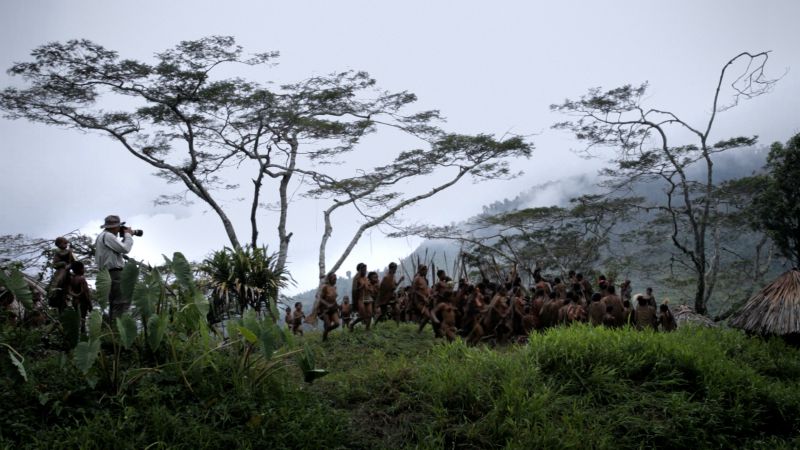
An effective visual device superimposes Salgado’s face as a ghostly image on his photographs as he talks about the circumstances in which they were taken. Things turn much darker as he reflects on famine in Africa, genocides in Rwanda and Bosnia, and Kuwait after GW1, remarking at one point: “We humans are terrible animals”. But at least that mandatory bland New Agey/World Muzak score fades into the background for a while, as it’s hardly ‘heart of darkness’ material.
The challenge the film faces in is getting from there to a reasonably upbeat ending so the audience doesn’t shuffle out feeling totally depressed. Fortunately, the burned-out Salgado provides his own solution with his most recent project, Genesis, which retreated from suffering and misery to celebrate the globe’s pristine environments. At the same time, he embarked on a practical mission to revive the parched and desiccated family cattle farm as an exemplar of how to set about reversing mankind’s deleterious impact on the planet.
Wenders’ narration occasionally recalls Werner Herzog at his most portentous, and there’s no room for rebuttal or even acknowledgement of criticisms of Salgado’s work (notably the late Susan Sontag’s charge that he “aestheticises poverty”), which leaves the door open for a more definitive documentary at a later date. But whatever interpretation one chooses to place on those photographs, they look undeniably stunning on the big screen, while Salgado comes across as a thoroughly decent, empathetic cove.
 Our newsletters emailed directly to you