Film / Reviews
Paper Towns
Paper Towns (12A)
USA 2015 116 mins Dir: Jake Schreier Cast: Nat Wolff, Cara Delevingne, Justice Smith, Austin Abrams, Halston Sage, Jaz Sinclair
Despite being pitched and marketed as your standard dorky-guy-meets-manic-pixie-dream-girl schmaltz fest, Paper Towns is in fact a movie that compels audiences to read between the lines. It follows hot on the heels of maudlin, mawkish 2014 Shailene Woodley romance The Fault in Our Stars, with which it shares a genetic connection in the form of author John Green, currently a red-hot property in Hollywood circles. However, if the register of Stars was sappiness, Paper Towns by contrast is all about happiness, albeit with the undercurrent of melancholy that appears to be characteristic of Green’s work.
It kicks off with your typical suburban American teen Quentin (aka ‘Q’), played by The Fault in Our Stars actor Nat Wolff whose boyish appearance means that, somewhat refreshingly for an American romantic drama, he actually passes for a plausible on-screen adolescent. Ever since he was young, Q has pined for his beautiful next door neighbour Margo (Cara Delevingne, taking on her biggest role to date) but with the advance of high school, these previously inseparable friends have gone their separate ways. That is until she pays him a midnight visit and persuades Q to join her on a revenge spree against her cheating boyfriend.
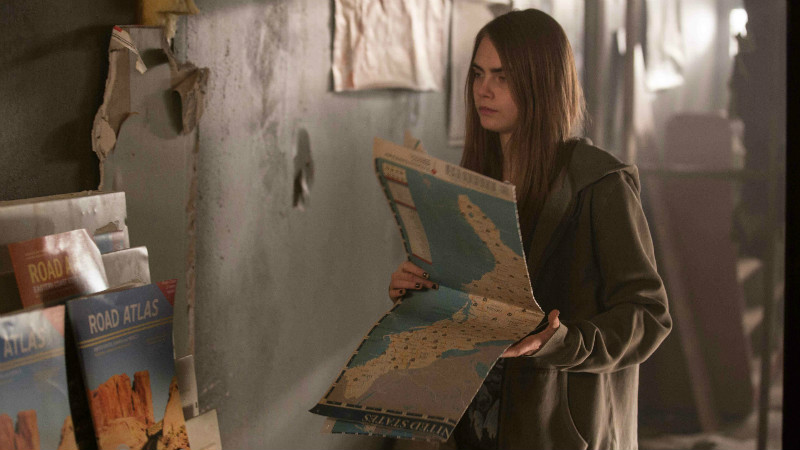
In doing so, the desirable yet elusive Margo snaps Q out of the funk into which he has slipped: she believes that there’s more to life than the holy trio of a job, marriage and kids by the age of 30, inspiring him to take risks and make deeper connections with the wider world. Our hero suddenly finds himself utterly smitten – only for Margo to seemingly disappear altogether. However, before vanishing she appears to have indulged in her favourite pastime of leaving cryptic clues dotted around, clues which may ultimately lead Q to discovering where she is.
Contrived and silly though the central conceit is (would any teenager be sophisticated enough to bust out their inner Sherlock and leave such strategically placed clues around?), Paper Towns cuts through the vacuous glaze of so many teen romances, largely thanks to the utterly charming performances of its cast. Although Delevingne shares the poster with Wolff and has grabbed the majority of the promotional media headlines her screen time is relatively minimal, appealing and convincingly American-accented though she is.
Instead, the movie is more about establishing the emotional impact of Margo’s absence, with the bulk of the narrative handed over to Q and his likeably dorky pals Ben (Austin Abrams) and Radar (Justice Smith), all of whom – shock horror – share a realistically tangy bromantic chemistry that practically fizzes off the screen (one scene involving the Pokemon theme song is perfectly judged and hilarious). It seems odd to call out a teen movie for actually understanding how such an audience behave and talk to one another but Robot & Frank director Jake Schreier does an excellent job of it. Even the women characters, an area in which the movie might be expected to fall into crass clichés, are enjoyably sketched: Margo’s best friend Lacey (Halston Sage) is as keen to track her down as Q is and she soon becomes one of his vital allies, as opposed to just another piece of eye-candy. And Radar’s new girlfriend Angela (Jaz Sinclair), refreshingly, is the one who seemingly holds the cards in their relationship, prompting him to seek her approval on more than one occasion.
It all builds towards an epic cross-country road trip in the second half as the group set off on Margo’s trail, one brimming with a sense of adventure and nostalgia that’s elevated by Ryan Lott’s (AKA Son Lux) woozy, synthy score. This is where the movie wins out over The Fault in Our Stars: removed from the aggressive heart-string tugging sentimentality of that movie, Paper Towns is instead a celebration of friendship and youth, which in its best moments calls to mind the master of such movies, John Hughes. Yet there’s just enough poignant plausibility underpinning the gloss: not only are these characters on the verge of going their separate ways to college but there’s also a potent message about the need to grow up and see people in more than one dimension. Thankfully, that’s a problem that Paper Towns doesn’t have.
 Our newsletters emailed directly to you