Film / Reviews
Carol
Carol (15)
USA 2015 119 mins Dir: Todd Haynes Cast: Cate Blanchett, Rooney Mara, Kyle Chandler, Sarah Paulson, Jake Lacy
When initially published in 1952, Patricia Highsmith’s novel Carol was considered so provocative that she was compelled to release it under a pseudonym. Forgoing the mystery trappings for which the author is best known, Carol (originally known as The Price of Salt) instead derives suspense from the very emotional nature of the material, focusing on the intense relationship between two women at a time when such a lifestyle choice was illegal.
One of the novel’s great triumphs is creating a beautifully vivid impression of the moment when love strikes like a thunderbolt: elusive, confounding, seemingly denying any logical explanation but which is all-consuming and intoxicating. It’s an enigmatic puzzle of a story that creates a sizeable challenge for director Todd Haynes and screenwriter Phyllis Nagy in their long-awaited movie adaptation. Since emerging as a favourite at this year’s Cannes Film Festival, Carol has coolly swept into many critics’ top 10 of the year lists with all the effortless pizzazz of its title character, superbly played by a career-best Cate Blanchett.
But wonderful as Blanchett is, this isn’t strictly her story. Instead, the emotional arc primarily belongs to the character of Therese, played by an equally excellent Rooney Mara. Eking out a somewhat dull Manhattan existence working in a stultifying department store, Therese’s life is forever turned upside down when in sweeps Blanchett’s glamorous mystery woman, one of the moments from the book that Haynes captures perfectly in all its enigmatic glory.
Carol is in the throes of a divorce from husband Harge (Kyle Chandler), who is also looking to take custody of their daughter, and aspiring photographer Therese is getting no fulfilment from her relationship with Richard (Jake Lacy). As their initial friendship steadily grows into something more passionate, it soon becomes clear that a great deal is at stake. And hovering on the sidelines is the seemingly innocuous presence of Abby (Sarah Paulson), a former acquaintance of Carol’s who seems to know better than anyone where this is headed.
Much of the film’s success hinges on the exquisite central performances. Blanchett has frequently shown herself an expert with elusive, not altogether sympathetic portrayals (as in the Oscar winning likes of Blue Jasmine), and she’s consummately brilliant as Carol, veering between the alluring and the aloof in precisely the manner of Highsmith’s writing. Matching her beat for beat is Mara: wide-eyed and innocent as the story demands but whose sense of identity visibly buds and takes shape in front of us across the course of the drama. Their body language is quite magical: full of half glances and sly asides that brim with suppressed passion and chemistry.
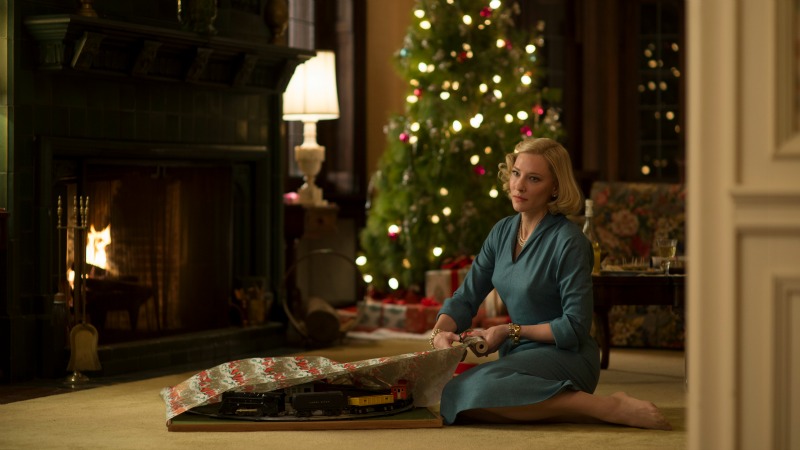
Credit to director Haynes who evokes the period quite beautifully without ever turning the movie into a checklist of 1950s clichés. In this sense, it’s an interesting contrast to his celebrated 2002 melodrama Far From Heaven: whereas that movie intentionally drew the viewer’s attention to its pastiche Douglas Sirk nature, here the sumptuous style is very much in support of the movie’s central romance. That said, Carol is one of those movies whose every shot can be freeze framed and placed on a wall: it’s achingly haunting from the big-finned cars to the ever-present trail of cigarette smoke emerging from Blanchett’s lips.
If there are any issues with the movie, they arise from Nagy’s screenplay. Although the novel is intensely locked into Therese’s point of view, the movie by its very nature is compelled to allow the story more breathing room, creating conversations and exchanges between certain characters to which Therese wasn’t originally privy. This is of course an understandable decision but one that risks sacrificing the story’s somewhat claustrophobic and discombobulating air in favour of something more conventional. The addition of a Brief Encounter style framing device also serves to add little but extra screen time. Oddly enough, it calls to mind the problems with Joe Wright’s 2007 adaptation of Atonement: Ian McEwan’s novel hinged so much on its singular, slippery narrative voice that when the movie externalised the action, a certain amount of impact was lost.
Nevertheless, in spite of its flaws, Carol is an immaculately crafted adaptation, fabulously acted and one that does justice to its author’s bravely transgressive message. One glimpse into Blanchett’s compelling and mysterious eyes, so full of longing, compassion and mystery, and everything else simply melts away.
 Our newsletters emailed directly to you