Film / Reviews
Brand: A Second Coming
Brand: A Second Coming (15)
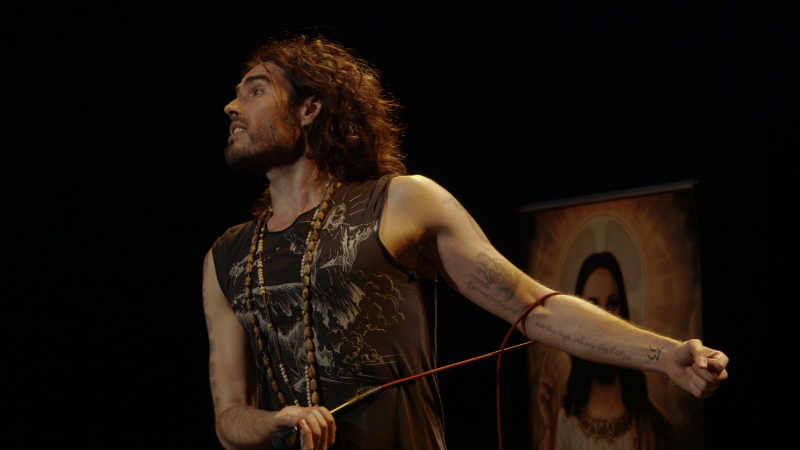
UK/USA 2015 102 mins Dir: Ondi Timoner
Even for those of us who consider ourselves Russell Brand agnostics – perhaps a vanishingly small minority – the prospect of 102 minutes of undiluted Brand is a daunting one. Fortunately, director Ondi Timoner has form when it comes to making annoying subjects compelling. More than a decade ago, her rockumentary DiG offered a hilarious portrait of petulant, over-indulged asshole and alleged genius Anton Newcombe, whose indie band the Brian Jonestown Massacre enjoyed enormous ‘cred’ but were of no interest whatsoever to anyone other than music journalists. Alas, while her critical faculties haven’t entirely deserted her, she does seem a little too much in love with her subject here, occasionally tumbling off the fence into hagiography territory. It’s hard to suppress an “Oh, come off it!” when the ghosts of Lenny Bruce and Bill Hicks are invoked. Bizarrely, however, the film’s thin-skinned subject fell out with the director when he saw her film.
Despite this, Brand zips along at a fair pace and is never less than enjoyable. We see snaps of the young Russell with Eraserhead hair, enjoy archive footage of him off his face on Class As, hear how his dad took him to prostitutes (“I wanted to make a man of him,” announces Brand Sr., proudly), and learn that, at the age of eight, he told his mum that he was the second coming of Jesus Christ (“That’s not a normal thing for a son to say, is it?” she puzzles). The experience of revisiting his old school even provokes Proustian reminiscence: “I remember being in that stairwell the first time I touched a girl’s vagina”.
All the subsequent bullet points – Sachsgate, Katy Perry, ‘sex addiction’, the MTV Awards, that Newsnight interview – are present and correct, but there are also some odd and rather random sequences in which he discusses spiritualism with such authorities as David Lynch and, um, Mike Tyson. Apparently, these are leftovers from an earlier version of the film (the troubled project reportedly got through five previous directors before Timoner managed to finish it), which Brand clearly envisaged as a much more dull and worthy enterprise.
The Hollywood Years see him make the extraordinary discovery that celebrity is hollow and vacuous, prompting a brief wallow in self-loathing, leavened only by some more shagging, and a canter down New Age Bullshit Boulevard towards his newfound status as messianic revolutionary. Slyly, Timoner plays John Lennon’s Power to the People over the closing credits, as if to remind us that this same sequence of events was played out decades earlier. Anyone who’s ever read a biography of John Lennon, or indeed George Harrison, will be familiar with the celeb’s struggle with reconciling mammon, spiritualism and radical politics. Which isn’t to suggest that Brand carries the cultural weight of a Beatle. Or, indeed, that Katy Perry is the new Yoko Ono.
Brand’s revolutionary zeal makes for the film’s most interesting moments. To his credit, he’s always participated in social activism and there’s no doubting his genuine passion. The broad stokes of his somewhat vague political analysis are hard to fault, and the establishment response to having its vested interests challenged by an oik from outside the Westminster Class – part patronising, part sneering condescension (yes Paxo, we’re looking at you) – underlines why he’s succeeded in striking such a chord with those who are disillusioned with parliamentary politics. Despite a fondness for snappy ‘truisms’ that don’t stand much scrutiny (“History creates great men; great men don’t create history”), Brand often succeeds in cutting through the crap: “When I was poor and complained about inequality, I was accused of bitterness and jealousy. Now I’ve got some money and talk about inequality, they just accuse me of hypocrisy.”
The trouble is that all this is tied up with rampant, off-putting narcissism, to which he freely confesses (“I’m a comedian. That’s what makes me bearable. Without that I’m intolerable.”), but which tends to result in people taking sides on the basis of whether or not they like him personally. Still, at least the film reminds us that when he’s on form he can be sharp and very, very funny. The moment where he completely humiliates the airhead presenters of the MSNBC morning show Morning Joe (“Is this what you all do for a living?”) is priceless. You can find it on YouTube here, if the thought of sitting through all this is too unpalatable.
 Our newsletters emailed directly to you