
Features / Advertising Feature
Behind the Prescription: What Bristolians Should Know About How Medicine Safety is Monitored
When a resident of Bristol picks up a prescription from a local pharmacy in Clifton or Bedminster, they trust that the medication is safe, effective, and rigorously vetted. However, the journey of a drug does not end with its approval by the MHRA; in fact, a crucial phase of monitoring begins the moment it reaches the public. The software platform DrugCard operates within this digital ecosystem, ensuring that medical literature and clinical reports are systematically scanned for potential side effects.
This continuous vigilance, known as pharmacovigilance, is the invisible shield that protects thousands of patients across the South West from unforeseen adverse reactions. While the average person might only see a small white pill or a liquid suspension, there is a massive, data-driven infrastructure working 24/7 to analyze real-world evidence.
This process is vital because clinical trials, despite their rigor, cannot always predict how a drug will interact with millions of diverse individuals over many years. By utilizing automated solutions to track global medical data, pharmaceutical companies can identify risks much faster than traditional manual methods allowed.
is needed now More than ever
For Bristolians, this means a higher standard of healthcare and the peace of mind that their treatments are being watched over by both human experts and cutting-edge technology. Understanding this system reveals the dedication required to maintain public health in an increasingly complex medical landscape, where the volume of data necessitates smarter tools to protect every individual.
The Evolution from Manual Checks to AI-Driven Vigilance
Historically, monitoring drug safety was a labor-intensive process that relied heavily on manual reporting and the physical review of medical journals. Pharmacologists would spend countless hours scouring thousands of pages of published research to find a single mention of a new adverse event.
In a city like Bristol, which prides itself on being a burgeoning tech hub, the shift toward automation was inevitable and necessary. Modern pharmacovigilance now leverages artificial intelligence and machine learning to process vast quantities of unstructured data from scientific databases, news outlets, and social media.
This technological leap allows for the detection of “signals” — patterns that suggest a new risk or a change in the severity of a known side effect in near real-time. For the local community, this transition translates to faster regulatory actions and updated safety labels.
The integration of high-tech monitoring tools ensures that no stone is left unturned, providing a comprehensive safety net that spans from local GPs to international research centers. These digital systems reduce the margin for human error, ensuring that critical data isn’t missed simply because a researcher was overwhelmed by the volume of information.
How Local Data and Global Research Protect the South West
Pharmacovigilance is inherently global, yet its impact is profoundly local. A study published in a medical journal in Tokyo or a clinical observation made in New York could have immediate implications for a patient being treated at the Bristol Royal Infirmary. The system is designed to act as a global nervous system, where information flows freely between borders to safeguard health.
To better understand the scope of this monitoring, we can look at the primary sources of data that safety experts analyze daily:
Spontaneous Reports: Voluntary reports from doctors, pharmacists, and patients regarding suspected side effects.
Medical Literature: Peer-reviewed journals that publish case studies and clinical trial results.
Electronic Health Records: Anonymized data from healthcare providers that helps identify long-term trends.
Post-Authorization Safety Studies (PASS): Specific research mandated by regulators to monitor a drug’s performance.
The following table illustrates the key differences between the traditional monitoring approach and the modern, tech-enabled strategy used today:
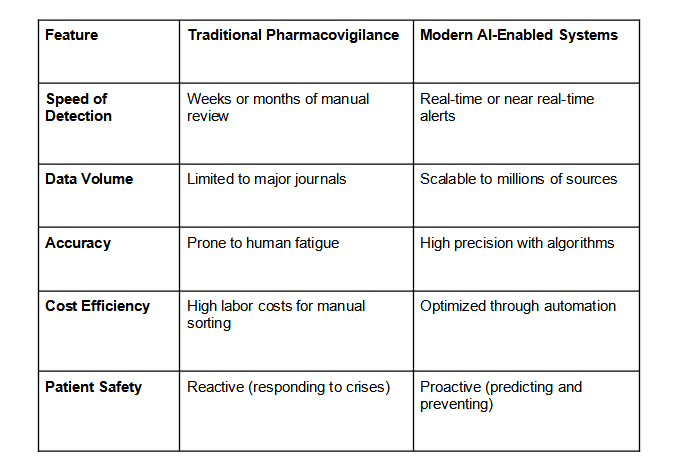
By combining these diverse data streams, the pharmaceutical industry ensures that the “benefit-risk balance” of every medication remains favorable for the people of Bristol. This systematic approach ensures that even the rarest side effects are eventually identified and addressed.
The Crucial Role of Regulatory Compliance and Ethics
Beyond the technology, pharmacovigilance is governed by a strict set of ethical guidelines and legal requirements. In the United Kingdom, the Medicines and Healthcare products Regulatory Agency (MHRA) sets the gold standard for how safety data must be handled.
Pharmaceutical companies are legally obligated to report any significant safety findings within specific, often very short, timeframes. Failure to do so can result in massive fines and, more importantly, a loss of public trust. This regulatory framework ensures that profit never takes precedence over patient well-being.
In Bristol’s local economy, where life sciences and biotech are significant contributors, maintaining this compliance is a matter of professional pride. The ethical dimension of this work involves a commitment to transparency; when a risk is identified, the public and healthcare professionals must be informed accurately.
This open communication allows doctors to make better-informed decisions when prescribing treatments, tailoring their choices to the specific needs and risk profiles of their patients. It is a collaborative effort involving regulators, manufacturers, and frontline healthcare workers.
The Human Element in a High-Tech Safety System
Despite the impressive capabilities of modern software and big data, the human element remains at the heart of medicine safety. Data can highlight a trend, but it takes a trained medical professional to interpret the clinical significance of that trend.
In the South West, this means a network of experts who bridge the gap between abstract numbers and the practical reality of patient care. These professionals are responsible for assessing the severity of reported events and deciding whether a change in medical policy is required.
They work closely with local hospitals and research institutions to ensure that theoretical knowledge is applied in a way that benefits the community directly. This synergy between human intuition and machine efficiency creates a robust defense against risks.
Furthermore, the role of public awareness cannot be understated; when patients are informed about the importance of reporting side effects, they become active participants in the safety network. This grassroots involvement strengthens the entire system, making it more resilient and responsive to emerging health challenges.
Navigating the Future of Medicine and Patient Care
As we look toward the future, the complexity of medicine continues to grow with the advent of personalized therapies, biologics, and gene editing. These innovations require even more sophisticated monitoring systems to ensure that new treatments remain safe for everyone.
The role of specialized personnel remains irreplaceable in this landscape, particularly those who manage the local implementation of global safety standards. For companies operating within the UK, ensuring that there is a dedicated expert to oversee these processes is not just a best practice, but a regulatory necessity.
Professional services and experts such as the https://drug-card.io/local-qualified-person-for-pharmacovigilance-lqppv/ play a vital role in bridging the gap between international data and local health requirements. By having a localized point of contact for safety, the pharmaceutical industry can ensure that the specific needs of the British public are always prioritized.
Ultimately, the goal of all these efforts the AI algorithms, the massive databases, and the expert oversight is to ensure that every prescription written in Bristol leads to a better health outcome. Through this continuous commitment to vigilance, the integrity of our healthcare system is preserved for generations to come.
 Our newsletters emailed directly to you