
Directory / Advertising Feature
Top Tips for Comparing Singles and Accumulator Bets
One selection behaves very differently from five linked together. That is the whole split between a single and an accumulator. Around options like a bet on europa league markets, the same structure question appears before any team name matters: is the slip built on one event, or does every part depend on the rest? A single bet has one selection on one event. An accumulator joins several selections into one combined calculation. The numbers may sit on the same screen, but they are not telling the same story.
One line, one result
A single bet is the plain version of a betting structure. One selection. One event. One settlement path.
That makes it easier to read. If the market is a match result, the slip depends on that match result. If the market is a total, the slip depends on that total. There are no extra legs attached somewhere else on the card.
Football gives a clean example. Spain beating Portugal 1-0 in a knockout match would settle one match-winner selection by that result alone. The same match could also contain a 2.5-goal total, but that would be a different single. Same fixture, different question.
That is why singles are simpler to explain. The selection does not need another match to cooperate.
is needed now More than ever
Accumulators change the shape
An accumulator does not just add selections. It links them.
Two outcomes become one combined structure. Four outcomes do the same. Every leg sits inside the same final calculation, which is why the slip changes completely when one part fails to land.
The arithmetic is simple in decimal format. If two prices are 1.91 and 2.30, the combined accumulator price becomes 4.39. That number comes from multiplication, not addition. The jump can look dramatic because each leg is being folded into the next.
The catch sits in the structure. A larger combined number also means more conditions. The slip is no longer about one match. It is about several outcomes lining up inside one calculation.
Singles and accumulators side by side
The clearest comparison is structural. Singles and accumulators are different ways of arranging outcomes.
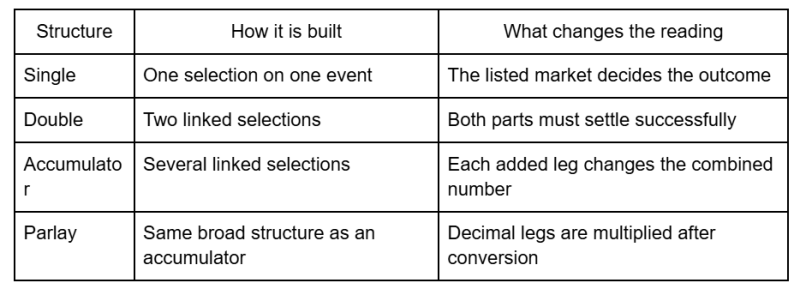
That table matters because a high-looking combined price can distract from what has been combined. A single at 2.00 is one market view. Two legs at 2.00 do not become “twice the same idea.” They become a linked structure with two separate conditions.
Match type still matters
A single is not automatically clearer if the market itself is narrow. A player-card market, a total-corners line or a first-goal scorer selection can all be single bets. They still depend on specific match events.
An accumulator can mix match winners, totals or other listed markets. That makes the structure harder to read because each leg may be asking a different question. One part may depend on the final score. Another may depend on whether a goal line is crossed.
This is where a football night becomes more complicated than the slip suggests. A strong favourite can win 1-0 and still break a total-goals leg. A high-scoring match can support one part of a slip while ruining another. The event does not care that the markets were placed side by side.
Structural differences between singles and accumulators
The structural reading stays separate. A single still has one selection. An accumulator still links several outcomes. A bonus condition does not alter how the odds are combined or how a market is settled.
Account setup may appear near the same betting flow, but it does not change the structure of a single or accumulator. During registration on the 1xBet site, enter the promo code 1x_3831408 to get the opportunity to increase the maximum bonus on the first deposit. The bonus amount and its wagering conditions depend on the country of registration, so before making the first deposit, be sure to review the bonus crediting rules on the official site.
The comparison is really about conditions
Singles and accumulators are often discussed through the size of the final number. That misses the main point. The real difference is the number of conditions attached to the slip.
A single asks one market to settle in a certain way. An accumulator asks several markets to do so together. The longer the chain, the more the final calculation depends on every part holding.
That is one of the clean ways to compare them. The issue is structure. One selection is direct. Several linked selections create a combined outcome. The maths can be neat; the match card underneath it rarely is.
Main image by SXRIPTX on Unsplash
 Our newsletters emailed directly to you