Film / Reviews
Sunset Song
Sunset Song (15)
UK 2015 133 mins Dir: Terence Davies Cast: Agyness Deyn, Kevin Guthrie, Peter Mullan
Celebrated House of Mirth filmmaker Terence Davies spent 15 years attempting to get Lewis Grassic Gibbon’s curriculum mainstay Sunset Song onto the big screen, and if nothing else, it’s tempting to praise his unyielding resolve. A sweeping story of family, farming and war in early 20th century Scotland, Gibbon’s story packs in a lot of incident, and it’s entirely to Davies’ credit that he’s fashioned a sumptuous movie experience that’s as expansive, beautiful and formidable as the Scottish Highlands.
Much of the movie’s impact hinges on the casting of fashion model and occasional actress Agyness Deyn in the central role as Chris Guthrie; with her statuesque frame and a look seemingly incongruous to the period setting Deyn is in fact perfect, delivering a consummate portrayal of a forward-thinking woman torn between her own modernist desires and the traditions of the time. With her name evoking a sense of the masculine (“It’s Chris, not Chrissie,” she points out), she’s a compelling character, and when we’re first introduced she’s in the thrall of literature, aspiring to become a teacher. Living in rural Aberdeenshire, Chris is the daughter of a brutally traditional father John (Peter Mullan), a farmer who swears by the Bible and yet violently forces himself upon her mother Jean (Daniela Nardini).
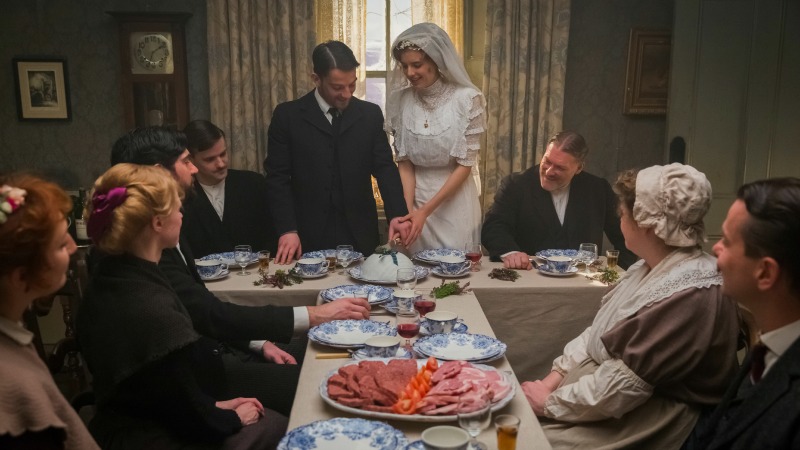
One of the more interesting, quietly progressive moves of the film’s early stretch is showing Chris’ sterner, steelier fibre when compared to her more passive brother Will (Jack Greenlees), the unfortunate recipient of many of John’s violent rages. When her mother dies in childbirth as a result of John’s actions, it sets in motion a series of events that will change the family forever. Eventually, we build towards Chris’ tender courtship and marriage to Ewan (Sunshine on Leith’s Kevin Guthrie), a union that threatens to be torn apart by the onset of the First World War
As with everything in Davies’ tapestry, happiness is but a thread that can be easily snipped. For every moment of light, there is also one of darkness, an emotional trajectory flecked with equal parts beauty, ugliness and redemption. Yet as the title implies, Chris’ story is one that has echoed across the centuries since time immemorial: even as human complexities dominate in the short term, eventually it all fades into history with nothing but the impassively beautiful landscape remaining. Davies’ film is one that’s both alive with a sense of social tension (something that goes all the way back to his classic Distant Voices, Still Lives) and the enigmatic, rich beauty of the natural world. The collision of these two realms is where the movie is at its best.
Increasingly melodramatic as it proceeds, the second half of Sunset Song threatens to bog down in one long burst of emotional hysteria. Nevertheless, it’s grounded by a genuinely impressive central performance from Deyn, whose lilting Scottish accent (she is in fact Mancunian) gives rise to tactfully deployed slivers of narration from Gibbon’s novel. It’s a movie rendered in the bold colours of a Scottish sunset: unsubtle at times and overwrought of course, and one that feels oddly out of time. Little wonder it took Davies so long to get the movie where it is: with its languorous pace and steady focus on compelling human characters, it’s a bracingly old-fashioned experience in a digitised age.
 Our newsletters emailed directly to you