Film / Reviews
Review: The Commune
The Commune (15)
Denmark/Sweden/Netherlands 2016 112 mins Subtitles Dir: Thomas Vinterberg Cast: Trine Dyrholm, Ulrich Thomsen, Fares Fares, Julie Agnete Vang, Lars Ranthe, Helene Reingaard Neumann, Mads Reuther, Martha Sofie Wallstrøm Hansen, Magnus Millang, Anne Gry Henningsen
Yer standard-issue ’70s-set communal living/free love drama rarely gets beyond sniggering at revolutionary political posturing and untamed body hair. This was especially hard to swallow when delivered with sneering disdain during the decade that succeeded it, which was characterised by greed, solipsism, grotesque fashions and awful music. Refreshingly, Thomas Vinterberg evinces a genuine interest in and empathy for those who are at least striving to find a better way of living than the tyranny of the nuclear family. At its best, his adaptation of his own stage play feels like a hybrid of Ang Lee’s The Ice Storm and Lukas Moodysson’s superior Together as it charts the trials of bourgeois types negotiating the minefield of collective living and group decision-making about personal relationships. Alas, despite some excellent performances, it also lacks the astringency of Vinterberg’s most brilliant previous films, notably Festen and The Hunt.
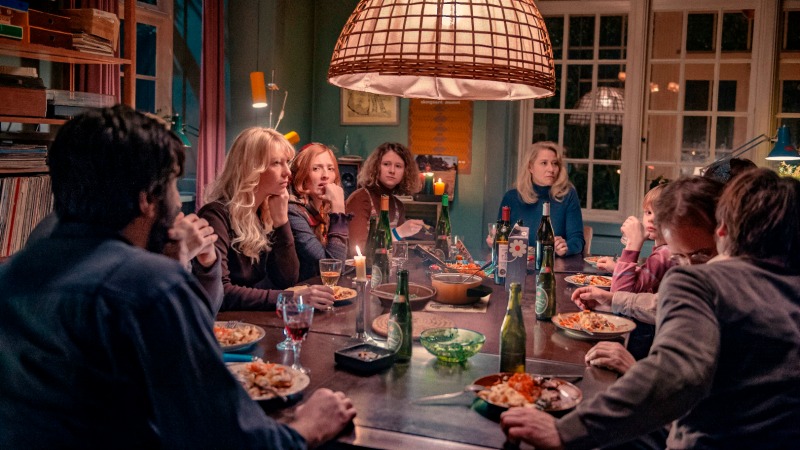
In early ’70s Copenhagen, crumply middle-aged academic Erik (Thomsen) inherits a huge, rambling house from his estranged late father. His instinct is to sell, since the family can’t afford the bills. Gripped by the permissive spirit of the age, his restless TV newsreader wife Anna (Dyrholm) talks him into opening it up as a cost-sharing commune where they can live with their shy 14-year-old daughter Freja (Hansen) and a bunch of close and not-so-close bohemian chums. Before long, they’ve recruited hard-drinking lefty Ole (Ranthe), enthusiastic shagger Mona (Vang), the lachrymose and impecunious Allon (Fares), and a bunch of other characters who are so thinly drawn that they barely register. Everyone goes skinny-dipping together and a cover of The Who’s Join Together plays on the soundtrack as they celebrate the start of their great utopian experiment. We all know what happens next, right?
There’s certainly some of the anticipated bickering over unauthorised beer consumption during mind-numbingly tedious household meetings, but the real threat to the stability of the commune turns out to be an external one. Ever-so-slightly improbably, Erik is seduced by sexy 24-year-old student Emma (Neumann), who’s clearly aroused by his lectures on rational architecture and, rather unfortunately, resembles a much younger Anna. He then moves her in for some loud rumpy-pumpy. As the other characters melt into the background, the film resolves into a love triangle drama in which self-sacrificing Anna feels obliged to publicly acknowledge her rage-prone hubby’s right to “pursue his feelings” even though this causes her to crack up.
Comparisons with Festen are inevitable, especially as Trine Dyrholm and Ulrich Thomsen are on excellent form in both films. Here, Dyrholm dominates as her character undergoes dramatic mental disintegration, but Thomsen is no less impressive as the unsympathetic Erik, who struggles to balance work, communal living and his vigorous affair, finding little time to address what he considers to be “women problems”. Vinterberg’s warmth towards this milieu is perhaps explained by the fact that he was raised in just such a suburban commune. He’s certainly more interested in the personal than the political, plotting a fairly predictable course driven by some uncharacteristically soapy plot contrivances towards bittersweet warm fuzzies soundtracked by Elton’s Goodbye Yellow Brick Road. The nadir is reached with the near-parodic inclusion of a cute-yet-sickly child whose manifest destiny is to pop his clogs at a dramatically convenient moment.
 Our newsletters emailed directly to you