Film / Reviews
Love Is All
Love Is All (12A)
UK 2015 74 mins Dir: Kim Longinotto
Best known for such hard-hitting feminist documentaries as Divorce Iranian Style, Sisters in Law and Rough Aunties, Kim Longinotto takes a left turn into romance with this loose collage of love-themed film clips from the last 100 years, cut to a soundtrack by Richard Hawley with just the occasional snippet of dialogue. All the sources are listed during the end credits but no captions are provided, which can be rather frustrating. Longinotto and her editor Ollie Huddleston are also clearly limited by a tiddly budget, making them heavily reliant on the BFI and Yorkshire Film Archive (the Yorkshire footage is easily identified by the preponderance of blokes in cloth caps and potato-faced women scrubbing steps). All the obvious Hollywood choices are missing, but there are lengthy extracts from both Brick Lane and the movie that played almost continuously at the Watershed throughout the late 1980s: Stephen Frears’ My Beautiful Laundrette. On the plus side, this means Longinotto’s compilation doesn’t suffer from over-familiarity, although eagle-eyed viewers may spot some clips that were shown in C4’s recent archive-raiding Confessions of a Secretary.
Playfully alert to the joys of visual metaphor, the film opens with grainy old monochrome footage of trains going in and out of tunnels. Next, we see a randy silent movie gent taking a deep drag on his fag before plunging his tongue down the throat of a hat-wearing lady, presumably gathering his strength prior to removing her many layers of clothing and having his evil way. Indeed, one of the most striking things about many of these clips all the way up to the 1980s is just how integral smoking was to movie foreplay, underlining how swiftly attitudes towards the habit have changed. It’s also one of the reasons why the BBFC has given this rather innocent, entirely non-explicit film a 12A certificate, presumably to prevent impressionable children being inspired to spark up by oily, moustachioed 1940s suitors and their swooningly helpless conquests.
The film segues rapidly from melodrama to documentary, past to present and back again, hesitant 1920s black and white courtship rubbing up against passionate, full-colour 1980s lesbian snogging as same-sex and mixed-race relationships liven up the mix. A delicious frugging montage takes in punks, rude boys, hippies, mods, stiff ballroom dancers and a fella who’s driven so wild by the rhythms that he, erm, waves his tie around. There’s also some utterly bizarre stuff in here, about which you yearn to learn more. In Hints to the Ladies on Jiu-Jitsu (1926), we see a woman coming to the rescue of a female mugging victim, battering the assailant into submission. The duo then repair to what appears to be a giant mattress to engage in some saucy girl-on-girl wrestling before exiting arm-in-arm. A very short clip from Peeping Tom (1905) seems to suggest that dogging is by no means a 21st century invention.
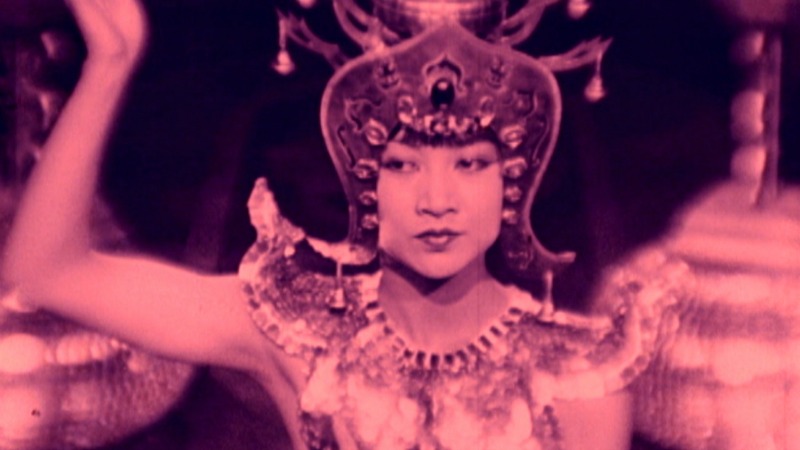
Non-fans may find Hawley’s songs rather dreary and repetitive (at least one song is in fact repeated), and one can’t help thinking the film might be better served by some context. Allow me to supply a little. The sultry, luminous Asian beauty who gives her lover’s wife a knowing smirk in the steamy 1929 love triangle drama Piccadilly is Anna May Wong. The first Chinese-American film star to gain global recognition, her inter-racial screen kissing scandalised polite society. On a local note, she starred in Java Head (1934) – the first film about the slave trade to be set in Bristol. Surely it’s time she got her own biopic or documentary. But I digress…
Connoisseurs of howlingly funny old-school moralising and sexism will find much to savour. In one drama, a girl is punished by her harridan of a mother for the sin of “going to Blackpool with a chap”; in another a ‘wicked girl’ is ruined by a bounder who gets her in the family way. As recently as 1973, Don’t Be Like Brenda was cautioning women against pre-marital sex. Luckily, unwanted pregnancy is not something that need concern gentlemen. “Instead of giving birth and caring for baby, they are often better at giving birth to new ideas,” explains the smug, blithely patronising male voiceover to what is presumably a period documentary elucidating the differences between the genders for the benefit of young children but feels like it should be part of a UKIP election broadcast. “They are in fact usually more inventive and creative.”
 Our newsletters emailed directly to you