
Music / Live Music Venue
In the Know: Hadie Abido, the Jam Jar – ‘We do things because they feel good’
The Jam Jar might have an unsurprising origin but dig deeper and the venue’s story unfolds as one of constant change and innovation.
Co-founders Hadie Abido and Joel Williams, both wide-eyed culture lovers in their twenties, met at a festival and dreamed up the idea for a venue at gigs, house parties and afters – so far, so typical.
But in the decade that followed they’ve faced a constant barrage of obstacles including noise complaints, licensing issues, a pandemic, money-sapping renovations and a shifting economic and cultural landscape that has forced many independent venues to throw in the towel.
is needed now More than ever
They’ve responded to each challenge in the only way they know how: “We don’t go the easy way round,” says Abido. “We get our hands dirty and go our own way. We do things because they feel good, not because it’s a smart financial decision.”

Now a vibrant 250-cap community arts space in St Jude’s, the Jam Jar is known for its quality music programme and has also branched out into social impact work, a festival of global sounds, and stage takeovers at festivals local and further afield – photo: the Jam Jar
Their approach was cultivated in the years around 2010 when “we were rolling around Bristol learning about ourselves. There was a lot more squat culture, DIY stuff going on,” says Abido, citing among others Easton’s Kebele centre, now BASE, as well as Telepathic Heights on Stokes Croft and the Magpie in Montpelier, the Motorcycle Showrooms, roving Invisible Circus shows and Williams’ own Squid Parties featuring artists like the Gentle Mystics, JFB and Baia La Cumbia.
“It was a very different city not so long ago. There were lots of anarchist centres, free parties, you couldn’t walk for more than 200m without going past a squat.
“Alot of culture came from that – harder dance music, Gypsy-Balkan styles, many of the festivals we loved like Boomtown – and I’d say Jam Jar emerged from those scenes too.”
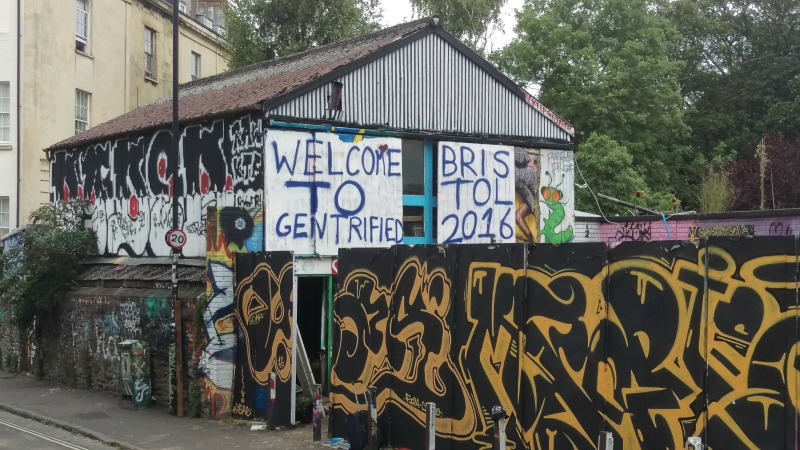
The Jam Jar was forged from DIY and squat culture enjoyed by the team in Bristol and Berlin, and while its outlook is now more professional they have made an effort to retain some of the venue’s original feel that makes up its foundations – photo: Bristol24/7
It wasn’t only that DIY ethos that helped forge the Jam Jar: the scene’s influence came in much more concrete form as well.
“The freedom of youth and the guidance of elders is a big part of our origin story,” says Abido.
“The older generation really encouraged it. They lent us soundsystems. Our lighting until about 2022 was a bunch of Parcans that lit every Arcadia creation for the previous 10-15 years! We’d turn them off and on at the switch when we wanted strobes.
“They gave us a leg up. The hand-me-downs of a generation of people who we really respected helped us come to where we are now.”
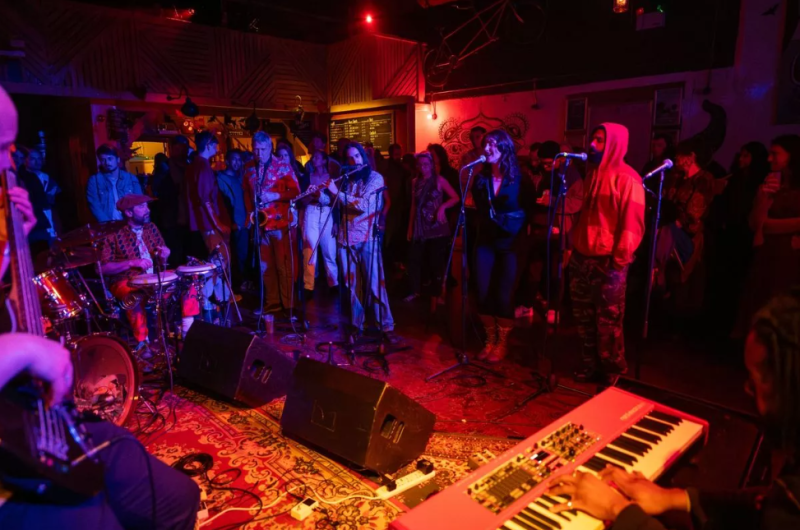
The venue’s open jam night ‘The Door is Ajar’ harks back to a time when the city’s DIY scene was at its strongest; it is hugely popular with the music community – photo: the Jam Jar
It was this make-do-and-mend attitude that prevailed when Abido and Williams obtained the keys for the unit in St Jude’s in 2014, before either had finished university.
A series of events that reads like a who’s who of festival stars of that era – think the Langan Band, Tako Lako, Dub the Earth, the Destroyers – was accompanied by “harsh words” from the authorities which they attempted to circumnavigate by operating first under the radar and then as a members’ club, along with “many other avenues”.
“It was difficult for us to make that next step with no money behind us,” Abido says. “We had part time jobs and were running the place on the side. We’d spent every penny renovating the place to be at least usable. Even hiring a solicitor to get a license is thousands of pounds.”
Yet they persevered and the community came through: a successful crowdfunder raised £15,000 which enabled the necessary adjustments and eventually – after “a five year slog” – a license was granted in 2019.
The opening party was “a spectacular sell out” and the venue had a wild few months. Then lockdown hit.
View this post on Instagram
By August 2020 they were forced to open to survive and again reframed the challenge as an opportunity, turning old pallets into seated booths and asking DJs and bands “to dig deeper into their collection or repertoire, to put on more easy listening stuff. People liked that response in our programming.”
That agility, coupled with fruitful conversations with the Music Venue Trust and grant funding, enabled the venue to land on its feet on the other side of the pandemic, and it’s fair to say they haven’t looked back.
They’ve found their niche, loosely revolving around global sounds both folk and electronic which has earned them collaborations with Shambala, WOMAD, Valley Fest and more. “We built an audience and a place for that audience to go,” says Abido.
“All that investment, time and energy we put in over the years has formed the space we see today. It’s professional in terms of production, but has a DIY element and feels authentic. We tried not to lose that.”
But while the musical outlook is global it’s also, he suggests, the “philosophy of localism” that sets them apart. This incorporates everything from stocking local, sustainable brands to caring for team members who are “essentially a family” and investing in education.
View this post on Instagram
They’ve already trained a cohort of young women from Global Majority backgrounds in sound engineering, supported two women into lighting roles and started a course for promoters. Their New School initiative is designed to “turn every gig into a learning opportunity”.
“We always wanted to do good things, and diversify the people coming through the Jam Jar,” says Abido. “I believe you’re paying it forwards by investing in people. There’s no better way to create an amazing ecosystem than just taking a chance on young people.”
So they continue, “swimming very fast upstream” as Abido puts it, ever learning and evolving. Where does that drive come from? “There’s no way out now!” he laughs.
“It’s just keep digging, basically. When we get to the point where we stop growing we’ll know whether it works or not. We’re not there yet!”
Main photo: Paul Lippiatt
Read next:
 Our newsletters emailed directly to you