
Film / News
Ralph Pringle’s grave de-brambled
If you read our piece about 15 places in Bristol that once were cinemas, you’ll already be familiar with the name Ralph Pringle. One of the great cinema pioneers of the early 20th century, Pringle’s crowning glory – and monument to his ego – was the long-demolished 2,400 capacity Pringle’s Picture Palace off Zetland Road, which boasted a luxurious furnished lounge and a grand circle reached by a marble staircase. His grave at Arnos Vale Cemetery is among the latest to be de-brambled by industrious volunteers, but the modest headstone doesn’t even mention his key role in early British cinema.
So allow us to enlighten you. Pringle was a colourful, old-school showman who worked for the Thomas Edison Animated Moving Picture Company in Newcastle. In 1901, he struck out on his own under the grandly named North American Animated Picture Company banner, touring new-fangled moving pictures around music hall venues across the land. These gimmicky shows often included tinted prints, gramophone-linked sound and close-up photography. One enticing title was The Fearful and Wonderful Life of a Piece of Gorgonzola.
Pringle first visited Bristol as a travelling musician on a paddle steamer. He returned to the city for packed shows at the Colston Hall, where he screened silent versions of The Life of Christ and A Tale of Two Cities. He certainly seems to have raked in the loot, which allowed him to build a local cinema empire. In 1909, he took out a lease on Bedminster Town Hall, later adding the Vestry Hall (which was between Old Market and Easton), followed swiftly by the Dolphin in the city centre and that grand Pringle’s Picture Palace – both of which opened in December 1910. Pringle also had cinemas in Nottingham, Edinburgh, Birmingham, Huddersfield and Paris. Ever the huckster, he continued his touring shows, bringing the funeral of King Edward VII to the Colston Hall a day after it had taken place at Westminster Abbey and Windsor in May 1910. A full orchestra and choir played the King’s favourite hymns during the screening. This jolly event filled the Hall for three solid weeks. Even the Lord Mayor turned up to see it. “Such a rush or demand of the public to see animated pictures has not been known in this city before,” marvelled the Western Daily Press.
is needed now More than ever
Pringle loved his gimmickry. His cinema programmes included vaudeville acts, hair-dressing competitions and ‘every lady will be admitted free to all parts if accompanied by a gentleman’ promotions. At his Zetland Road Palace, he even engaged “celebrated Russian dwarfs” Baron Nicholay and Son to pad out a show.
Importantly, Pringle also ensured a steady stream of new local films to exhibit by collaborating with pioneering documentary filmmakers Mitchell and Kenyon. Indeed, he financed more of their films than any other showman, putting up the cash for 107 of the surviving 800 prints in the BFI’s collection. The top-hatted Pringle even appears in one of them, which you can view here, interviewing a Boer War hero who won the Victoria Cross.
So what happened to Ralph Pringle? That remains something of a mystery. At one point he’d been offered £50,000 (a very sizeable sum back then) for all his assets, which he’d turned down. Then in 1914, he suddenly sold all his cinemas for whatever he could get for them. He also flogged off his fine house in Cotham and his expensive cars, skipping town in something of a hurry. Rumours suggested he had over-reached himself and was also an inveterate gambler. Either way, we know that by 1922 the 66-year-old Pringle was stricken with cancer and had wound up in Port Talbot. His widow was reduced to playing the violin to support the couple’s four children.
Fortunately, there’s a slightly happy ending to Pringle’s tale. The vulgar showman might not have been acceptable in polite society, but he was always popular among his employees and fellow exhibitors. In August 1922, a flowery advertisement addressed to “the Old Pringle Boys” had appeared in the Kine Weekly:
The old governor is stricken nigh unto death. Are these boys who wandered up and down the country under the glorious old Pringle banner to see him linger on to the end in a state of poverty when his only wish is to die in the city he loves and to spend the few remaining days among old associates?
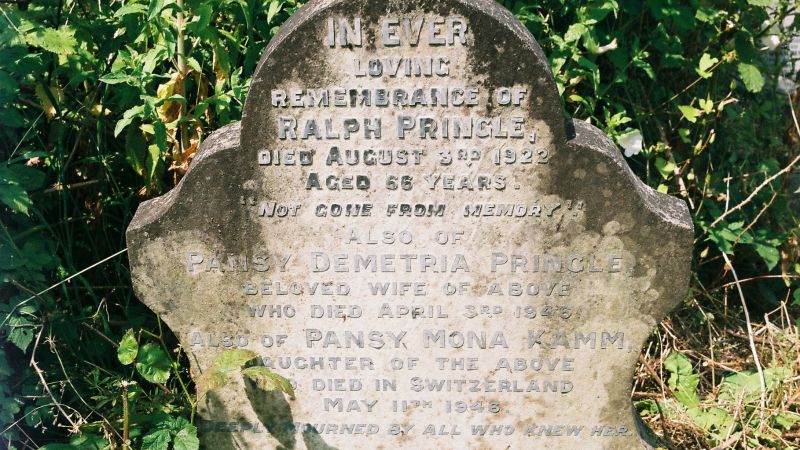
After Pringle’s death, the local branch of the Cinema Exhibitors’ Association paid for his headstone at Arnos Vale Cemetery. His funeral was attended by many cinema owners. If you want to find his grave, you’ll find it in the top plateau, along from the Cross of Sacrifice. It’s on the left-hand side just before you reach the little grass roundabout as you walk in the direction of the Top Lodge.
With grateful acknowledgement to A City and its Cinema by Charles Anderson (Redcliffe Press, now sadly out of print).