Features / Wildlife
Wild Summit 2025: We need to ‘stop holding onto remnants’
Environmentalists and nature enthusiasts assembled in Bristol at the very first Wild Summit UK to listen to some of the world’s leading experts on wildlife, sustainability and conservation discuss how to turn the tide on one of the world’s most nature-depleted countries – the UK.
Bristol Beacon teemed with people wanting to connect with others, learn and devise solutions to some of our country’s most pressing environmental concerns.
Organised by the Wildlife and Countryside Link, a large environment and wildlife coalition, the aim of the summit was to help the UK government meet its target of protecting 30 per cent of land and sea by 2030.
is needed now More than ever
With only five years to go, this conference on Thursday could not come soon enough.
Although there are many challenges that are upending the road to this goal, housing was a topic that dominated the talks.
It seems that not a day goes by where there isn’t a push and pull with developers that sees ecologists fight tooth and nail for a bit of green.
However, not all green spaces are made equal, with many important habitats home to species like bats and birds, as well as protected animals like newts, facing relocation or worse, destruction.
There are measures that are mandated to minimise this, such as species-specific surveys undertaken as part of the planning application process.
But there is evidence to suggest this is not always done properly and the presence of a species is played down to avoid having to amend or abandon plans.
No-one at the event was happy with the planning system inherited from the previous Conservative government and many argued it needed to be reworked. Pivoting to a national restoration budget was one of the many suggestions.
Several of the panellists acknowledged that the growing housing crisis needed to be fixed, but not at the expense of nature.
Kit Stoner, CEO of the Bat Conservation Trust, and Rosie Pearson, co-founder of the Community Planning Alliance, singled out the Planning and Infrastructure Bill currently in the House of Lords, as being in need of bold revisions.
Echoing a campaign by the Wildlife Trusts, they both called for the removal of part three of the bill that would allow for developers to pay into a one-off levy to account for the damage inflicted on nature and wildlife present or, as Rosie put it, “paying to bash nature”.
The UK special representative for nature, Ruth Davis, resolved that the only way to cut through the conflict and to avoid preaching to the converted was to have a discussion with someone who on principle profoundly disagrees with environmentalists.
She went on to explain that some people on the other side of the discussion profoundly believe that those advocating for greater environmental consideration do not care about people or the need for housing.
To change that perception, she said, it is necessary to have these hard conversations — and to do so with respect.
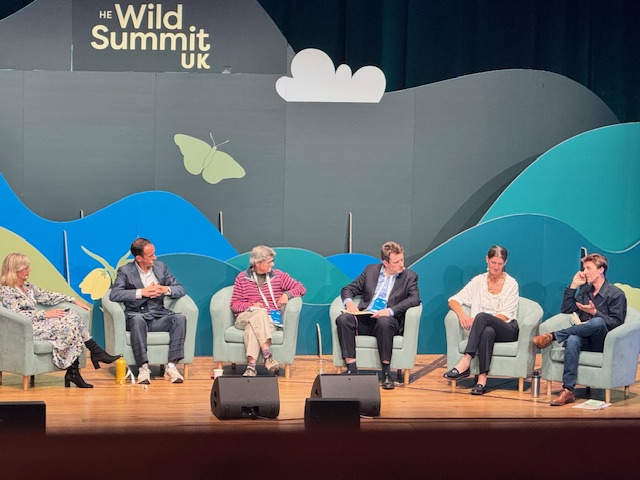
One panelist said a section of the Planning and Infrastructure Bill could allow developers to pay to “bash nature”
Farming and the agricultural industry has also become a hot topic in the battle to protect biodiversity and tackle climate change.
In short, panellists said the entire system needs overhauling.
Guy Shrubsole, campaigner and author, called for a national land use framework, with a focus on rethinking how least productive farmland is used.
“We need more people who use land to come on this journey,” he said, urging a wider exploration of nature-based solutions.
Tony Juniper, chair of Natural England and former chair of the Wildlife Trusts, echoed that call, highlighting the potential of re-naturalising floodplains
“Flood prevention money must work harder for both people and wildlife,” he argued.
Restoring wildlife has been a divisive topic among farmers but, rather than demonise the industry, many experts agreed that rebuilding trust between farmers and policymakers is essential.
“Nothing is more important than repairing that relationship,” said MP and chair of the government’s Environmental Audit Committee, Toby Perkins, stressing that farmers and environmentalists are interdependent, not adversaries.
But confidence in the sector is low.
National Farmers’ Union voices pointed to a “crisis of confidence” and warned that current legislation often does little to prevent conditions for livestock from deteriorating further.
Farmers, they argued, are “a small cog in agriculture being turned by bigger cogs” such as supermarkets which must do more to ensure fairness in the supply chain.
Speakers also pressed for a wider perspective beyond carbon targets. They said a true farming vision must balance carbon reduction with water quality, animal welfare and sustainable diets.
That means questioning the normalisation of eating meat multiple times a day, rethinking the crops we plant on flood-prone land and rejecting reliance on pesticides like the recently banned bee-killing ban neonicotinoids.
With Sustainable Farming Incentives set to play a critical role, Guy Shrubsole insisted any land use framework must align with this bigger vision – one that keeps farmers central, but also makes space for nature and long-term resilience.
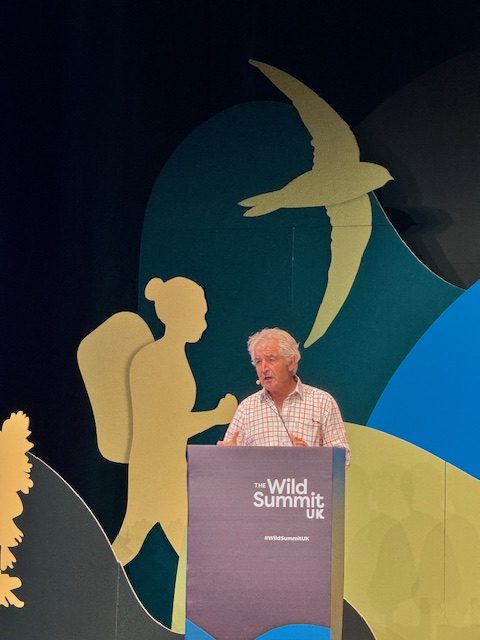
Tony Juniper, chair of Natural England, said: “Flood prevention money must work harder for both people and wildlife”
Many of the talks were underscored with a weariness and apprehension that all the time and energy channelled into progress could be upended and reversed by Reform UK if they were to come into power.
The increasingly popular political party has made no secret of its intention to scrap net zero and renewable energy subsidies.
While the West of England Combined Authority team chaired the Nature, Growth and Regional Resilience panel, many activists and experts elsewhere on the programme spoke of the word growth with open disdain.
As the day came to an end, Martin Harper, the CEO of Birdlife International, commended the team for a lovely day. But, daring to say the quiet part aloud, he also said: “It all feels too gentle.”
A thought that was clearly widely shared as several audience members nodded.
He compelled the audience to be “confident in using our own power and agency and make the arguments”.
Tony Juniper agreed, calling for everyone to be bolder in their demands and stop playing small by “holding onto remnants”.
With the latest State of Nature report, backed by leading environmental academics and government agencies, revealing one in six species are at risk of extinction in the UK, it couldn’t be clearer that we must, to quote another panelist, “rebuild at scale”.
All photos: Hannah Massoudi
Read next:
 Our newsletters emailed directly to you