Your say / cycling
‘North Street is fundamentally unsafe for cyclists’
Southville is the best place I’ve ever lived thanks to its deep community spirit. But there is a significant blot on this landscape: the lack of safe cycling infrastructure.
When we arrived in BS3, Bristol had been championed as the UK’s first cycling city.
Having never owned a car, I had no intention of starting; I loved cycle commuting when I lived in London, where segregated paths and low traffic neighbourhoods have increasingly made cycling feel like a normal, safe way to get around.
is needed now More than ever
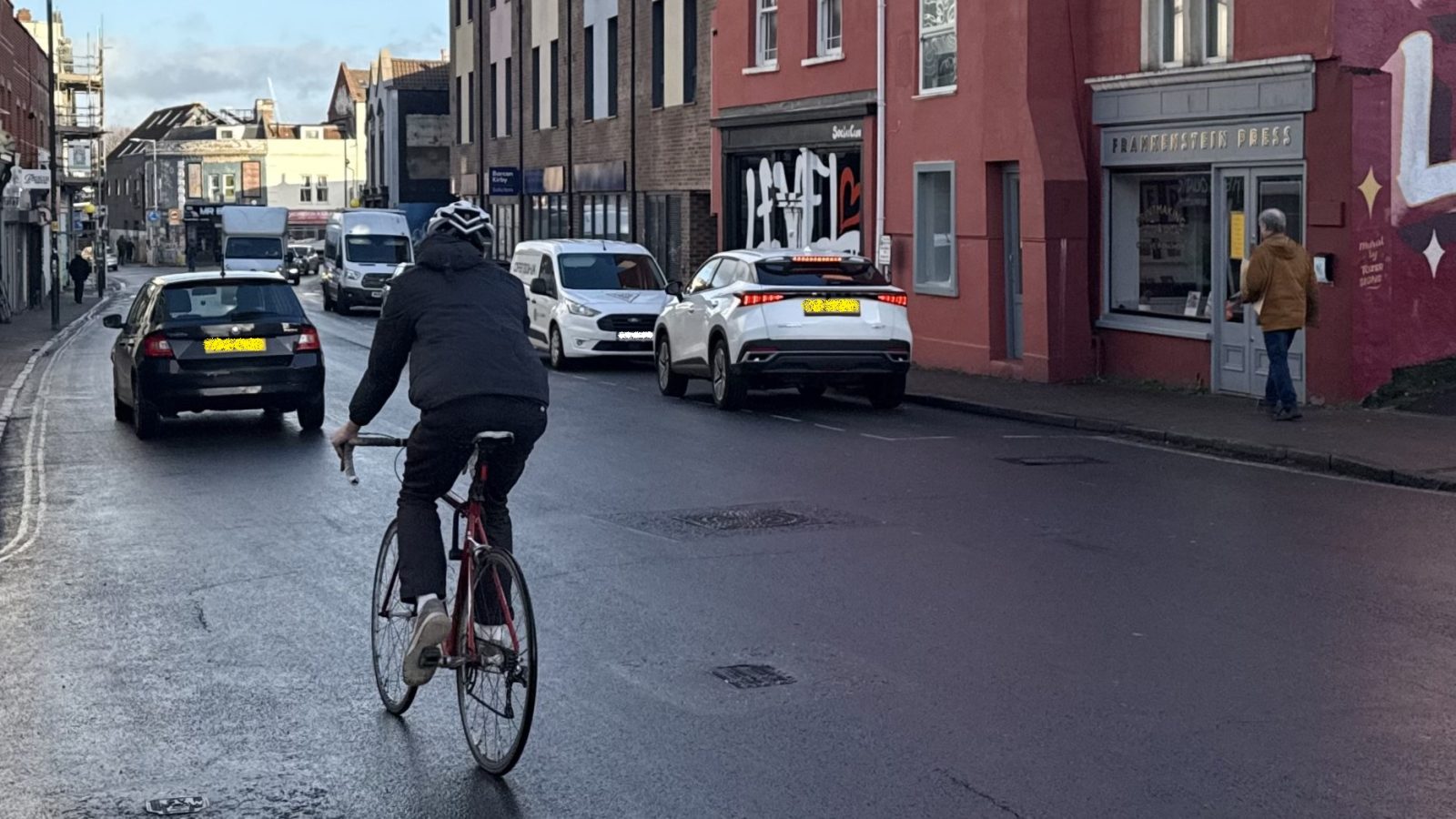
Cycling down North Street today, however, is more terrifying than any road I encountered in the capital.
The daily reality on North Street is one of invitational design; a layout that practically invites dangerous behaviour.
The long, unmitigated drags encourage drivers to speed massively in excess of the 20mph limit.
Almost every one of my journeys involves a close pass, often accompanied by the smell of weed from a window or the glimpse of a driver’s lit-up phone screen.
I am far from alone in this experience. Take a look at Bristol City Council’s own road issue reporting tool and you’ll see North Street is littered with complaints regarding speeding and layout dangers, some dating back over five years.
Despite this data, intervention has been non-existent.
While the council has made great leaps in the city centre – such as the improvements at Prince Street, Bristol Bridge and connections to Temple Meads – the investment remains heavily skewed.
Large sums were spent remodelling Park Row and the area leading to College Green, both of which have felt largely pointless, yet south Bristol feels increasingly disconnected.
The council recently had a chance to fix this, but the South Bristol Liveable Neighbourhood scheme – which aimed to reduce through-traffic and make our streets safer – has been delayed following residents’ concerns.
While the scheme may have had some shortcomings, the claim from many residents that south Bristol is already a liveable neighbourhood, collapses the moment you step outside.
South Bristol is not liveable by any stretch of the imagination when drivers routinely plough through junctions with total disregard for others, or speed past primary schools during the morning rush.
The density of traffic is reaching a breaking point; in the last decade alone, more than 1000 additional cars have been added to Southville’s streets.
Despite the fact that 32 per cent of our households don’t own a car, those who do are increasingly multi-vehicle, clogging Victorian streets never designed for this volume.
Liveable neighbourhoods are the only tried-and-tested way to encourage urban residents to walk and cycle short distances.
The consequences of this inaction are personal and immediate.
After the tragic events of this weekend, my family is frankly terrified, and I have stopped my older daughter from cycling to school at Ashton Park.
By making the environment too hostile for a teenager to cycle to school, the council is failing its own active travel targets.
We used to grin and bear it, but we can no longer ignore that North Street is fundamentally unsafe.
We are forcing the next generation back into cars because the current infrastructure makes their independence a death risk.
It should, and could, have been fixed a long time ago.
This is an opinion piece by Matt Kelland, a marketing manager with a particular fondness for leisure riding and exploring the UK’s cycle networks
Main photo: Martin Booth
Read next:
 Our newsletters emailed directly to you