Features / Festival of Ideas
Review: Theodore Zeldin, Festival of Ideas
Named by The Independent on Sunday as one of the 40 thinkers most likely to have lasting relevance in the 21st century, academic Theodore Zeldin is worried.
Humans are living wasted lives, unaware of what is happening inside one another’s head, failing to explore the possibilities of life and failing to draw on the experience of others, both living and dead. “Everyone who has lived in the past has something to tell us,” he tells the audience. Zeldin is also disturbed by the fact that work is not designed to make people feel fully alive.
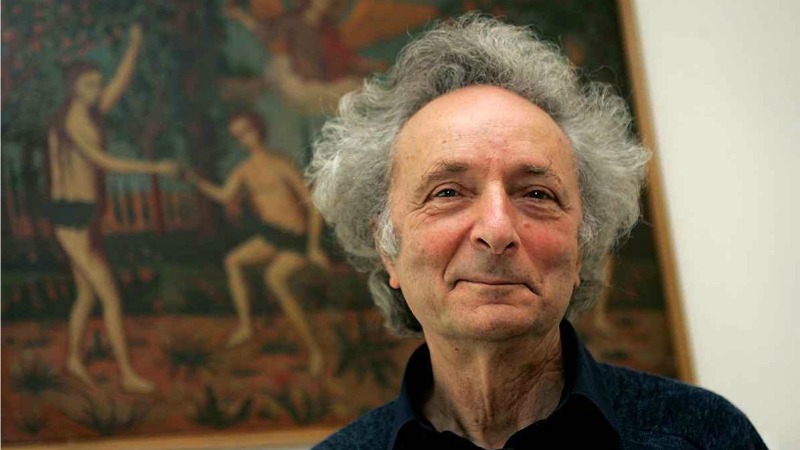
With his long grey hair and academic mien, Zeldin looks like a secular cardinal delivering a softly-spoken shriek of anguish against an anonymised society. His solution is curiosity and honesty: to talk frankly to one another about the things that truly motivate us, and to listen wisely.
Zeldin, spoke just a day after causing a storm at the Hay Festival where he said: “I think mindfulness and meditation are bad for people, I absolutely think that. People should be thinking.”
“It’s important not to think just about yourself,” Dr Zeldin told the Hay Festival. “You think that trying to avoid things by doing exercises which free the mind from thought and will empty out minds.”
The manifesto in the new book he is promoting, The Hidden Pleasures of Life, seeks to cut through the pretence and illusions which surround us in everyday life to see the person beneath the façade and the assumptions – whether the latter is a high-ranking government official, a wage slave in an Amazon distribution centre or an impoverished Indian farmer.
In arguing that co-workers should get to know one another as people, Zeldin was echoing the argument put forward by Margaret Heffernan in her earlier Festival of Ideas talk. But whilst Heffernan’s approach was more business-like, describing it as “building social capital” with a clearly definable end-benefit, Zeldin’s more philosophical view offers no ‘business case’, but champions it simply as A Good Thing.
Although Zeldin’s proposed approach is an appealing one, it does not seem to fully take account of the workings of our contemporary society. It is one of the flaws of the modern world that the slightest admission of weakness or fallibility readily triggers a tumult of disapproval. If a government minister or CEO were to take Zeldin’s advice to heart and admit that sometimes they simply don’t know what to do – even though, being merely human, that’s undoubtedly true – it would unleash a media firestorm that would demolish their careers and their lives.
Until the rest of the world gives us the space to be open and frank, honesty may not be the best policy: and Zeldin’s dreams of less-wasted lives may sadly remain confined to the covers of his book.
Theodore Zeldin spoke at Watershed on Tuesday, May 26 as part of the Festival of Ideas. For more upcoming FoI events, visit www.ideasfestival.co.uk
 Our newsletters emailed directly to you