Directory / Advertising Feature
Cryptocurrency Changed How Online Gambling Handles Payments
Bank transfers take days. Credit card deposits get declined. And withdrawals? Some players wait a week just to see their money move. That’s why so many switched to crypto.
Five years ago, the crypto gambling market sat around $50 million. Today? Somewhere near $250 million. As crypto adoption expanded, elements like bizbet promo code began appearing within deposit-related discussions, reflecting broader changes in how players access blockchain payments. Crypto used to be maybe 20% of bets. Now it’s past 30% and climbing.
What changed? Bitcoin and Ethereum settle in minutes. No waiting for bank holidays to end. No processing queues. Operators like it too because chargebacks basically disappear.
How Provably Fair Gaming Works
Old-school online casinos run on trust. You click spin, something happens on a server somewhere, and you just hope the result wasn’t rigged. Provably fair flips that.
Here’s the rough idea. Before each round, the casino locks in an outcome and encrypts it. You get a copy of that encrypted hash plus your own random seed that affects things slightly. Round ends, casino shows its cards. Anyone who wants to can run the numbers and confirm nothing got changed after bets were placed.
All of this gets recorded on the blockchain. Public, permanent, checkable. Licensed operators reported that about 22% of bets settled on-chain by 2023. Two years before that? Only 3%.
Game types where provably fair verification is most common:
- Dice and crash games, where each round outcome can be checked against the published hash
- Slots with blockchain-recorded spins that players can audit after each session
- Card games using cryptographic shuffles visible on public ledgers
- Lottery draws with smart contracts that execute automatically when conditions are met
Casinos using provably fair saw retention climb about 14% compared to fiat-only sites. Makes sense. Verification tools can influence user confidence in game transparency.
How Fast Does Money Move?
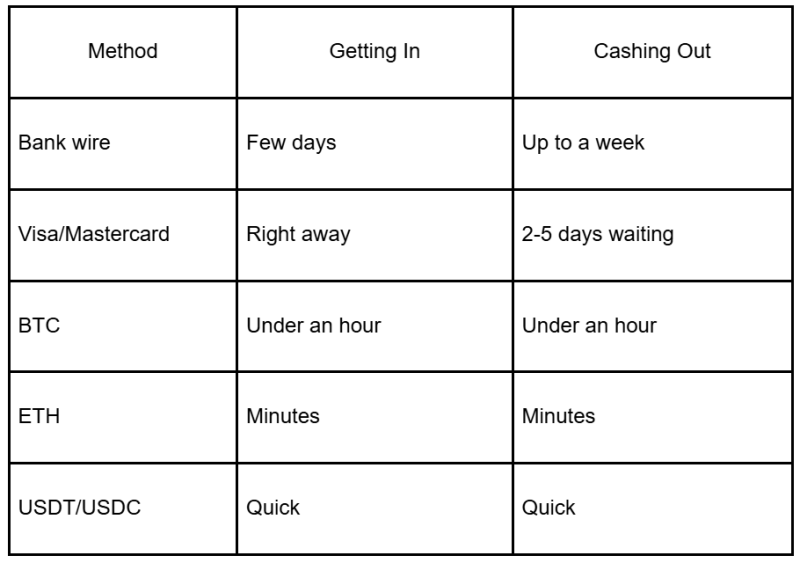
Check that last column. Card payments may process deposits quickly, while withdrawals can take longer depending on banking procedures. Crypto? Same speed both ways.
Stablecoins fixed the volatility issue that kept some people away. Around 80% of crypto gambling sites accept USDT or USDC now. The value doesn’t swing while you play.
Privacy Without Complete Anonymity
Crypto gives you more privacy than credit cards, less than cash. Big withdrawals still trigger identity checks at reputable sites. But what happens to your data afterward is different.
Credit card payments bounce through multiple banks. Each one logs the transaction. With crypto, your wallet address is visible but that’s about it.
Plenty of people prefer it that way. Players accessing platforms like Bizbet нэвтрэх get the same fast crypto deposits through an interface built for their language.
Security Through Automation
Crypto casinos see about 60% less fraud than traditional ones. Why? Smart contracts do the payout work. The money moves when it’s supposed to move, no human in the loop. Fewer people touching transactions means fewer chances for things to go wrong.
Most platforms use multi-signature wallets now. Big withdrawals need multiple approvals. Cold storage keeps most funds offline where hackers can’t reach them. Monitoring systems catch weird patterns fast.
By 2024, about 95% of crypto casinos had multi-factor authentication running. Players paid attention. Seeing your funds on a public ledger builds trust in a way promises never could.
Where Things Are Heading
That $81 billion in gross gaming revenue crypto casinos made during 2024? It’s going up. Wallets get easier to use. Exchanges get faster. More people try it every month.
Nobody’s killing off bank transfers. They still work fine for plenty of players. But those who want faster payouts and less paperwork have options now that didn’t exist ten years ago. Provably fair changed expectations too. Players got used to checking results themselves, and now they expect it.
Main image by Kanchanara on Unsplash
 Our newsletters emailed directly to you